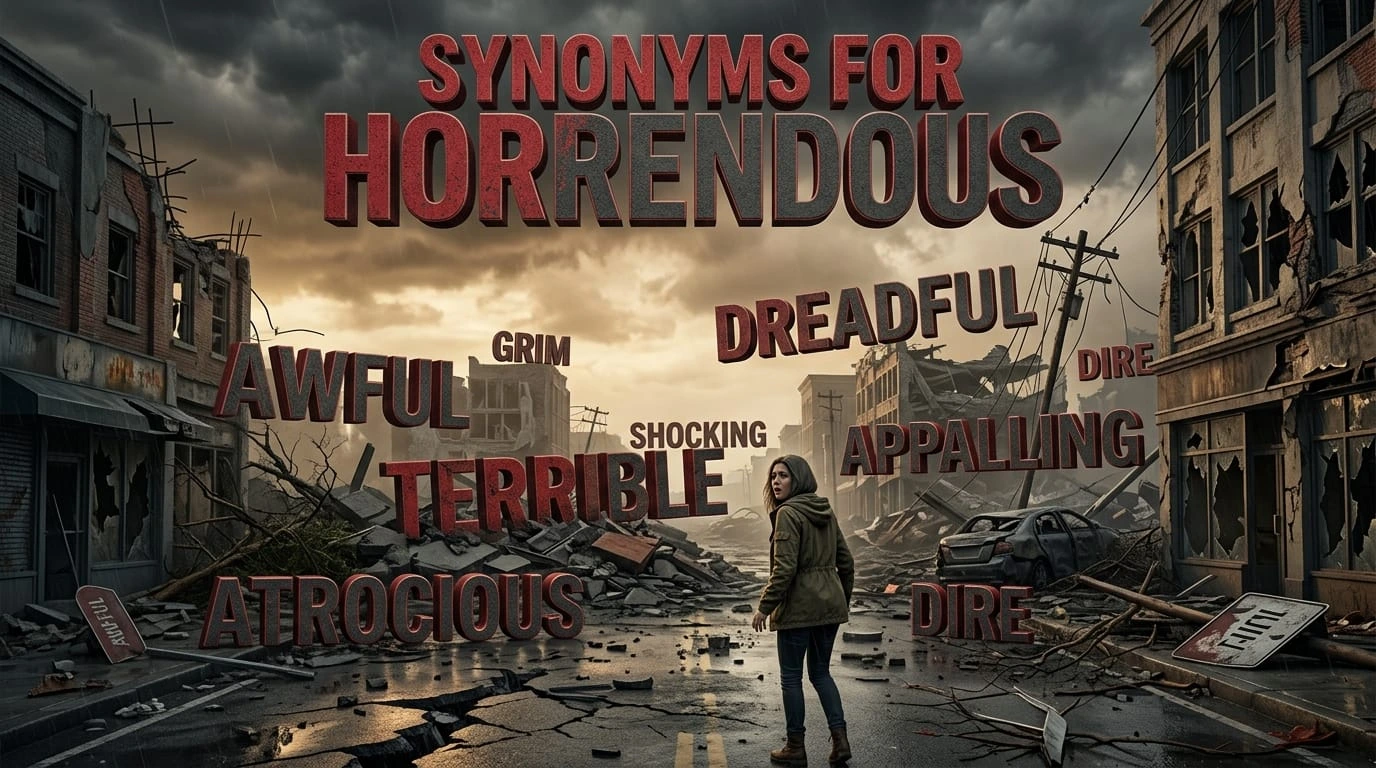
Synonyms for horrendous include terrible, dreadful, awful, horrible, appalling, atrocious, and horrific, depending on the context.
Definition
Horrendous (Adjective):
Extremely bad, unpleasant, frightening, or shocking.
The word is used for things that are far worse than ordinary problems. It can describe experiences, conditions, events, injuries, mistakes, costs, or situations.
Examples
- The travelers faced horrendous weather.
- The company received complaints about the horrendous service.
Connotative Meaning
Connotation: the feeling or idea that a word suggests beyond its direct meaning.
- Positive tone: Horrendous does not normally carry a positive meaning.
- Negative tone: It strongly suggests something extremely bad, shocking, unpleasant, or disturbing.
- Neutral tone: The word itself is strongly negative, although the speaker may use it simply to emphasize the severity of a situation.
Etymology: Synonyms for horrendous
Horrendous comes from Latin horrendus, meaning “to be dreaded” or “to be feared.” It is related to the Latin verb horrēre, meaning “to bristle” or “to tremble with fear.”
- Old English (450–1100): The modern form was not part of Old English.
- Middle English (1100–1500): Latin-derived vocabulary increasingly entered English through French and scholarly usage.
- Modern English (1500–Present): Horrendous developed as a strong adjective meaning extremely dreadful, terrible, or shocking.
Pronunciation (IPA)
- IPA: /həˈrendəs/
- Syllables: hor-ren-dous
Affixation Pattern: Synonyms for horrendous
- Root: horr- / Latin horrēre, meaning “to tremble” or “to fear”
- Prefix: None in the modern English form
- Suffix: -ous, meaning “characterized by” or “full of”
- Word formations:
- horrendous: adjective
- horrendously: adverb
- horrendousness: noun, rare
Prototype Meaning: Synonyms for horrendous
The strongest everyday idea behind horrendous is extremely bad or shocking. It is more forceful than ordinary words such as bad or unpleasant. People often use it for severe conditions, terrible experiences, shocking events, very poor service, or situations that are difficult to tolerate.
Prototype Categorization: Synonyms for horrendous
- General extreme negativity: terrible, horrible, dreadful, atrocious, abominable: useful when something is simply extremely bad.
- Fear and shock: horrific, terrifying, horrifying, frightful, shocking: better when fear or strong shock is central.
- Disgust and offense: repulsive, revolting, offensive, hideous: suitable when something creates disgust or strong dislike.
- Serious and severe situations: dire, grim, disastrous, catastrophic: useful for serious conditions, failures, or consequences.
- Strong disapproval: disgraceful, deplorable, heinous: appropriate when behavior or actions deserve strong criticism.
- Pain and discomfort: miserable, unbearable, nasty, woeful: useful when describing unpleasant experiences, conditions, or sensations.
This grouping makes synonym choice easier because horrendous can express different shades of extreme negativity. For example, terrifying emphasizes fear, while repulsive emphasizes disgust and catastrophic emphasizes severe consequences.
30 Synonyms for Horrendous With Meaning & Examples
1. Terrible (Adjective)
Meaning: Extremely bad, unpleasant, or upsetting.
Examples:
- We had a terrible experience at the hotel.
- The storm caused terrible damage.
2. Horrible (Adjective)
Meaning: Very unpleasant, frightening, or bad.
Examples:
- The accident was horrible.
- She had a horrible headache.
3. Appalling (Adjective)
Meaning: Extremely bad or shocking.
Examples:
- The report revealed appalling conditions.
- The service was appalling.
4. Dreadful (Adjective)
Meaning: Extremely bad or unpleasant.
Examples:
- We experienced dreadful weather.
- The food had a dreadful taste.
5. Atrocious (Adjective)
Meaning: Extremely bad, especially in quality or behavior.
Examples:
- The team’s performance was atrocious.
- The roads were in atrocious condition.
6. Abominable (Adjective)
Meaning: Extremely unpleasant or unacceptable.
Examples:
- The prisoners suffered abominable treatment.
- The room was in an abominable state.
7. Shocking (Adjective)
Meaning: Very surprising and upsetting because something is so bad.
Examples:
- The report described shocking levels of neglect.
- The price increase was shocking.
8. Horrific (Adjective)
Meaning: Extremely frightening, disturbing, or terrible.
Examples:
- The witnesses described a horrific scene.
- The disaster had horrific consequences.
9. Frightful (Adjective)
Meaning: Extremely unpleasant, frightening, or bad.
Examples:
- They faced frightful conditions during the journey.
- The noise was frightful.
10. Ghastly (Adjective)
Meaning: Very unpleasant, shocking, or frightening.
Examples:
- The room had a ghastly smell.
- He suffered a ghastly injury.
11. Hideous (Adjective)
Meaning: Extremely ugly, unpleasant, or offensive.
Examples:
- The building had a hideous design.
- She thought the wallpaper was hideous.
12. Unspeakable (Adjective)
Meaning: So bad or shocking that it is difficult to describe.
Examples:
- The victims endured unspeakable suffering.
- The conditions were unspeakable.
13. Disgraceful (Adjective)
Meaning: So bad or unacceptable that it causes shame or criticism.
Examples:
- The workers faced disgraceful treatment.
- His behavior was disgraceful.
14. Shocking (Adjective)
Meaning: Causing strong surprise or disapproval because of something extreme.
Examples:
- The investigation uncovered shocking mistakes.
- The level of waste was shocking.
15. Terrifying (Adjective)
Meaning: Causing extreme fear.
Examples:
- The storm was terrifying.
- They heard a terrifying sound outside.
16. Horrifying (Adjective)
Meaning: Causing intense fear, shock, or disgust.
Examples:
- The documentary showed horrifying images.
- It was a horrifying experience.
17. Repulsive (Adjective)
Meaning: Extremely unpleasant or disgusting.
Examples:
- The smell was repulsive.
- The behavior was repulsive to many people.
18. Revolting (Adjective)
Meaning: Extremely disgusting or offensive.
Examples:
- The food had a revolting smell.
- The conditions were revolting.
19. Offensive (Adjective)
Meaning: Causing strong dislike, anger, or disgust.
Examples:
- The comments were deeply offensive.
- The smell was offensive.
20. Disturbing (Adjective)
Meaning: Causing worry, sadness, fear, or discomfort.
Examples:
- The film contained disturbing scenes.
- The findings were deeply disturbing.
21. Dire (Adjective)
Meaning: Extremely serious, urgent, or bad.
Examples:
- The country faced dire economic conditions.
- The situation became dire after the storm.
22. Grim (Adjective)
Meaning: Very serious, unpleasant, or without much hope.
Examples:
- The report presented a grim picture.
- The rescue team faced grim conditions.
23. Woeful (Adjective)
Meaning: Extremely bad or showing great sadness or suffering.
Examples:
- The team’s performance was woeful.
- The service was woeful that evening.
24. Miserable (Adjective)
Meaning: Extremely unpleasant, unhappy, or uncomfortable.
Examples:
- We spent a miserable night in the cold.
- The weather made the trip miserable.
25. Disastrous (Adjective)
Meaning: Causing serious damage, failure, or harm.
Examples:
- The decision had disastrous results.
- The business suffered a disastrous loss.
26. Catastrophic (Adjective)
Meaning: Causing extremely serious damage or destruction.
Examples:
- The earthquake had catastrophic effects.
- The failure could have catastrophic consequences.
27. Deplorable (Adjective)
Meaning: Extremely bad and deserving strong disapproval.
Examples:
- The animals were kept in deplorable conditions.
- The lack of safety was deplorable.
28. Nasty (Adjective)
Meaning: Very unpleasant, harmful, or offensive.
Examples:
- He received a nasty cut.
- They encountered a nasty problem.
29. Heinous (Adjective)
Meaning: Extremely evil or shocking, especially when describing a serious crime or act.
Examples:
- The court condemned the heinous crime.
- It was a heinous act of violence.
30. Unbearable (Adjective)
Meaning: So unpleasant or painful that it is very difficult to tolerate.
Examples:
- The heat became unbearable.
- The noise was unbearable after several hours.
Antonyms of Horrendous
Pleasant (Adjective)
Enjoyable, comfortable, or satisfying.
Wonderful (Adjective)
Extremely good, enjoyable, or impressive.
Excellent (Adjective)
Extremely good in quality.
Delightful (Adjective)
Very pleasant, enjoyable, or pleasing.
Wonderful (Adjective)
Causing great pleasure or satisfaction.
Agreeable (Adjective)
Pleasant or acceptable.
Tolerable (Adjective)
Good or bearable enough to be accepted.
Manageable (Adjective)
Not too difficult, serious, or unpleasant to handle.
Short Questions and Answers
What does horrendous mean?
Horrendous means extremely bad, shocking, frightening, or unpleasant. It is a strong word used to emphasize the severity of something.
When should horrendous be used?
Use horrendous when something is far worse than ordinary or mildly unpleasant. It works well for situations, conditions, experiences, damage, service, mistakes, and other extreme problems.
Is horrendous positive or negative?
Horrendous has a strongly negative connotation. It describes something that is extremely bad, disturbing, unpleasant, or shocking.
How is it different from similar words?
Horrendous is a broad word for something extremely bad. Horrific often focuses on fear or horror, repulsive focuses on disgust, catastrophic focuses on severe damage or consequences, and heinous is mainly used for extremely wicked acts or crimes.
Conclusion
Learning synonyms for horrendous can help you describe extreme situations with greater accuracy. Words such as appalling, atrocious, horrific, dreadful, shocking, disastrous, repulsive, deplorable, and catastrophic all express strong negativity, but each has its own focus. Choosing the right word makes your writing clearer and more powerful without relying on the same adjective repeatedly. English learners can improve their vocabulary by studying these differences and creating simple sentences with each new word. Writers can also use contextual synonyms to make descriptions more precise and natural. Remember that horrendous is already a very strong word, so it should be saved for situations that truly deserve strong emphasis. Practicing a few related words each day can gradually improve both your speaking and writing skills.
Synonyms for Glasses: 30 Similar Words

I’m a language enthusiast and content writer specializing in English vocabulary, synonyms, word meanings, and alternative word choices. My goal is to help readers expand their vocabulary and express themselves with greater clarity through simple, accurate, and easy-to-understand language guides.