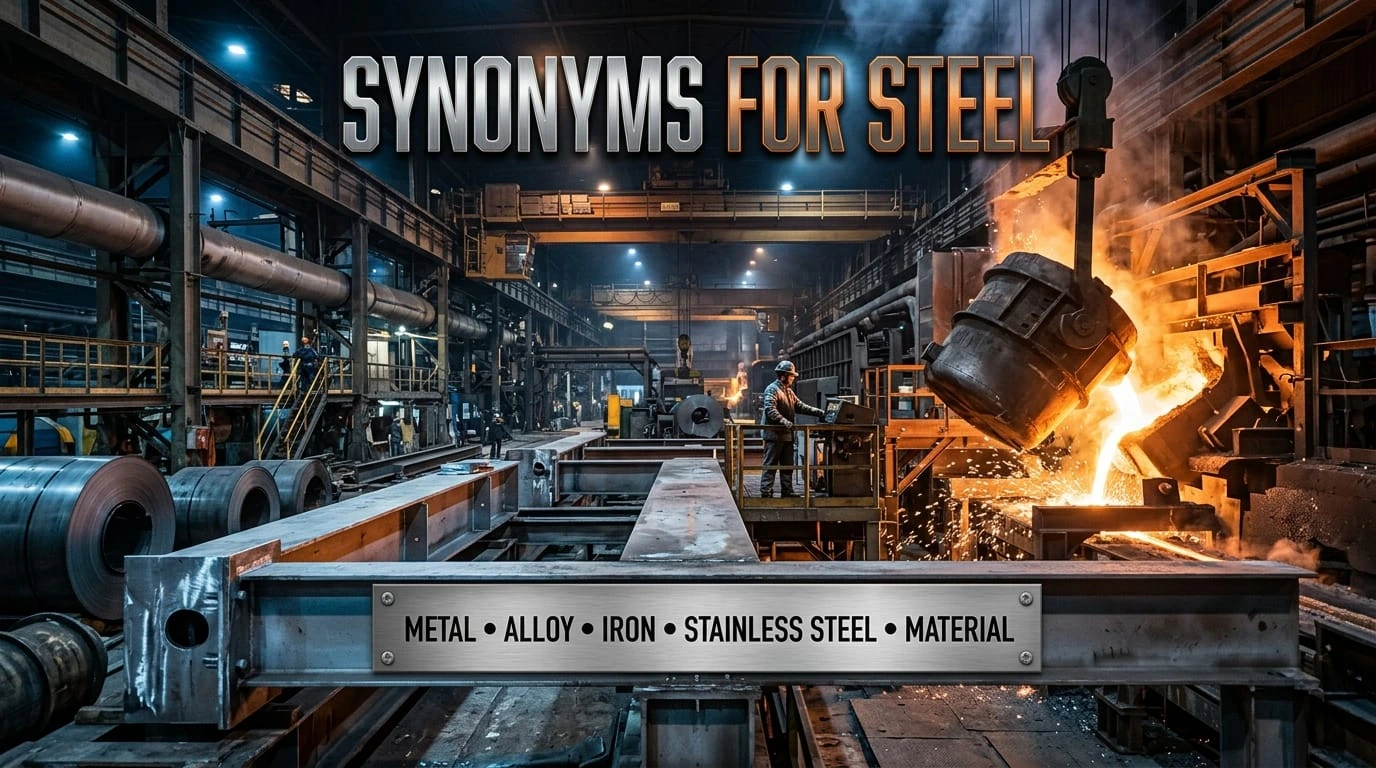
Synonyms for steel include metal, alloy, iron, strengthen, harden, brace, fortify, resilience, courage, and grit.
Steel is a strong word with more than one common use. As a noun, it refers to a hard metal made mainly from iron and carbon. As a verb, steel means to prepare yourself mentally for something difficult. For example, a worker may handle steel beams, while a person may steel themselves before hearing bad news. Because the word works in both physical and emotional contexts, choosing the right alternative can make writing clearer. Learning related words also helps English learners avoid repetition and gives writers more ways to describe strength, firmness, courage, and metal materials. In this guide, we will explore the meaning of steel, its history, pronunciation, word forms, useful synonyms, contextual alternatives, antonyms, and semantic groups. The examples will show how each word fits naturally into a sentence.
Meaning of Steel
Definition
Steel (Noun): A strong metal made mainly from iron and carbon and widely used in construction, tools, machines, and products.
Steel (Verb): To prepare yourself mentally or emotionally to face something difficult.
Examples
- The bridge is supported by massive steel beams.
- She steeled herself before entering the difficult meeting.
Connotative Meaning
Positive tone: Strength, toughness, durability, courage, and determination.
Negative tone: Hardness, coldness, or lack of emotion when used figuratively.
Neutral tone: The physical metal or the act of mentally preparing for something.
(Connotation means the feeling or idea that a word suggests beyond its basic meaning.)
Etymology
- Old English (450–1100): Steel comes from Old English stēle, referring to the hard metal.
- Middle English (1100–1500): The word developed through forms such as stele and continued to refer to the metal.
- Modern English (1500–Present): Steel became established as the standard spelling. Its verb use developed from the idea of becoming hard or strong like steel.
Pronunciation (IPA)
- IPA: /stiːl/
- Syllables: steel: 1 syllable
Affixation Pattern of Steel
- Root: steel
- Prefix: None
- Suffix: None in the basic word
- Word formations:
- steel: noun / verb
- steeled: verb
- steeling: verb
- steely: adjective
- steelworker: noun
- steelwork: noun
- steelworks: noun
- steelmaker: noun
- steelmaking: noun
- steel-clad: adjective
30 Synonyms of Steel With Meaning & Examples
Because steel has both a metal sense and a figurative verb sense, some alternatives below are contextual rather than exact substitutes. This keeps the list useful without forcing inaccurate synonyms.
1. Iron (Noun)
Meaning: A strong metal that is closely related to steel but is not the same material.
Examples:
- The old gate was made of iron.
- Iron is an important material in many industries.
2. Metal (Noun)
Meaning: A broad term for materials such as iron, steel, copper, and aluminum.
Examples:
- The frame is made from strong metal.
- The factory produces several types of metal parts.
3. Alloy (Noun)
Meaning: A material made by combining two or more elements, usually including metals.
Examples:
- Steel is an alloy based mainly on iron.
- The engineer selected a lightweight alloy for the project.
4. Stainless Steel (Noun)
Meaning: A corrosion-resistant type of steel containing chromium.
Examples:
- The kitchen sink is made from stainless steel.
- Stainless steel is common in medical equipment.
5. Carbon Steel (Noun)
Meaning: Steel in which carbon is an important alloying element.
Examples:
- The manufacturer used carbon steel for the tool.
- Carbon steel is widely used in construction.
6. Metalwork (Noun)
Meaning: Objects or work made by shaping metal.
Examples:
- The building has attractive metalwork.
- Skilled workers completed the decorative metalwork.
7. Ironwork (Noun)
Meaning: Objects or structures made from iron or iron-based metal.
Examples:
- The balcony features detailed ironwork.
- The historic gate has beautiful ironwork.
8. Hardware (Noun)
Meaning: Metal tools, fittings, or parts used for construction or practical purposes.
Examples:
- The carpenter bought new hardware for the door.
- The store sells building hardware.
9. Reinforcement (Noun)
Meaning: Material or support added to make something stronger.
Examples:
- The concrete needs steel reinforcement.
- Extra reinforcement strengthened the structure.
10. Strengthen (Verb)
Meaning: To make something stronger or more resistant.
Examples:
- Engineers added beams to strengthen the bridge.
- The new supports will strengthen the wall.
11. Fortify (Verb)
Meaning: To make something stronger or more secure.
Examples:
- Workers fortified the building with stronger supports.
- The walls were fortified against heavy weather.
12. Harden (Verb)
Meaning: To make something physically harder or emotionally tougher.
Examples:
- Heat treatment can harden the metal.
- Difficult experiences can harden a person.
13. Toughen (Verb)
Meaning: To make someone or something tougher and more resistant.
Examples:
- The process toughens the material.
- Training helped toughen the young athlete.
14. Brace (Verb)
Meaning: To prepare yourself for something difficult or unpleasant.
Examples:
- She braced herself for the difficult conversation.
- He braced for the sudden change.
15. Prepare (Verb)
Meaning: To get ready for an event, task, or difficulty.
Examples:
- She prepared herself for the interview.
- They prepared for the challenging journey.
16. Ready (Verb)
Meaning: To make someone or something ready for an event or situation.
Examples:
- He readied himself for the examination.
- The team readied the equipment for use.
17. Fortify Oneself (Verb Phrase)
Meaning: To make yourself mentally or emotionally stronger before difficulty.
Examples:
- She fortified herself before delivering the speech.
- He fortified himself against possible criticism.
18. Compose Oneself (Verb Phrase)
Meaning: To calm and control your emotions before dealing with something.
Examples:
- She paused to compose herself.
- He composed himself before answering the question.
19. Rally (Verb)
Meaning: To regain strength, confidence, or determination.
Examples:
- She rallied before the final round.
- The team rallied after falling behind.
20. Gather Courage (Verb Phrase)
Meaning: To find the bravery needed to face something difficult.
Examples:
- He gathered courage before speaking.
- She gathered courage and asked for help.
21. Steel Oneself (Verb Phrase)
Meaning: To mentally prepare yourself for something painful or difficult.
Examples:
- She steeled herself for the bad news.
- He steeled himself before entering the room.
22. Harden Oneself (Verb Phrase)
Meaning: To become emotionally tougher in preparation for hardship.
Examples:
- He hardened himself against disappointment.
- She tried to harden herself before the difficult task.
23. Toughness (Noun)
Meaning: The quality of being strong and able to withstand difficulty.
Examples:
- The material is known for its toughness.
- His mental toughness helped him continue.
24. Strength (Noun)
Meaning: The quality of being physically or mentally strong.
Examples:
- The strength of the structure impressed the engineers.
- She showed great strength during the crisis.
25. Resilience (Noun)
Meaning: The ability to recover and continue after difficulty.
Examples:
- Her resilience helped her overcome the setback.
- The material has excellent resilience under pressure.
26. Fortitude (Noun)
Meaning: Mental and emotional strength during hardship.
Examples:
- He showed great fortitude during the crisis.
- Her fortitude impressed everyone around her.
27. Resolve (Noun)
Meaning: Strong determination to do something or face a challenge.
Examples:
- She showed strong resolve during the negotiations.
- His resolve did not weaken after the setback.
28. Determination (Noun)
Meaning: A firm decision to achieve a goal or overcome difficulty.
Examples:
- Her determination helped her finish the project.
- His determination remained strong despite failure.
29. Courage (Noun)
Meaning: The ability to face fear, pain, or difficulty.
Examples:
- It took courage to speak honestly.
- She showed great courage during the emergency.
30. Grit (Noun)
Meaning: Courage and persistence when facing difficulty.
Examples:
- The athlete showed remarkable grit.
- Her grit helped her complete the demanding training.
Prototype Meaning
The most typical meaning of steel is the strong metal made mainly from iron and carbon. When people hear the word, they often picture beams, bridges, tools, buildings, machines, or other durable structures. In its figurative use, steel suggests becoming mentally strong and preparing yourself to face something difficult.
Prototype Categorization
The alternatives above can be grouped by the meaning they express:
- Metal and material: iron, metal, alloy, stainless steel, carbon steel, metalwork, ironwork, hardware.
- Physical strengthening: reinforcement, strengthen, fortify, harden, toughen.
- Mental preparation: brace, prepare, ready, fortify oneself, compose oneself, steel oneself.
- Emotional strength: toughness, strength, resilience, fortitude, resolve, determination, courage, grit.
- Recovery and persistence: rally, resilience, resolve, grit.
This grouping helps writers choose a word based on the exact situation instead of treating every alternative as an interchangeable synonym.
Antonyms of Steel
1. Soften (Verb)
Meaning: To make something less hard or less severe.
2. Weaken (Verb)
Meaning: To make something less strong or effective.
3. Yield (Verb)
Meaning: To stop resisting or give way.
4. Surrender (Verb)
Meaning: To stop resisting and accept defeat or control.
5. Fragility (Noun)
Meaning: The quality of being easily damaged or broken.
6. Vulnerability (Noun)
Meaning: The state of being open to harm or difficulty.
Short Questions and Answers
What does steel mean?
Steel usually means a strong metal made mainly from iron and carbon. As a verb, it means to prepare yourself mentally for something difficult.
When should steel be used?
Use steel for the metal itself or when describing mental preparation, especially before a difficult or unpleasant event.
Is steel positive or negative?
It depends on context. It can suggest strength and courage, but figurative uses can sometimes suggest emotional hardness or coldness.
How is it different from similar words?
Steel is specific when referring to the metal. As a verb, it is close to brace and prepare, but it often suggests becoming mentally tough before difficulty.
Conclusion
Learning the different meanings of steel can make your English more precise. The word can describe a strong metal, but it can also describe mental preparation and emotional toughness. Words such as strengthen, harden, brace, fortitude, resolve, courage, resilience, and grit can express related ideas in different situations. Material-related alternatives such as alloy, metal, ironwork, and reinforcement are useful when writing about construction, engineering, or manufacturing. Knowing these differences helps you avoid repetition and choose words that match your exact meaning. Regular vocabulary practice is a simple way to improve both writing and speaking. When you learn a new word, study its meaning, context, grammar, and related words rather than memorizing a list alone.
Synonyms for Gulp: 25 Powerful Alternatives to Know

I am a language content specialist focused on English synonyms, vocabulary development, and word meanings. I create clear, practical guides that help readers choose the right words and communicate with confidence.