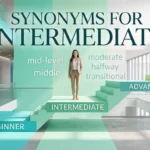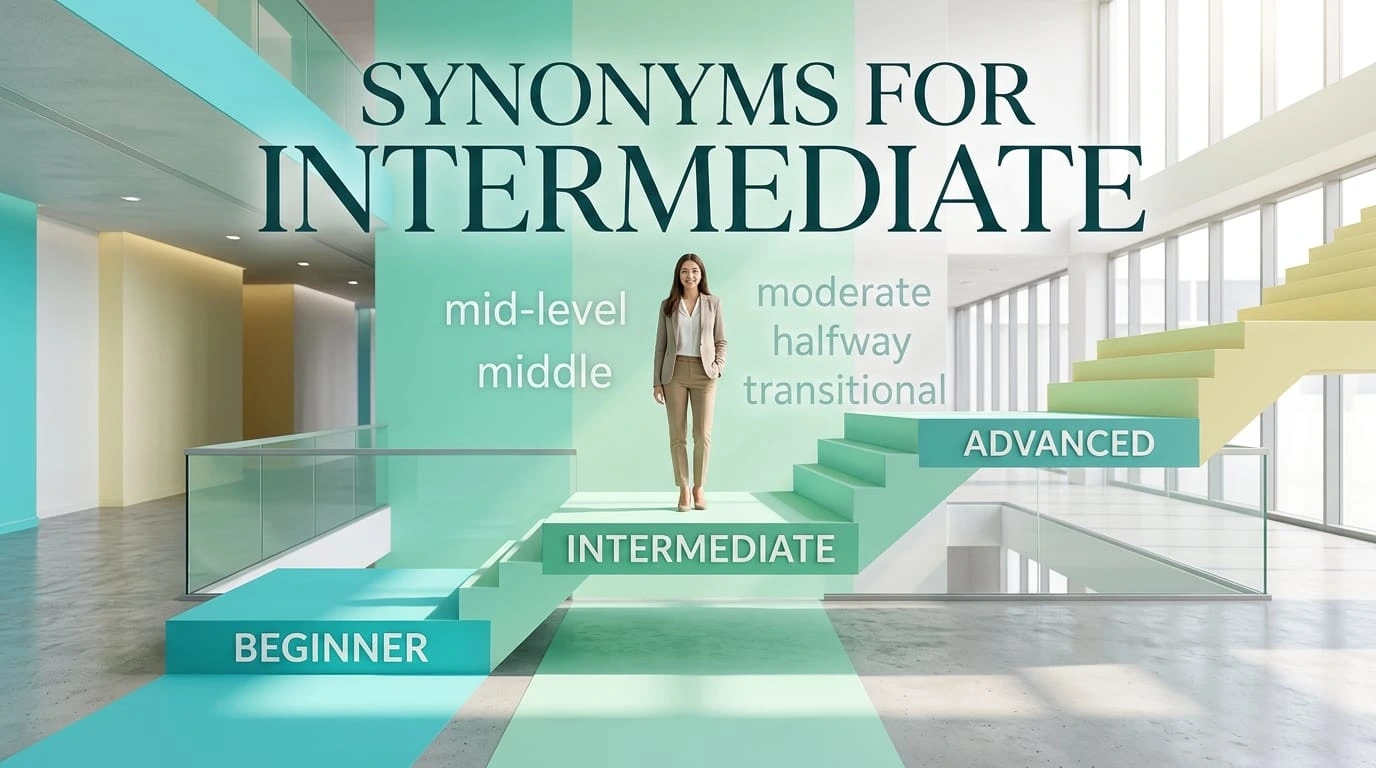
Synonyms for intermediate include mid-level, moderate, middle, average, midway, in-between, transitional, and halfway, depending on the context.
Intermediate describes something that is in the middle of two levels, stages, places, or conditions. If you have learned basic English and can now hold simple conversations but are not yet fluent, you may describe your level as intermediate. The word is common in education, language learning, sports, technology, and everyday descriptions of progress. However, using the same word again and again can make writing sound flat. Learning related words gives you more precise ways to describe a middle position, moderate level, or stage of development. In this guide, we will explore useful synonyms and contextual alternatives for intermediate. You will learn their meanings, examples, word forms, pronunciation, history, and differences in use. The goal is not simply to memorize words but to understand which alternative sounds natural in each situation.
Meaning of Intermediate
Definition
Intermediate (Adjective/Noun):
Something that is between two levels, stages, places, or conditions; it can also describe a person or thing at a middle level of ability.
Examples
- She joined an intermediate English course after completing the beginner class.
- This book is suitable for intermediate learners.
Connotative Meaning
Connotation: the feeling or idea that a word suggests beyond its basic meaning.
- Positive tone: It can suggest progress, growing ability, and development.
- Negative tone: In some contexts, it may suggest that something is not yet advanced or complete.
- Neutral tone: Most often, intermediate simply describes a middle level or position.
Etymology
The word intermediate comes from Latin intermedius, meaning “between” or “in the middle.” It combines inter-, meaning “between,” with medius, meaning “middle.”
- Old English (450–1100): The modern word was not part of ordinary Old English vocabulary.
- Middle English (1100–1500): Latin-based forms entered English through French and learned usage.
- Modern English (1500–Present): Intermediate developed as a word for something situated between two points, levels, or stages. Its educational meaning later became common for learners at a middle level.
Pronunciation (IPA)
- IPA: /ˌɪntərˈmiːdiət/
- Syllables: in-ter-me-di-ate
Affixation Pattern of Intermediate
- Root: medi- / medius, meaning “middle”
- Prefix: inter-, meaning “between”
- Suffix: -ate, forming an adjective
- Word formations:
- intermediate — adjective/noun
- intermediately — adverb
- intermediateness — noun, uncommon
- intermediacy — noun
- intermediary — noun/adjective, related word
30 Synonyms and Contextual Alternatives for Intermediate
Note: Intermediate has several meanings, so no single synonym works in every sentence. The alternatives below are grouped by actual usage rather than treating unrelated words as perfect substitutes.
1. Mid-level (Adjective)
Meaning: At a level between beginner and advanced.
Examples:
- This course is designed for mid-level English learners.
- She applied for a mid-level programming position.
2. Middle (Adjective)
Meaning: Located or positioned between two extremes or points.
Examples:
- He chose the middle level of difficulty.
- The test measures middle stages of development.
3. Moderate (Adjective)
Meaning: Neither very low nor very high in degree or intensity.
Examples:
- The exercise requires moderate skill.
- She has a moderate level of experience.
4. Average (Adjective)
Meaning: Typical or around the middle of a range.
Examples:
- His performance was average for his age group.
- The task requires average technical ability.
5. Medium (Adjective)
Meaning: At a middle size, level, amount, or degree.
Examples:
- Choose the medium difficulty setting.
- The course has a medium level of complexity.
6. Transitional (Adjective)
Meaning: Relating to a period or stage between two conditions.
Examples:
- Students need support during the transitional stage.
- The program helps learners make a transitional move toward advanced study.
7. Developing (Adjective)
Meaning: Growing or improving but not fully developed.
Examples:
- She has developing writing skills.
- The student is a developing speaker.
8. Progressing (Adjective)
Meaning: Moving forward toward a higher level.
Examples:
- He is a progressing English learner.
- Her skills are steadily progressing.
9. Moderate-Level (Adjective)
Meaning: Existing at a middle degree of difficulty, ability, or intensity.
Examples:
- The workshop covers moderate-level grammar.
- They offer moderate-level training for new employees.
10. Competent (Adjective)
Meaning: Having enough skill or ability to do something successfully.
Examples:
- She is a competent English speaker.
- He became competent at basic coding.
11. Proficient (Adjective)
Meaning: Having a good level of skill in something.
Examples:
- She is proficient in English.
- He became proficient with the software.
Usage note: Proficient usually suggests stronger ability than intermediate.
12. Capable (Adjective)
Meaning: Having the ability to do something successfully.
Examples:
- He is capable of handling more difficult tasks.
- She is a capable intermediate-level writer.
13. Seasoned (Adjective)
Meaning: Experienced and skilled because of long practice.
Examples:
- The company hired a seasoned technician.
- A seasoned player helped train the team.
Usage note: Seasoned generally suggests experience rather than simply being at a middle level.
14. Experienced (Adjective)
Meaning: Having knowledge or skill gained through practice.
Examples:
- She is an experienced language teacher.
- The position requires an experienced worker.
15. Advanced-Beginner (Adjective)
Meaning: Beyond the beginner stage but not yet at an intermediate level.
Examples:
- This course is suitable for advanced-beginner learners.
- His reading skills are at an advanced-beginner level.
16. Midway (Adjective/Adverb)
Meaning: At a point approximately halfway between two stages or positions.
Examples:
- She is midway through the training program.
- We are midway between the basic and advanced stages.
17. In-Between (Adjective)
Meaning: Existing between two levels, states, or choices.
Examples:
- His skills are at an in-between level.
- She chose an in-between option.
18. Halfway (Adjective/Adverb)
Meaning: At or near the middle point between two stages or places.
Examples:
- He is halfway through the course.
- The students are halfway between beginner and advanced levels.
19. Central (Adjective)
Meaning: Located in the middle of something.
Examples:
- The village occupies a central position.
- The course covers the central stage of the program.
20. Intermediate-Level (Adjective)
Meaning: Belonging to a middle stage of ability or difficulty.
Examples:
- She enrolled in an intermediate-level writing course.
- The tutorial explains intermediate-level grammar.
21. Midstage (Adjective/Noun)
Meaning: Relating to or occurring in the middle stage of a process.
Examples:
- The project has reached its midstage.
- Midstage training focuses on practical skills.
22. In-Between Level (Noun Phrase)
Meaning: A level that falls between two more clearly defined levels.
Examples:
- His ability is at an in-between level.
- The school offers an in-between level for progressing students.
23. Bridging (Adjective)
Meaning: Helping connect two levels, stages, or groups.
Examples:
- Students take a bridging course before advanced study.
- The program provides bridging training for new learners.
24. Connecting (Adjective)
Meaning: Linking two separate stages or areas.
Examples:
- The course serves as a connecting stage between basic and advanced study.
- This module is a connecting step in the training process.
25. Successive (Adjective)
Meaning: Following another stage or level in a sequence.
Examples:
- Students move through successive levels of training.
- Each successive stage becomes more challenging.
26. Midway Point (Noun Phrase)
Meaning: The point that lies between two ends or stages.
Examples:
- The course is at its midway point.
- We reached the midway point of the training program.
27. Moderate-Skill (Adjective)
Meaning: Requiring or showing a middle amount of skill.
Examples:
- The activity requires moderate-skill technical knowledge.
- It is designed for workers with moderate-skill abilities.
28. Semi-Advanced (Adjective)
Meaning: More developed than basic but not fully advanced.
Examples:
- The students are ready for semi-advanced exercises.
- The course introduces semi-advanced writing techniques.
29. Near-Advanced (Adjective)
Meaning: Close to an advanced level but not fully advanced.
Examples:
- Her English is near-advanced.
- He is taking a near-advanced communication course.
30. Bridge Level (Noun)
Meaning: A stage that connects one level of learning or development to another.
Examples:
- The school created a bridge level between basic and advanced classes.
- Students complete the bridge level before entering the advanced program.
Prototype Meaning
The clearest idea behind intermediate is “in the middle.” When people hear the word, they often imagine a level that sits between beginner and advanced. In language learning, for example, an intermediate student knows more than basic words and grammar but still has areas that need improvement. The word can also describe a middle stage in a process or something physically positioned between two points.
Prototype Categorization
- Middle-level alternatives: mid-level, middle, medium, moderate — useful when describing something that sits around the middle of a scale.
- Learning and skill alternatives: developing, competent, proficient, capable, semi-advanced — useful when discussing someone’s ability or progress.
- Between-stage alternatives: transitional, midway, halfway, in-between, bridging — best when emphasizing movement or position between two stages.
- Experience-based alternatives: experienced, seasoned, capable — these describe ability gained through practice, although they are not exact replacements for intermediate.
- Process-based alternatives: midstage, successive, bridge level, midway point — useful when describing a particular stage in a process or program.
- Context-specific level phrases: intermediate-level, moderate-level, advanced-beginner, near-advanced: useful when a precise description of ability or difficulty is needed.
This approach helps writers avoid treating all 30 expressions as interchangeable. Intermediate is about position or level, while words such as proficient focus on ability and transitional focuses on movement between stages.
Antonyms of Intermediate
Beginner (Noun/Adjective)
A person or level with little previous knowledge or experience.
Basic (Adjective)
Relating to the simplest or starting level of knowledge or ability.
Elementary (Adjective)
Relating to an early or simple stage of learning.
Advanced (Adjective)
Having a high level of knowledge, ability, or development.
Expert (Noun/Adjective)
A person or level showing very high skill or specialized knowledge.
Extreme (Adjective)
Far from the middle or ordinary level.
Short Questions and Answers
What does intermediate mean?
Intermediate means being in the middle of two levels, stages, places, or conditions. In education, it usually describes a learner who is beyond the beginner stage but not yet advanced.
When should intermediate be used?
Use intermediate when you want to describe a middle level of ability, difficulty, development, or position. It is especially common in courses, training, language learning, and skill descriptions.
Is intermediate positive or negative?
Intermediate is normally neutral. It simply identifies a middle level. Its effect depends on the context. In a learning course, it can suggest that a person has already moved beyond the beginner stage.
How is it different from similar words?
Intermediate focuses on a middle position or level. Moderate describes a middle degree or intensity, while proficient focuses on skill. Transitional emphasizes movement between stages, and advanced describes a higher level.
Conclusion
Understanding intermediate and its related alternatives can make your English more flexible and precise. Words such as mid-level, moderate, developing, proficient, transitional, midway, competent, and bridging can describe different aspects of a middle stage or level. However, they do not all have exactly the same meaning. A learner’s skill may be proficient, a course may be mid-level, and a program may be transitional. Choosing the right expression helps your writing sound natural instead of repetitive. It also makes your descriptions clearer for readers. Try learning these words in small groups based on their meaning rather than memorizing a long list. Use one or two alternatives in your own sentences each day. With regular practice, you can build a stronger vocabulary and communicate your ideas with greater confidence.
Synonyms for underscore: 30 Powerful Alternatives

I am a professional content writer with a passion for English vocabulary and word meanings. I create clear, informative guides on synonyms, alternative words, and word usage to help readers choose the right word and communicate with confidence.