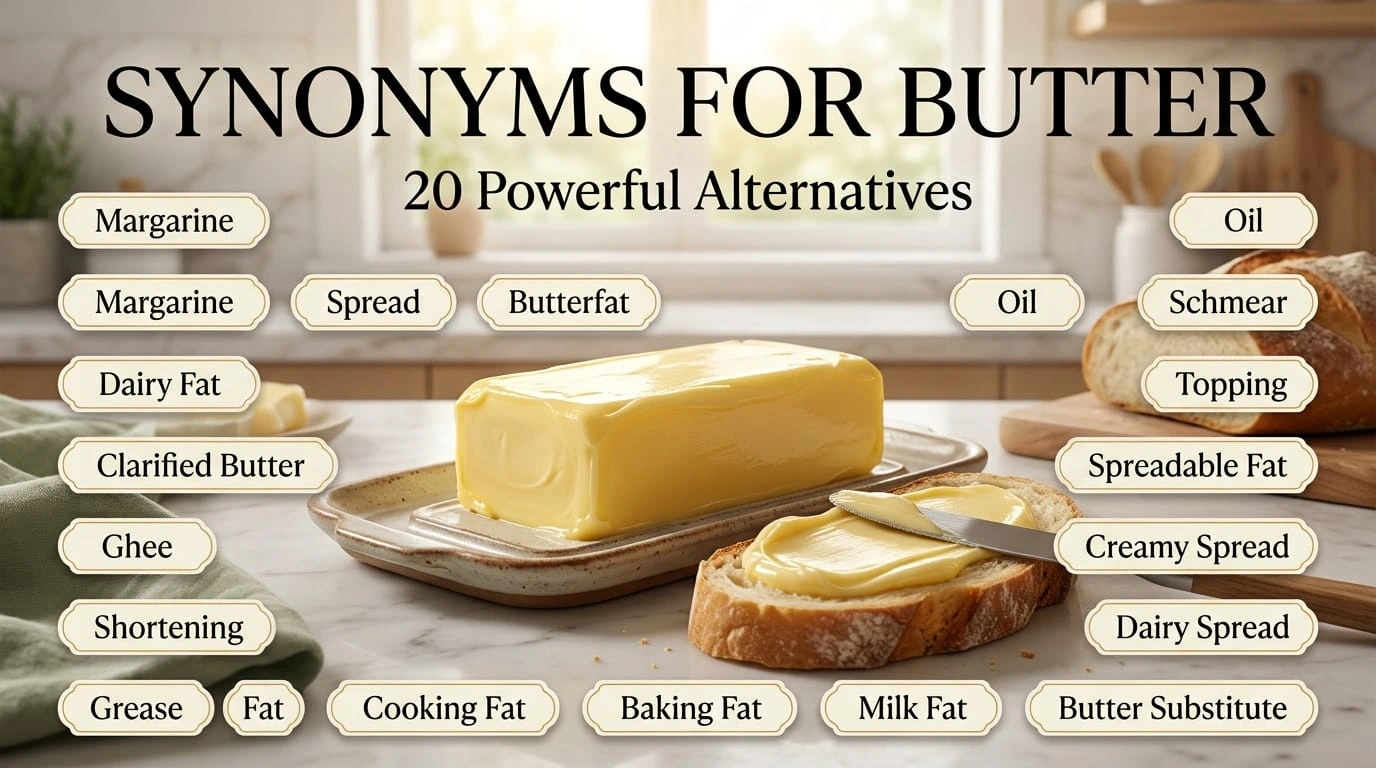
Butter synonyms are words like spread, ghee, margarine, and dairy spread that describe butter, its types, uses, or alternatives.
Butter is a common dairy food made by churning cream. You might spread it on toast, melt it over vegetables, or use it when baking a cake. Because it appears so often in everyday cooking, the word butter is familiar to almost every English learner. However, writers sometimes need different words to describe butter, its texture, its use, or similar spreads. Learning synonyms for butter can help you avoid repetition and choose more precise vocabulary. For example, spread may describe how butter is used, while margarine refers to a butter substitute rather than a true synonym. In this guide, we will explore the meaning, history, pronunciation, word forms, and contextual synonyms of butter. You will also see simple examples and semantic categories to help you understand which alternative works best in different situations.
Meaning of Butter
Definition
Butter (noun): A soft, fatty dairy product made by churning cream or milk.
Butter (verb): To spread butter on food.
Examples
- I put butter on my toast every morning.
- Melt the butter before adding it to the mixture.
Connotative Meaning
Connotation means the feeling or association a word creates beyond its basic meaning.
- Positive tone: Butter can suggest richness, comfort, freshness, and good taste.
- Negative tone: In some contexts, butter may suggest something overly rich or high in fat.
- Neutral tone: It can simply refer to the dairy product or the act of spreading it.
Etymology
The word butter has a long history and is related to words for this dairy product in several European languages.
- Old English (450–1100): Butere or butere referred to butter and came through Latin influence.
- Middle English (1100–1500): The word developed into forms such as butere and butter.
- Modern English (1500–Present): Butter became the standard English spelling and developed additional uses, including the verb meaning “to spread with butter.”
The deeper origin is linked to Latin butyrum, from Greek boutyron, meaning butter.
Pronunciation (IPA)
- IPA: /ˈbʌtər/
- Syllables: but-ter
Affixation Pattern of Butter
- Root: butter
- Prefix: None
- Suffix: None in the basic word
Word Formations
- Butter: noun / verb
- Buttered: adjective / past-tense verb
- Buttering: present participle / gerund
- Buttery: adjective / noun
- Butterless: adjective
30 Synonyms for Butter With Meaning & Examples
Note: English does not have 30 exact synonyms for butter. The list below includes true contextual alternatives, near-synonyms, related food terms, substitutes, and descriptive expressions. Choosing the right word depends on the context.
1. Spread (Noun)
Meaning: A soft food placed on bread, crackers, or other foods.
Examples:
- Butter is a popular spread for toast.
- Choose a creamy spread for the sandwiches.
2. Dairy Spread (Noun)
Meaning: A spread made primarily from dairy ingredients.
Examples:
- This dairy spread is easy to spread on bread.
- The recipe uses a soft dairy spread.
3. Butterfat (Noun)
Meaning: The fat naturally found in milk and cream and used to make butter.
Examples:
- High butterfat gives the product a rich taste.
- The cream contains a large amount of butterfat.
4. Milk Fat (Noun)
Meaning: Fat naturally present in milk.
Examples:
- Milk fat contributes to butter’s creamy texture.
- The product contains concentrated milk fat.
5. Clarified Butter (Noun)
Meaning: Butter from which water and milk solids have been removed.
Examples:
- The chef cooked the vegetables in clarified butter.
- Clarified butter is often used for frying.
6. Ghee (Noun)
Meaning: A type of clarified butter commonly used in South Asian and Middle Eastern cooking.
Examples:
- She cooked the rice with ghee.
- Ghee adds a rich flavor to the dish.
7. Brown Butter (Noun)
Meaning: Butter heated until its milk solids turn brown and develop a nutty flavor.
Examples:
- The chef used brown butter in the sauce.
- Brown butter gives the cookies a deeper flavor.
8. Cultured Butter (Noun)
Meaning: Butter made from cultured or fermented cream.
Examples:
- The bakery uses cultured butter in its pastries.
- Cultured butter has a distinctive tangy taste.
9. Whipped Butter (Noun)
Meaning: Butter that has been beaten to make it lighter and easier to spread.
Examples:
- I prefer whipped butter on my toast.
- Whipped butter spreads easily when cold.
10. Salted Butter (Noun)
Meaning: Butter containing added salt.
Examples:
- The recipe calls for salted butter.
- Salted butter adds extra flavor to the bread.
11. Unsalted Butter (Noun)
Meaning: Butter made without added salt.
Examples:
- Bakers often use unsalted butter.
- Add a pinch of salt when using unsalted butter.
12. Butter Substitute (Noun)
Meaning: A product used instead of butter.
Examples:
- The recipe allows a butter substitute.
- She chose a plant-based butter substitute.
13. Margarine (Noun)
Meaning: A spread made mainly from vegetable or other non-dairy fats and used as a substitute for butter.
Examples:
- He used margarine instead of butter.
- Margarine can be used in some baking recipes.
14. Plant-Based Butter (Noun)
Meaning: A butter-like spread made without traditional dairy butter.
Examples:
- She bought plant-based butter for the recipe.
- Plant-based butter can be used on toast.
15. Vegan Butter (Noun)
Meaning: A non-dairy butter alternative suitable for vegan diets.
Examples:
- The cookies were made with vegan butter.
- Vegan butter works well in many recipes.
16. Cooking Fat (Noun)
Meaning: A fat used to cook or fry food.
Examples:
- Butter is a common cooking fat.
- Use a small amount of cooking fat in the pan.
17. Baking Fat (Noun)
Meaning: Fat used in baking to add flavor, texture, or moisture.
Examples:
- Butter is a popular baking fat.
- The recipe requires a solid baking fat.
18. Table Spread (Noun)
Meaning: A spread intended to be served with bread or other foods.
Examples:
- Butter is a traditional table spread.
- The restaurant offers several table spreads.
19. Creamy Spread (Noun)
Meaning: A smooth, soft food spread over another food.
Examples:
- The creamy spread melted over the warm bread.
- Add a little creamy spread to the sandwich.
20. Fat (Noun)
Meaning: A substance used in food for flavor, texture, and cooking.
Examples:
- Butter is a type of fat.
- The recipe needs a small amount of fat.
21. Lipid (Noun)
Meaning: A scientific term for a group of water-insoluble substances that includes fats.
Examples:
- Butter contains several types of lipids.
- Dietary lipids provide energy.
22. Dairy Fat (Noun)
Meaning: Fat obtained from milk or other dairy products.
Examples:
- Butter is mainly composed of dairy fat.
- The product contains concentrated dairy fat.
23. Milk-Derived Fat (Noun)
Meaning: Fat obtained from milk.
Examples:
- Butter is a milk-derived fat.
- The recipe uses a milk-derived fat for richness.
24. Rich Spread (Noun)
Meaning: A flavorful, fatty spread used on food.
Examples:
- The warm bread was served with a rich spread.
- Add a rich spread to the baked potatoes.
25. Cream Spread (Noun)
Meaning: A creamy spread used on bread or other foods.
Examples:
- The chef served the rolls with a cream spread.
- This cream spread has a smooth texture.
26. Butter-Based Spread (Noun)
Meaning: A spread made primarily from butter.
Examples:
- The sandwich contains a butter-based spread.
- We prepared a simple butter-based spread.
27. Melted Butter (Noun)
Meaning: Butter that has been heated until it becomes liquid.
Examples:
- Pour melted butter over the popcorn.
- Add the melted butter to the bowl.
28. Soft Butter (Noun)
Meaning: Butter that has been allowed to become soft enough to spread.
Examples:
- Use soft butter for the cake mixture.
- The bread was topped with soft butter.
29. Butter Mixture (Noun)
Meaning: A mixture containing butter and other ingredients.
Examples:
- Prepare the butter mixture before baking.
- Spread the butter mixture over the bread.
30. Butter-Flavored Spread (Noun)
Meaning: A spread designed to have a taste similar to butter.
Examples:
- The product is a butter-flavored spread.
- He used a butter-flavored spread on the toast.
Prototype Meaning
The most typical meaning of butter is a creamy, solid dairy product made by churning cream. When people hear the word butter, they usually imagine a yellow or pale-colored spread placed on bread, toast, pancakes, or vegetables. It is also a common ingredient in cakes, cookies, sauces, and other cooked foods.
Prototype Categorization
The 30 alternatives above fall into several useful semantic groups:
| Category | Words | Best Use |
|---|---|---|
| Direct descriptions | spread, dairy spread, creamy spread | General food writing |
| Butter components | butterfat, milk fat, dairy fat, lipid | Scientific or nutritional writing |
| Types of butter | clarified butter, ghee, brown butter, cultured butter | Cooking and food writing |
| Butter varieties | whipped butter, salted butter, unsalted butter | Product and recipe descriptions |
| Substitutes | margarine, vegan butter, plant-based butter, butter substitute | Alternative-food contexts |
| Cooking terms | cooking fat, baking fat, melted butter | Recipes and instructions |
| Descriptive phrases | rich spread, soft butter, butter mixture | Creative and descriptive writing |
This categorization helps writers choose a word based on meaning and context rather than replacing butter with an inaccurate synonym.
Antonyms of Butter
Butter does not have a true direct antonym because it is a concrete noun naming a food product.
However, some words can provide a contrast depending on context:
Margarine
A butter substitute rather than an antonym.
Oil
A different type of cooking fat that can sometimes replace butter.
Butterless
Describes something made without butter.
Fat-Free
Describes food containing little or no fat and therefore contrasts with butter’s high-fat nature.
Non-Dairy
Describes products that do not contain traditional dairy ingredients.
Short Questions and Answers
What does butter mean?
Butter is a dairy product made by churning cream and is commonly used as a spread, cooking fat, and baking ingredient.
When should butter be used?
Use butter when referring to the actual dairy product or the act of spreading it on food.
Is butter positive or negative?
Butter is neutral. Its connotation depends on context. It can suggest richness and comfort, but it can also be associated with high-fat foods.
How is butter different from margarine?
Butter is made from dairy cream, while margarine is a butter substitute usually made from plant-based or other non-dairy fats.
Is ghee a synonym for butter?
Not exactly. Ghee is a type of clarified butter, so it is closely related to butter but is more specific.
What is another word for butter in cooking?
Depending on the context, you can use cooking fat, baking fat, spread, clarified butter, ghee, or margarine. These are not all exact synonyms.
What is the closest synonym for butter?
Spread is one of the closest general alternatives when describing butter as a food placed on bread or other foods. However, spread is broader than butter.
Conclusion
Learning synonyms for butter can help you write more clearly and avoid repeating the same word. However, it is important to choose alternatives based on their exact meaning. Words such as spread describe how butter is used, while ghee and clarified butter describe specific types of butter. Margarine, vegan butter, and plant-based butter are substitutes rather than exact synonyms. Terms such as butterfat and dairy fat describe components of butter rather than the whole product. Understanding these differences makes your vocabulary more accurate. For English learners and writers, the best approach is to learn words in context instead of memorizing long lists. Practice using a few alternatives in recipes, food descriptions, and everyday sentences. This will improve your vocabulary, strengthen your writing and speaking, reduce repetition, and build confidence in English.
Synonyms for Marvel: Better Words for Amazement

I am a professional content writer with a passion for English vocabulary and word meanings. I create clear, informative guides on synonyms, alternative words, and word usage to help readers choose the right word and communicate with confidence.