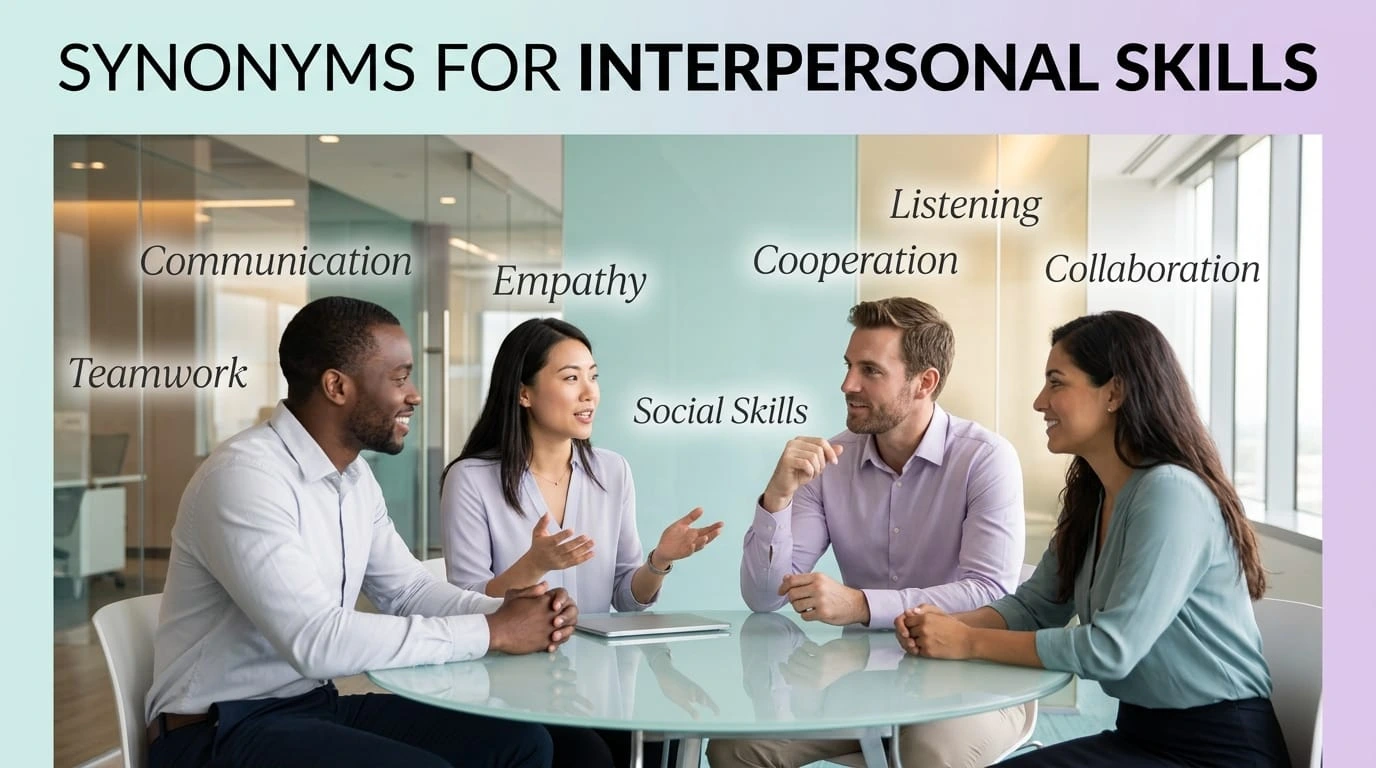
Synonyms for interpersonal skills include people skills, social skills, communication skills, relationship skills, teamwork, empathy, cooperation, collaboration, and emotional intelligence.
Interpersonal skills are the abilities people use to communicate, connect, and work well with others. For example, a teacher needs to listen to students, explain ideas clearly, and show patience during difficult moments. These actions all involve interpersonal skills. The phrase is common in job descriptions, interviews, education, and everyday communication. Learning other words for interpersonal skills can help English learners and content writers use more precise and natural language. It also helps avoid repeating the same phrase in writing. In this guide, you will learn what interpersonal skills mean in simple words, how to use related terms, and how to choose the right alternative in different situations. You will also learn their pronunciation, etymology, grammar, 22 useful synonyms, examples, and common contextual alternatives.
Meaning of Interpersonal Skills
Definition
Interpersonal skills (plural noun): The abilities that help a person communicate, cooperate, understand others, and build good relationships.
Interpersonal Skills in Simple Words
In simple words, interpersonal skills are people skills. They help you talk to others, listen well, understand feelings, solve disagreements, and work together.
For example, being friendly, patient, respectful, and a good listener are all parts of interpersonal skills.
Examples
- Good interpersonal skills help teachers build trust with students.
- Strong interpersonal skills are useful when working with a team.
Connotative Meaning
Connotation: The feelings or ideas that a word suggests beyond its basic meaning.
- Positive tone: Friendly, respectful, cooperative, understanding, and approachable.
- Negative tone: Poor interpersonal skills may suggest difficulty communicating or working with others.
- Neutral tone: A general term for abilities used in communication and social interaction.
What Are Other Words for Interpersonal Skills?
The best alternative depends on the context. Common expressions include people skills, social skills, communication skills, relationship skills, social competence, interpersonal competence, and human relations skills.
For workplace writing, people skills and communication skills are common. In academic writing, social competence or interpersonal competence may sound more precise.
Etymology
The phrase interpersonal skills combines the words interpersonal and skills.
- Old English (450–1100): Skill is related to Old Norse skil, connected with knowledge, understanding, and distinction.
- Middle English (1100–1500): Skill developed meanings related to knowledge, ability, and practical expertise.
- Modern English (1500–Present): Skill refers to an ability developed through learning and practice. Interpersonal combines inter- meaning “between” with personal, meaning related to a person.
The phrase interpersonal skills is now widely used in education, psychology, management, and workplace communication.
Pronunciation (IPA)
- Interpersonal: /ˌɪntərˈpɜːrsənəl/
- Skills: /skɪlz/
Syllables: in-ter-per-son-al skills
Affixation Pattern of Interpersonal Skills
- Root: personal / skill
- Prefix: inter- in interpersonal
- Suffix: -al in interpersonal
Word formations:
- interpersonal adjective
- personal adjective/noun
- personally adverb
- personality noun
- skill noun
- skilled adjective
- skillful adjective
- skillfully adverb
22 Synonyms of Interpersonal Skills With Meanings and Examples
Note: Some terms below are close synonyms, while others are more specific contextual alternatives. They are not all interchangeable in every sentence.
1. People Skills (Noun Phrase)
Meaning: The ability to communicate and interact effectively with other people.
Examples:
- Good people skills are important for customer service.
- Her people skills help her work with different personalities.
2. Social Skills (Noun Phrase)
Meaning: Abilities used to communicate and behave appropriately in social situations.
Examples:
- Children develop social skills through group activities.
- Strong social skills can make conversations easier.
3. Communication Skills (Noun Phrase)
Meaning: Abilities that help a person share and understand information clearly.
Examples:
- Teachers need strong communication skills.
- Good communication skills can reduce misunderstandings.
4. Relationship Skills (Noun Phrase)
Meaning: Abilities that help people create and maintain positive relationships.
Examples:
- Relationship skills are useful at work and at home.
- Listening is an important relationship skill.
5. Teamwork (Noun)
Meaning: The ability to work effectively with others toward a shared goal.
Examples:
- The project required excellent teamwork.
- Good teamwork helped the group finish early.
6. Cooperation (Noun)
Meaning: The act of working together willingly with others.
Examples:
- The project succeeded through cooperation.
- Cooperation makes group work easier.
7. Collaboration (Noun)
Meaning: Working with others to achieve a common result.
Examples:
- The task required close collaboration.
- Successful collaboration depends on clear communication.
8. Empathy (Noun)
Meaning: The ability to understand another person’s feelings and situation.
Examples:
- Empathy helps managers understand employees.
- Her empathy made the student feel heard.
9. Emotional Intelligence (Noun Phrase)
Meaning: The ability to understand and manage emotions in yourself and others.
Examples:
- Emotional intelligence can support healthy workplace relationships.
- Leaders often use emotional intelligence during difficult conversations.
10. Active Listening (Noun Phrase)
Meaning: Giving full attention to another person while trying to understand their message.
Examples:
- Active listening can prevent misunderstandings.
- The counselor used active listening during the conversation.
11. Social Competence (Noun Phrase)
Meaning: The ability to interact effectively and appropriately with other people.
Examples:
- Social competence helps students work in groups.
- The training focused on improving social competence.
12. Social Intelligence (Noun Phrase)
Meaning: The ability to understand social situations and respond appropriately.
Examples:
- Social intelligence helps people handle difficult conversations.
- Her social intelligence was useful during negotiations.
13. Interpersonal Competence (Noun Phrase)
Meaning: The ability to interact successfully with other people.
Examples:
- The course develops interpersonal competence.
- Strong interpersonal competence supports effective teamwork.
14. Conversational Skills (Noun Phrase)
Meaning: Abilities used to start, maintain, and manage conversations.
Examples:
- Conversational skills improve with regular practice.
- Good conversational skills make meetings easier.
15. Relationship-Building Skills (Noun Phrase)
Meaning: Abilities used to develop trust and positive connections with others.
Examples:
- Managers need strong relationship-building skills.
- Trust is important when building relationships.
16. Conflict-Resolution Skills (Noun Phrase)
Meaning: Abilities used to handle disagreements and find peaceful solutions.
Examples:
- Conflict-resolution skills help teams solve problems.
- The course teaches useful conflict-resolution skills.
17. Negotiation Skills (Noun Phrase)
Meaning: Abilities used to reach an agreement between people with different needs.
Examples:
- Good negotiation skills are useful in business.
- Her negotiation skills helped both sides reach an agreement.
18. Leadership Skills (Noun Phrase)
Meaning: Abilities used to guide, support, and work effectively with others.
Examples:
- Team leaders need strong leadership skills.
- Her leadership skills helped unite the group.
19. Listening Skills (Noun Phrase)
Meaning: The ability to hear, understand, and respond appropriately to others.
Examples:
- Good listening skills are essential for teachers.
- His listening skills helped him understand the problem.
20. Networking Skills (Noun Phrase)
Meaning: Abilities used to create and maintain professional connections.
Examples:
- Strong networking skills can help build professional relationships.
- The workshop focused on practical networking skills.
21. Human Relations Skills (Noun Phrase)
Meaning: Abilities used to maintain positive and effective relationships with other people.
Examples:
- Human relations skills are important for supervisors.
- Training helped employees improve their human relations skills.
22. Relational Skills (Noun Phrase)
Meaning: Abilities that help people form and maintain effective relationships.
Examples:
- Counseling requires strong relational skills.
- Good relational skills can build trust between coworkers.
Prototype Meaning
The most typical meaning of interpersonal skills is the ability to communicate and work well with other people. When people hear this phrase, they often think of communication, listening, empathy, teamwork, cooperation, respect, and relationship-building. These abilities help people interact successfully in personal, educational, and professional settings.
Prototype Categorization
The 22 synonyms and related terms can be grouped by their main meaning:
| Category | Synonyms and Related Terms | Main Focus |
|---|---|---|
| General Social Interaction | People skills, Social skills, Social competence, Social intelligence | Interacting with people and handling social situations |
| Communication | Communication skills, Conversational skills, Listening skills, Active listening | Sharing, receiving, and understanding information |
| Relationships | Relationship skills, Relationship-building skills, Relational skills, Human relations skills | Building trust and maintaining relationships |
| Teamwork and Cooperation | Teamwork, Cooperation, Collaboration | Working with others toward a shared goal |
| Emotional Understanding | Empathy, Emotional intelligence | Understanding feelings and managing emotions |
| Professional Interaction | Negotiation skills, Leadership skills, Networking skills | Working effectively with people in professional settings |
| Conflict and Competence | Conflict-resolution skills, Interpersonal competence | Managing disagreements and interacting effectively |
This grouping helps writers choose a term that matches the exact situation instead of repeating interpersonal skills.
What Is a Better Way to Say “Strong Interpersonal Skills”?
The best alternative depends on what you want to emphasize.
- Excellent people skills natural and common
- Strong communication skills when communication is the main focus
- Excellent relationship-building skills when building trust matters
- Strong social skills useful for general social interaction
- Excellent interpersonal competence more formal and academic
- Strong collaboration skills useful when teamwork is the focus
Original: She has strong interpersonal skills.
Alternative: She has excellent people skills and communicates well with her team.
What Are 10 Common Interpersonal Skills?
Ten common interpersonal skills are:
- Communication
- Active listening
- Empathy
- Teamwork
- Cooperation
- Conflict resolution
- Negotiation
- Relationship building
- Emotional intelligence
- Adaptability
These skills can overlap. For example, good conflict resolution often requires communication, empathy, listening, and emotional control.
Antonyms of Interpersonal Skills
There is no single exact antonym because interpersonal skills describe a group of abilities. Contextual opposites include:
1. Poor Communication
Meaning: Difficulty expressing or understanding information clearly.
2. Social Incompetence
Meaning: Difficulty interacting effectively or appropriately with others.
3. Social Isolation
Meaning: A state of being separated from regular social interaction.
4. Uncooperativeness
Meaning: An unwillingness to work with or help others.
5. Communication Barriers
Meaning: Problems that prevent clear communication.
6. Interpersonal Conflict
Meaning: Disagreement or tension between people.
7. Poor Listening
Meaning: Failure to give enough attention to what another person says.
8. Aloofness
Meaning: A distant or unfriendly manner toward other people.
Short Questions and Answers
What Do Interpersonal Skills Mean?
Interpersonal skills are abilities that help people communicate, cooperate, understand others, and build positive relationships.
When Should You Use Interpersonal Skills?
They are useful whenever you communicate or work with other people, including at school, at work, in interviews, and in everyday life.
Are Interpersonal Skills Positive or Negative?
The phrase itself is neutral. It can describe strong abilities or, when modified by words such as poor, weak abilities.
How Are Interpersonal Skills Different From Similar Terms?
Interpersonal skills is a broad term. Communication skills focus on sharing information, while empathy focuses on understanding feelings. Teamwork focuses on working toward a shared goal.
Conclusion
Learning interpersonal skills and their synonyms can make your English more precise and flexible. Instead of repeating the same phrase, you can use terms such as people skills, social skills, communication skills, teamwork, empathy, collaboration, or relationship skills depending on the context. These alternatives also help you describe specific abilities more clearly. Strong vocabulary is useful in writing, speaking, interviews, education, and professional communication. Understanding the differences between related terms helps you choose the right expression and avoid vague language. Practice a few new words each day and use them in real sentences. With regular practice, you can improve your vocabulary, strengthen your communication, and feel more confident using English.
Synonyms for Good That Start With T: 30 Great Words

I am a language content specialist focused on English synonyms, vocabulary development, and word meanings. I create clear, practical guides that help readers choose the right words and communicate with confidence.