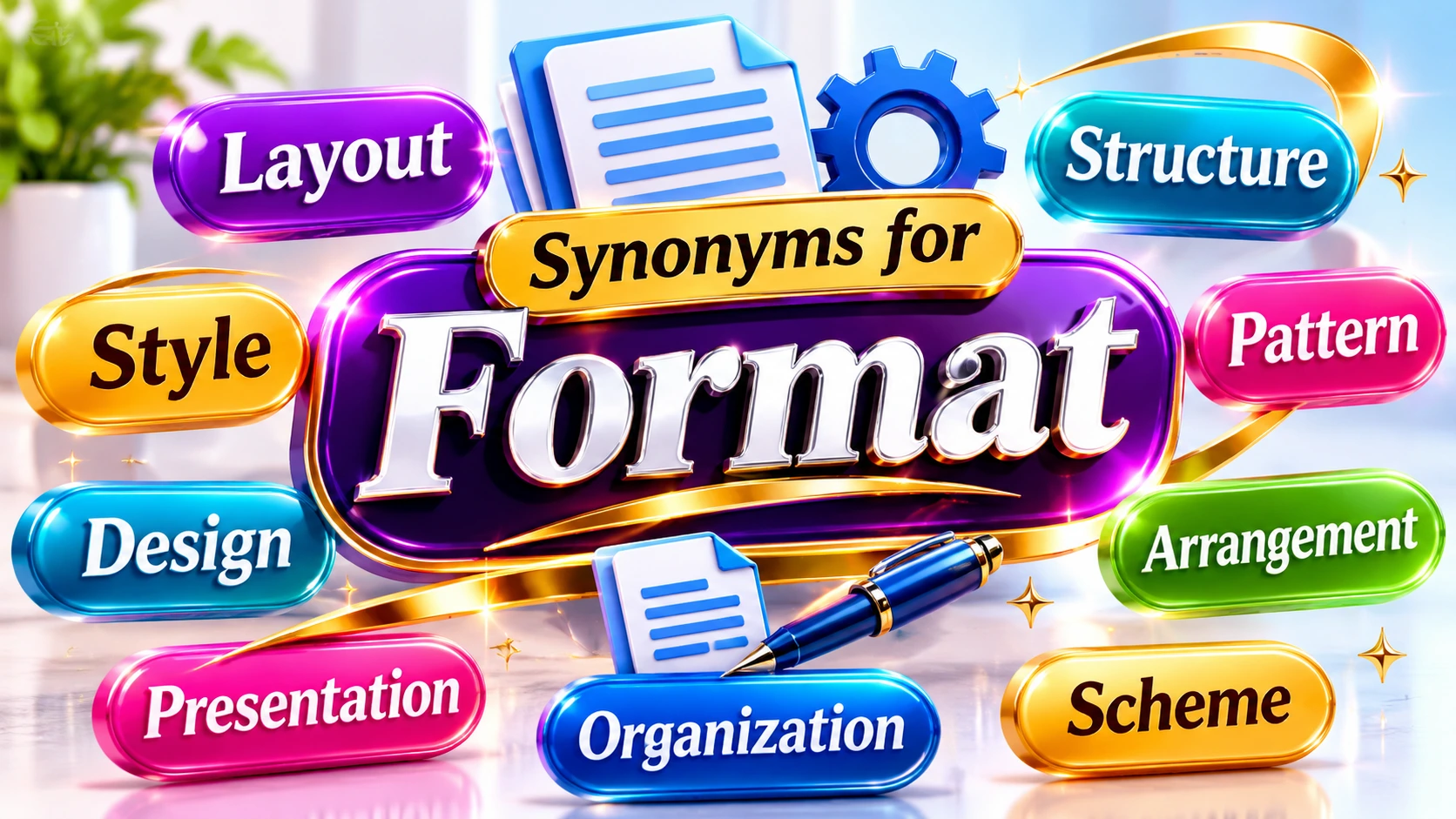
Synonyms for format, including layout, structure, arrangement, template, design, pattern, and style, to describe how information, documents, and content are organized.
Format means the way something is arranged, presented, or organized. For example, a teacher may ask students to follow a set format for an essay. A website designer may choose a new format for a page. The word is common in school, business, writing, technology, and daily life.
Learning synonyms for format helps you explain ideas in more precise ways. Instead of using the same word again and again, you can choose an alternative that fits your meaning. For example, layout may describe the placement of items on a page, while template refers to a ready-made design that people can use. This guide explains the meaning of format, its pronunciation and word history, and 30 useful synonyms with simple meanings and examples. You will also learn related words, antonyms, and how to choose the best term for each situation.
Meaning of Format
Definition
Format (Noun and Verb):
- Noun: The way information, text, or content is arranged or presented.
- Verb: To arrange, prepare, or set something in a particular form.
Examples
- Please use the correct format for your school assignment.
- I need to format this document before sending it.
Connotative Meaning
(Connotation: the feeling or idea a word suggests beyond its basic meaning.)
- Positive tone: Format can suggest a clear, neat, and professional presentation. The report has a clean format.
- Negative tone: It may suggest strict rules or limits. The format is too rigid for creative work.
- Neutral tone: It can simply describe how something is arranged. The files use the same format.
Etymology of Format
The word format entered English through French, with roots in Latin formare, meaning “to form” or “to shape.” Its modern uses include the arrangement of printed material, digital content, and data.
- Old English (450–1100): Format was not a common English word in this period. English used other words related to form and shape.
- Middle English (1100–1500): The word format was not yet widely established in English. Related terms for form and arrangement were in use.
- Modern English (1500–present): Format came into English through French and became common for describing the shape, layout, or arrangement of printed works and, later, digital files and media.
Pronunciation (IPA)
- IPA: /ˈfɔː.mæt/ (British English); /ˈfɔːr.mæt/ (American English)
- Syllables: for-mat
- Stress: The first syllable.
Affixation Pattern of Format
- Root: format
- Prefix: None in the base word.
- Suffix: No suffix in the base form. The endings -ted, -ting, and -ter appear in related forms.
Word formations
- Format (noun): a way of arranging or presenting something.
- Format (verb): to arrange or prepare something in a particular form.
- Formatted (adjective / past participle): arranged according to a format.
- Formatting (noun / verb): the process of arranging or preparing content.
- Formatter (noun): a person or tool that formats content.
- Reformat (verb): to format something again or in a different way.
- Reformatted (adjective / past participle): formatted again.
- Reformatting (noun / verb): the act of formatting again.
30 Synonyms of Format With Meaning and Examples
The best synonym for format depends on the context. Some words describe how information is arranged, while others refer to a design, file type, or set of rules.
1. Layout (Noun)
Meaning: The way items are placed on a page or screen.
Examples:
- The website has a simple layout.
- I changed the layout of my essay.
2. Structure (Noun)
Meaning: The way the parts of something are organized.
Examples:
- The report has a clear structure.
- Please improve the structure of your article.
3. Arrangement (Noun)
Meaning: The way things are placed or organized.
Examples:
- I like the arrangement of the pictures.
- The arrangement of the text looks neat.
4. Design (Noun)
Meaning: The plan or style used to create something.
Examples:
- The designer chose a modern design.
- The document design makes it easy to read.
5. Style (Noun)
Meaning: The particular way something is presented or created.
Examples:
- The teacher prefers this style of writing.
- Choose a style that suits your website.
6. Template (Noun)
Meaning: A ready-made pattern used to create something similar.
Examples:
- I used a template for my resume.
- This template helps students organize their essays.
7. Framework (Noun)
Meaning: A basic structure that guides how something is organized.
Examples:
- The writer followed a clear framework.
- We need a framework for the training course.
8. Pattern (Noun)
Meaning: A repeated or established way of arranging something.
Examples:
- The report follows a familiar pattern.
- Use the same pattern for each section.
9. Configuration (Noun)
Meaning: The way parts or settings are arranged.
Examples:
- The software supports different configurations.
- Check the device configuration before use.
10. Organization (Noun)
Meaning: The way information or items are arranged in a clear order.
Examples:
- The organization of the article is excellent.
- Good organization makes the report easier to follow.
11. Presentation (Noun)
Meaning: The way information is shown or shared with others.
Examples:
- The presentation of the data was clear.
- Improve the presentation of your research findings.
12. Setup (Noun)
Meaning: The way something is arranged or prepared for use.
Examples:
- The classroom setup supports group work.
- I changed the setup of my workspace.
13. Scheme (Noun)
Meaning: A planned system for arranging or organizing something.
Examples:
- The colors follow a simple scheme.
- The project uses a clear classification scheme.
14. Plan (Noun)
Meaning: An outline of how something will be arranged or done.
Examples:
- We made a plan for the report.
- The lesson plan follows a clear order.
15. Outline (Noun)
Meaning: A brief structure showing the main points of a piece of writing.
Examples:
- Write an outline before starting your essay.
- The outline helped organize the main ideas.
16. Form (Noun)
Meaning: The shape, type, or arrangement in which something appears.
Examples:
- The information is available in digital form.
- Submit the application in the correct form.
17. Shape (Noun)
Meaning: The form or arrangement that something takes.
Examples:
- The discussion gave shape to the final report.
- The content can take different shapes for different audiences.
18. Composition (Noun)
Meaning: The way different parts are combined to create a whole.
Examples:
- The composition of the page feels balanced.
- The designer improved the composition of the image.
19. Order (Noun)
Meaning: The sequence in which items or ideas are arranged.
Examples:
- Put the steps in the correct order.
- The order of the sections makes sense.
20. System (Noun)
Meaning: An organized set of rules or methods used to manage something.
Examples:
- The company uses a standard filing system.
- We need a system for naming our files.
21. Specification (Noun)
Meaning: A detailed statement of the requirements something must meet.
Examples:
- The file must meet the required specifications.
- Follow the formatting specifications in the guide.
22. Convention (Noun)
Meaning: An accepted rule or practice for presenting or arranging something.
Examples:
- The paper follows academic writing conventions.
- Capital letters follow standard formatting conventions.
23. Model (Noun)
Meaning: An example or pattern that can guide the creation of something.
Examples:
- Use this report as a model.
- The sample provides a model for future assignments.
24. Version (Noun)
Meaning: A particular form of something that may differ from another form.
Examples:
- Please send me the PDF version.
- The new version uses a different page design.
25. File Type (Noun Phrase)
Meaning: The kind of digital file, such as PDF, DOCX, or JPEG.
Examples:
- Choose the correct file type before saving.
- The website accepts this file type.
26. Medium (Noun)
Meaning: The method or channel used to communicate or present information.
Examples:
- Video is an effective medium for this lesson.
- The message can be shared through different media.
27. Mode (Noun)
Meaning: A particular way or method of operating or presenting something.
Examples:
- The app has a dark mode.
- The course offers both online and classroom modes.
28. Type (Noun)
Meaning: A particular kind or category of something.
Examples:
- What type of document do you need?
- This type of file is easy to share.
29. Category (Noun)
Meaning: A group of items that share similar features.
Examples:
- Place each article in the correct category.
- The files are sorted by category.
30. Standard (Noun)
Meaning: An accepted rule or level used to guide how something is prepared or presented.
Examples:
- Follow the standard for academic references.
- The company uses a common formatting standard.
Prototype Meaning of Format
The most typical meaning of format is the way information or content is arranged and presented. People may picture a document with headings, paragraphs, spacing, and margins, or a digital file saved as a PDF or Word document. The word can also describe the structure of a TV show, a lesson, or a website. Its exact meaning depends on the subject. In writing, it often refers to layout and presentation; in technology, it may refer to a file type or the process of preparing a storage device.
Prototype Categorization
The synonyms can be grouped by the meaning they share. This helps writers choose words that fit their exact context instead of replacing format with an unsuitable alternative.
- Page and content arrangement: Layout, structure, arrangement, organization, order, composition. These words focus on how parts are placed or connected.
- Visual appearance and presentation: Design, style, presentation, shape. Use these when discussing how something looks or is shown.
- Ready-made patterns and guidance: Template, framework, pattern, model, outline, plan. These terms describe examples or structures that guide the creation of content.
- Technical setup and file choices: Configuration, setup, file type, version, mode, medium. These are useful for software, devices, documents, and digital media.
- Rules and systems: Scheme, system, specification, convention, standard. These refer to methods, requirements, or accepted ways of doing things.
- Kinds and groups: Form, type, category. These describe what kind of thing something is, rather than necessarily how it is arranged.
Antonyms of Format
There is no single direct antonym for format because it can mean a structure, a presentation style, or the act of preparing something. The best opposite depends on the context.
– Disorganization (Noun): A lack of order or clear structure.
The disorganization of the report made it hard to read.
– Disorder (Noun): A state in which things are not arranged properly.
The files were left in disorder.
– Chaos (Noun): A state of complete confusion or lack of order.
The notes were in chaos.
– Randomness (Noun): A lack of a clear plan or pattern.
The randomness of the page design confused readers.
– Unstructured (Adjective): Not arranged according to a clear structure.
The document was unstructured and difficult to follow.
– Disorganized (Adjective): Not arranged in a clear or orderly way.
The disorganized notes needed editing.
– Unformatted (Adjective): Not arranged according to a particular formatting style.
The text was unformatted when I copied it.
– Improvisation (Noun): The act of creating or doing something without a prepared plan.
The speaker relied on improvisation rather than a fixed presentation format.
Short Questions and Answers
What does format mean?
Format means the way something is arranged, organized, or presented. It can also mean to prepare content or a device according to specific requirements.
When should format be used?
Use format when discussing document layouts, file types, presentation styles, media structures, or the process of arranging information. For example, “Save the report in PDF format.”
Is format positive or negative?
Format is usually neutral. It can suggest a clear and professional presentation, but a strict format may also limit creativity.
How is format different from similar words?
Layout focuses on where items appear. Structure focuses on how parts fit together. Template is a ready-made guide, while style describes the way something is presented. File type refers to a digital file category.
Conclusion
Learning synonyms for format helps you explain how information is arranged, presented, and stored. Words such as layout, structure, design, template, and organization have related meanings, but each fits a different situation. Choosing the right word makes your writing clearer and helps you avoid repetition in essays, reports, emails, and website content.
These alternatives are useful for students, teachers, content writers, and anyone who works with documents or digital media. Start by learning a few words each day. Write simple sentences with each one and notice how its meaning changes in different contexts. With regular practice, you can build your vocabulary, improve your speaking and writing, and feel more confident using English.
Synonyms for Tentative: 25 Words to Know

I’m Daniel Carter, specialize in helping readers discover synonyms, expand their vocabulary, and choose the perfect word with confidence. My content helps readers improve their English, avoid common mistakes, and write with confidence. My goal is to provide accurate, reliable, and easy-to-understand language resources