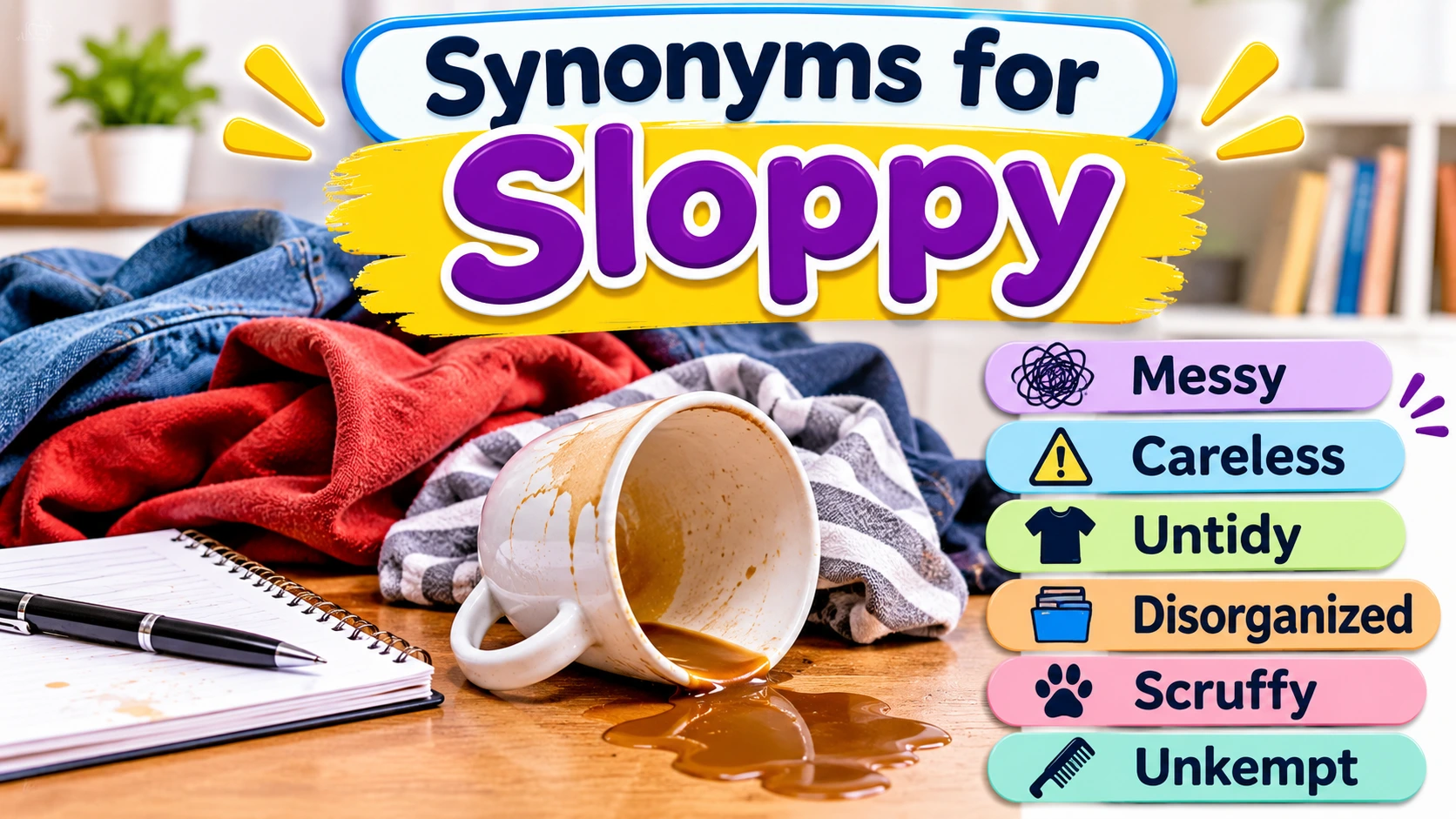
Quick Answer
| Synonym | Meaning |
|---|---|
| Careless | Lacking attention |
| Messy | Not neat |
| Untidy | Not organized |
| Disorganized | Lacking order |
| Scruffy | Untidy in appearance |
People often use the word sloppy to talk about clothes, rooms, writing, work, and even behavior. However, using the same word again and again can make your writing sound dull. Learning synonyms helps you express your ideas in a clear and interesting way.
English learners can use these words to build their vocabulary and speak with more confidence. Writers can also choose more exact words to explain what they mean. In this guide, you will learn the meaning of sloppy, 30 useful synonyms, their meanings, natural examples, antonyms, pronunciation, and word history. You will also discover how to choose the right word for different situations.
Meaning of Sloppy
Definition
Sloppy (adjective): Not neat, careful, or well organized; often showing a lack of attention or effort.
The word can also describe food or other materials that are wet, soft, or messy.
Examples
- His sloppy handwriting was hard to read.
- The team made several sloppy mistakes during the game.
- She wore sloppy clothes while cleaning the house.
- The sauce made the meal look sloppy.
Connotative Meaning
Connotation: The feelings or ideas that a word suggests beyond its basic meaning.
- Positive tone: Sloppy usually has no positive tone. However, a relaxed or informal style may be acceptable in some settings.
- Negative tone: Sloppy often suggests carelessness, poor quality, untidiness, or a lack of effort.
- Neutral tone: The word can describe a physical condition, such as sloppy mud or a sloppy mixture, without judging someone’s character.
The meaning depends on the context. Calling someone’s work sloppy is usually criticism, while describing a muddy path as sloppy focuses on its condition.
Etymology of Sloppy
The word sloppy developed from slop, a word associated with loose, wet, or messy material. Its history reflects the way the word expanded from physical messiness to careless work and behavior.
- Old English (450–1100): The exact modern word sloppy is not established as a common Old English adjective. Its history is linked to later forms of slop.
- Middle English (1100–1500): Forms related to slop were used for loose garments and loose or messy material. The word’s development reflects associations with looseness and mess.
- Modern English (1500–Present): Sloppy came to describe things that are wet or messy, as well as work, writing, and behavior that lack care or precision.
Today, the word is commonly used in everyday English to describe untidy appearances, careless actions, and work that needs improvement.
Pronunciation (IPA)
- IPA: /ˈslɒpi/ (British English); /ˈslɑːpi/ (common American English pronunciation)
- Syllables: slop-py
- Part of speech: Adjective
- Word stress: First syllable
Affixation Pattern of Sloppy
- Root: Slop
- Prefix: None
- Suffix: -y, which helps form the adjective sloppy from slop.
Word Formations
- Slop (noun): Wet, messy material or food waste.
- Slop (verb): To spill or move liquid in a messy way.
- Sloppy (adjective): Messy or careless.
- Sloppily (adverb): In a messy or careless way.
- Sloppiness (noun): The quality of being messy or careless.
Examples:
- The child slopped water onto the floor.
- His sloppy work contained many errors.
- She sloppily painted the old fence.
- The manager complained about the sloppiness of the report.
30 Synonyms of Sloppy With Meaning and Examples
Not every synonym of sloppy has the same meaning. Some describe physical mess, while others refer to poor work, weak attention, or a person’s appearance. Choose the word that best fits your sentence.
1. Careless (Adjective)
Meaning: Not giving enough attention to a task or its details.
Examples:
- His careless work contained several mistakes.
- Be careful not to make careless errors in your essay.
2. Messy (Adjective)
Meaning: Untidy, dirty, or difficult to keep in order.
Examples:
- My bedroom is messy after the party.
- He left a messy desk full of papers.
3. Untidy (Adjective)
Meaning: Not neat or properly arranged.
Examples:
- His untidy room needed cleaning.
- She looked untidy in her wrinkled clothes.
4. Disorganized (Adjective)
Meaning: Lacking a clear order or system.
Examples:
- The disorganized office made it hard to find files.
- His disorganized notes confused the whole class.
5. Scruffy (Adjective)
Meaning: Untidy or worn in appearance, especially when describing a person or clothes.
Examples:
- He arrived in a scruffy old jacket.
- The scruffy puppy needed a bath.
6. Unkempt (Adjective)
Meaning: Not properly cared for or kept neat.
Examples:
- His unkempt hair covered his forehead.
- The garden looked unkempt after months without care.
7. Negligent (Adjective)
Meaning: Failing to give proper care or attention to a duty.
Examples:
- The negligent worker ignored important safety rules.
- A negligent review allowed serious errors to remain.
8. Haphazard (Adjective)
Meaning: Done without a clear plan, order, or method.
Examples:
- The books were placed in a haphazard order.
- Their haphazard approach wasted valuable time.
9. Shoddy (Adjective)
Meaning: Poorly made or completed, often because of low quality or insufficient care.
Examples:
- The company received complaints about its shoddy products.
- The editor rejected the shoddy report.
10. Slapdash (Adjective)
Meaning: Done quickly and carelessly, without enough attention to quality.
Examples:
- He gave the presentation a slapdash finish.
- The slapdash repair failed after one day.
11. Hasty (Adjective)
Meaning: Done too quickly, often without enough thought or care.
Examples:
- She made a hasty decision and later regretted it.
- His hasty work missed several important details.
12. Imprecise (Adjective)
Meaning: Not exact, clear, or accurate enough.
Examples:
- The report used imprecise language.
- His imprecise instructions confused the students.
13. Inaccurate (Adjective)
Meaning: Not correct or exact.
Examples:
- The article contained inaccurate information.
- An inaccurate calculation changed the final result.
14. Faulty (Adjective)
Meaning: Not working correctly or containing errors.
Examples:
- The faulty design caused several problems.
- The inspector found a faulty connection.
15. Defective (Adjective)
Meaning: Having a fault that makes something imperfect or unable to work properly.
Examples:
- The shop replaced the defective product.
- The defective part caused the machine to stop.
16. Inept (Adjective)
Meaning: Lacking the skill or ability needed to do something well.
Examples:
- His inept handling of the situation made things worse.
- The team suffered because of inept management.
17. Unprofessional (Adjective)
Meaning: Not meeting the standards expected in a workplace or professional setting.
Examples:
- Sending an unfinished report was unprofessional.
- His unprofessional behavior upset the client.
18. Unpolished (Adjective)
Meaning: Not fully refined, improved, or finished.
Examples:
- Her first draft was interesting but unpolished.
- The speech sounded unpolished during rehearsal.
19. Rough (Adjective)
Meaning: Not smooth, finished, or carefully developed.
Examples:
- He submitted a rough draft of the essay.
- The carpenter left a rough edge on the table.
20. Patchy (Adjective)
Meaning: Uneven or incomplete, with some parts better than others.
Examples:
- The report showed patchy research.
- His attendance record was patchy throughout the term.
21. Inconsistent (Adjective)
Meaning: Not staying at the same level of quality, behavior, or performance.
Examples:
- The writer produced inconsistent results.
- Her work was inconsistent throughout the semester.
22. Sloppy-looking (Adjective)
Meaning: Having an appearance that seems messy or poorly arranged.
Examples:
- The sloppy-looking uniform needed ironing.
- His sloppy-looking desk made the office seem untidy.
23. Unsystematic (Adjective)
Meaning: Done without a clear or organized method.
Examples:
- The student used an unsystematic approach to research.
- Their unsystematic filing process caused delays.
24. Disorderly (Adjective)
Meaning: Lacking order or proper arrangement.
Examples:
- The papers were scattered across a disorderly desk.
- The disorderly room was difficult to clean.
25. Disheveled (Adjective)
Meaning: Having a messy or untidy appearance, especially hair or clothing.
Examples:
- He arrived at work looking disheveled.
- Her disheveled hair showed that she had rushed out.
26. Neglectful (Adjective)
Meaning: Failing to give enough care or attention to someone or something.
Examples:
- The neglectful owner ignored the damaged fence.
- A neglectful approach to maintenance caused expensive repairs.
27. Inattentive (Adjective)
Meaning: Not paying enough attention to what is happening or what needs to be done.
Examples:
- The inattentive student missed the main point.
- An inattentive proofreader may overlook spelling errors.
28. Uncareful (Adjective)
Meaning: Not taking enough care when doing something; less common than careless.
Examples:
- His uncareful handling damaged the package.
- An uncareful review can leave errors in the final copy.
29. Improper (Adjective)
Meaning: Not correct, suitable, or acceptable for a particular situation.
Examples:
- The report used an improper format.
- Improper handling of the equipment created a safety risk.
30. Slatternly (Adjective)
Meaning: Untidy or careless in personal appearance or housekeeping; an old-fashioned and often insulting term.
Examples:
- The novel describes the character as slatternly.
- The outdated review unfairly called her appearance slatternly.
Usage note: Careless, messy, untidy, shoddy, and slapdash are useful everyday alternatives. Words such as negligent, defective, and inaccurate have more specific meanings and are not interchangeable with sloppy in every sentence.
Prototype Meaning of Sloppy
The most typical meaning of sloppy is messy or careless. When people hear this word, they often imagine an untidy room, wrinkled clothes, messy handwriting, or work completed without enough attention. The word can describe both physical appearance and the quality of a task. For example, sloppy handwriting looks untidy, while sloppy research may contain errors or lack proper organization. Its central idea is a lack of neatness, care, or precision.
Prototype Categorization of Sloppy Synonyms
Grouping synonyms by meaning helps you select the most suitable word. Although many words overlap with sloppy, each one highlights a different quality.
1. Physical Mess and Untidiness
These words describe rooms, clothes, hair, or other visible things that are not neat.
- Messy: Generally untidy or dirty.
- Untidy: Not neatly arranged.
- Scruffy: Worn or untidy in appearance.
- Unkempt: Not properly maintained.
- Disheveled: Having messy hair or clothing.
- Disorderly: Lacking order.
- Sloppy-looking: Appearing messy.
- Slatternly: Untidy in appearance or housekeeping; often insulting.
Example: His untidy room and disheveled hair made him look unkempt.
2. Carelessness and Lack of Attention
These words focus on the person or action responsible for a mistake or poor result.
- Careless: Not paying enough attention.
- Negligent: Failing to meet a duty of care.
- Neglectful: Not giving enough care or attention.
- Inattentive: Not concentrating.
- Uncareful: Not taking enough care.
Example: The careless and inattentive worker made errors that a more careful review could have prevented.
3. Poor Work and Low Quality
These words describe work, products, or results that do not meet expected standards.
- Shoddy: Poorly made or completed.
- Slapdash: Done carelessly and too quickly.
- Faulty: Containing errors or not working correctly.
- Defective: Having a fault.
- Inept: Showing a lack of skill.
- Unprofessional: Below expected professional standards.
- Unpolished: Not fully refined.
- Rough: Not fully finished.
- Improper: Not correct or suitable.
Example: The client rejected the shoddy report because it was rough, unpolished, and unprofessional.
4. Poor Organization and Planning
These words describe tasks or systems that lack order or a clear method.
- Disorganized: Lacking an effective system.
- Haphazard: Arranged or done without a plan.
- Unsystematic: Lacking a clear method.
Example: The disorganized team followed a haphazard process instead of using a systematic plan.
5. Speed, Accuracy, and Consistency
These words describe work that is rushed, inaccurate, uneven, or incomplete.
- Hasty: Done too quickly.
- Imprecise: Not exact.
- Inaccurate: Incorrect.
- Patchy: Uneven or incomplete.
- Inconsistent: Not maintaining the same standard.
Example: His hasty editing produced an inaccurate and inconsistent article.
How Does This Categorization Help Writers?
Semantic categories help writers choose words that express the exact problem. Use messy for an untidy room, careless for an avoidable mistake, slapdash for rushed work, and negligent when someone fails to meet a duty. Use imprecise when details are not exact and unpolished when a draft needs improvement.
Choosing a word based on its meaning makes writing clearer and prevents awkward word choices.
Antonyms of Sloppy
Antonyms are words with opposite meanings. The best antonym depends on whether sloppy describes appearance, behavior, or work.
1. Neat (Adjective)
Meaning: Clean and arranged in an orderly way.
- She keeps her desk neat.
- His neat handwriting was easy to read.
2. Tidy (Adjective)
Meaning: Properly arranged and free from mess.
- The children left the classroom tidy.
- He wore a tidy uniform.
3. Careful (Adjective)
Meaning: Giving enough attention to avoid mistakes.
- She was careful when checking the report.
- A careful worker checks every detail.
4. Meticulous (Adjective)
Meaning: Extremely careful about small details.
- The editor was meticulous when checking the article.
- His meticulous planning helped the project succeed.
5. Organized (Adjective)
Meaning: Arranged in a clear and effective order.
- She keeps her notes organized.
- The organized team finished the task on time.
6. Orderly (Adjective)
Meaning: Neat, systematic, and well arranged.
- The files were stored in an orderly manner.
- The orderly classroom helped students focus.
7. Precise (Adjective)
Meaning: Exact and accurate.
- The scientist recorded precise measurements.
- Please give precise instructions.
8. Accurate (Adjective)
Meaning: Correct and free from errors.
- The report contains accurate information.
- Her accurate answer impressed the teacher.
9. Thorough (Adjective)
Meaning: Complete and careful, with all important details considered.
- The inspector conducted a thorough review.
- A thorough explanation helped the students understand.
10. Professional (Adjective)
Meaning: Meeting the standards expected in a job or workplace.
- She wrote a professional email.
- His professional conduct impressed the client.
Short Questions and Answers
What does sloppy mean?
Sloppy means messy, untidy, or careless. It can describe a person’s appearance, a room, handwriting, work, or behavior.
When should sloppy be used?
Use sloppy when something lacks neatness, care, or precision. For example, you can describe sloppy handwriting, sloppy work, or a sloppy room.
Is sloppy positive or negative?
The word is usually negative because it suggests a lack of care or order. However, when describing wet or loose material, it may simply describe a physical condition.
How is sloppy different from similar words?
Sloppy is a broad term for messiness or carelessness. Messy usually describes untidiness, careless focuses on a lack of attention, shoddy suggests poor quality, and slapdash describes rushed, careless work.
What is the most common synonym for sloppy?
Careless and messy are common alternatives. Use careless for actions or mistakes and messy for untidy places or things.
Can sloppy describe a person?
Yes. It can describe a person’s untidy appearance or careless behavior. However, it may sound critical or insulting, depending on the context.
What is the opposite of sloppy?
Common antonyms include neat, tidy, careful, organized, precise, and meticulous.
Conclusion
Learning the meaning of sloppy and its synonyms can help you become a stronger English speaker and writer. Words such as careless, messy, untidy, shoddy, and slapdash may seem similar, but each describes a different kind of problem. Choosing the right word helps you explain your ideas clearly and avoid repetition.
These words are useful in schoolwork, daily conversations, emails, and professional writing. You can improve your vocabulary by learning a few new synonyms each day and using them in your own sentences. Try describing a messy room, a careless mistake, or a poorly finished task with different words. With regular practice, you will learn to choose more precise words and express your thoughts with greater confidence.
Synonyms for Discomfort: 25 Words for Feelings You Can’t Explain

I’m an English language researcher and content writer focused on synonyms, vocabulary development, and word choice. Through clear and informative articles, I help readers expand their vocabulary and choose the right words with confidence.