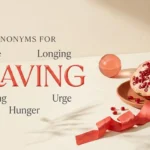
Explore synonyms for craving, including desire, yearning, longing, urge, hunger, and appetite, to express intense wants and deep feelings.
Craving means a strong desire for something. You may crave your favorite food after a long day. You may also crave love, success, or peace. The word is common in daily speech, books, and online writing. It helps us express what we want or feel deeply.
However, using the same word again and again can make writing dull. Learning synonyms for craving helps you share your thoughts in a clearer and more natural way. Some words express a simple wish, while others show a deep need or powerful longing. Each word has its own meaning and use.
In this guide, you will learn the meaning of craving, 25 useful synonyms, their examples, word origins, pronunciation, and antonyms. You will also discover how to choose the right word for different feelings and situations.
Meaning of Craving
Definition
Craving (Noun): A strong desire or need for something, such as food, love, attention, or success.
Craving (Verb): The present participle of crave, meaning to want something very strongly.
Examples
- I had a strong craving for chocolate after dinner.
- She has a deep craving for love and acceptance.
- He is craving a chance to prove his skills.
- Many people experience food cravings when they feel stressed.
Connotative Meaning
Connotation (the feelings or ideas a word brings to mind): Craving often suggests a strong desire that is difficult to ignore.
- Positive tone: A craving for knowledge can encourage learning and growth.
- Negative tone: A craving for power may lead someone to make selfish choices.
- Neutral tone: A craving for ice cream simply describes a strong wish for a particular food.
The tone depends on what a person wants and how that desire affects their actions.
Etymology
The word craving comes from the verb crave, which has been used in English for centuries. Its deeper origin is uncertain, so it is best not to assign it a definite ancient root.
- Old English (450–1100): There is no firmly established Old English form that can confidently be identified as the direct source of modern crave.
- Middle English (1100–1500): Forms of crave appeared in Middle English, expressing a strong request, demand, or desire.
- Modern English (1500–Present): Crave developed into a common word for wanting something strongly. Craving is now widely used for food, emotional needs, and personal ambitions.
Today, the word can describe both physical desires and emotional or psychological wants.
Pronunciation (IPA)
- IPA: /ˈkreɪ.vɪŋ/
- Syllables: crav-ing
- Word stress: The first syllable.
The word begins with the same sound as crave and ends with the sound heard in sing.
Affixation Pattern of Craving
- Root: Crave
- Prefix: None
- Suffix: -ing, used to form the present participle and gerund.
Word Formations
- Crave (verb): To want something strongly.
- Craves (verb): Wants something strongly.
- Craved (verb): Wanted something strongly in the past.
- Craving (verb): Wanting something strongly.
- Craving (noun): A strong desire for something.
- Craver (noun): A person who craves something; an uncommon word.
Related Expressions
- Food craving: A strong desire for a particular food.
- Craving for attention: A strong wish to receive attention from others.
- Craving for affection: A strong desire for love and warmth.
- Craving for success: A strong desire to achieve goals.
- Uncontrollable craving: A desire that feels difficult to resist.
25 Synonyms of Craving With Meanings and Examples
Not every synonym has exactly the same meaning as craving. Some describe a strong desire, while others express a wish, need, or ambition. Choose the word that best fits your sentence.
1. Desire (Noun)
Meaning: A strong feeling of wanting something.
Examples:
- She has a strong desire to learn English.
- His desire for success motivates him every day.
2. Longing (Noun)
Meaning: A deep and lasting wish for something, especially something absent or difficult to obtain.
Examples:
- He felt a longing for his childhood home.
- Her longing for peace grew after years of stress.
3. Yearning (Noun)
Meaning: A deep and powerful desire for something.
Examples:
- She felt a yearning for freedom.
- His yearning to become a teacher inspired him to study.
4. Urge (Noun)
Meaning: A sudden or strong feeling that pushes someone to do something.
Examples:
- I had an urge to call my friend.
- She felt the urge to eat something sweet.
5. Hunger (Noun)
Meaning: A strong physical or emotional desire for something.
Examples:
- He has a hunger for knowledge.
- Her hunger for success keeps her focused.
6. Thirst (Noun)
Meaning: A strong desire to gain or experience something.
Examples:
- The young writer has a thirst for knowledge.
- His thirst for adventure took him to new places.
7. Passion (Noun)
Meaning: A strong feeling of enthusiasm or love for something.
Examples:
- She has a passion for teaching.
- His passion for music began at an early age.
8. Wish (Noun)
Meaning: A feeling of wanting something to happen or become true.
Examples:
- My wish is to travel around the world.
- She expressed a wish to see her family again.
9. Want (Noun)
Meaning: A desire or need for something that is missing.
Examples:
- He felt a want for greater freedom.
- Her want for approval affected her decisions.
10. Need (Noun)
Meaning: Something necessary or strongly wanted.
Examples:
- She has a need for emotional support.
- His need for rest became clear after the long journey.
11. Aspiration (Noun)
Meaning: A strong desire to achieve something important.
Examples:
- Her aspiration is to become a doctor.
- He worked hard to fulfill his career aspirations.
12. Ambition (Noun)
Meaning: A strong desire to achieve success or reach a goal.
Examples:
- His ambition drives him to improve his skills.
- She has the ambition to run her own business.
13. Yearning Desire (Noun Phrase)
Meaning: A deep and powerful wish for something.
Examples:
- She felt a yearning desire to return home.
- His yearning desire for change grew stronger.
14. Inclination (Noun)
Meaning: A natural tendency or preference for doing or having something.
Examples:
- She has an inclination toward creative work.
- He felt an inclination to help his neighbors.
15. Impulse (Noun)
Meaning: A sudden desire to do something without much thought.
Examples:
- On impulse, she bought a new book.
- He resisted the impulse to interrupt the speaker.
16. Appetite (Noun)
Meaning: A desire for food or a strong interest in something.
Examples:
- I have an appetite for spicy food.
- She has a healthy appetite for learning new skills.
17. Itch (Noun)
Meaning: An informal, strong desire to do or experience something.
Examples:
- He had an itch to explore a new city.
- She felt an itch to start a creative project.
18. Drive (Noun)
Meaning: A strong inner force that motivates someone to act or succeed.
Examples:
- Her drive to succeed impressed her teachers.
- He has the drive to overcome difficult challenges.
19. Compulsion (Noun)
Meaning: A powerful urge to do something that may be difficult to control.
Examples:
- He felt a compulsion to check his phone.
- Her compulsion to keep everything organized caused stress.
20. Fixation (Noun)
Meaning: An unusually strong or persistent focus on something.
Examples:
- His fixation on fame affected his friendships.
- She developed a fixation on reaching the perfect score.
21. Lust (Noun)
Meaning: A very strong desire, often related to sexual pleasure or intense personal wants.
Examples:
- The novel explores lust and jealousy.
- His lust for power damaged his relationships.
22. Coveting (Noun or Gerund)
Meaning: Strongly wanting something that belongs to someone else.
Examples:
- Coveting another person’s success can lead to envy.
- He spent too much time coveting his neighbor’s possessions.
23. Pining (Noun or Gerund)
Meaning: Experiencing a deep, often sad longing for someone or something.
Examples:
- She was pining for her family while studying abroad.
- He spent months pining for his lost friendship.
24. Craving for More (Noun Phrase)
Meaning: A strong desire to gain or experience more of something.
Examples:
- She had a craving for more knowledge.
- His craving for more success never seemed to end.
25. Yearn (Verb)
Meaning: To feel a deep and powerful desire for something.
Examples:
- Many people yearn for a peaceful life.
- She yearns to make her family proud.
Usage note: Yearn is a verb, while craving is often used as a noun. They express similar ideas but do not always fit into the same sentence structure.
Prototype Meaning
The prototype meaning of craving is a strong desire for something that a person wants very much. People often imagine a person wanting a favorite food, such as chocolate, after a long day. However, the word also describes emotional desires, such as a craving for love, attention, freedom, or success. Its central idea is a desire that feels stronger than an ordinary wish. Depending on the context, a craving may be harmless, motivating, or difficult to control.
Prototype Categorization
The synonyms of craving can be grouped by the type and strength of desire they express. This table helps writers choose words that fit the meaning and tone of their sentences.
| Semantic Category | Synonyms and Related Expressions | Typical Meaning | Best Used When |
|---|---|---|---|
| Strong Desire | Desire, longing, yearning, yearning desire | A powerful wish for something | Describing deep personal feelings |
| Sudden Urge | Urge, impulse, itch | A desire that appears suddenly | Describing an immediate wish to act |
| Physical Desire | Hunger, thirst, appetite | A desire for food or a strong need for something | Discussing food or metaphorical hunger |
| Emotional Desire | Longing, yearning, pining, wish | A deep emotional need or wish | Writing about love, home, or relationships |
| Goals and Achievement | Aspiration, ambition, drive, passion | A strong wish to achieve or improve | Discussing careers, education, and success |
| Needs and Preferences | Need, want, inclination, wish | Something desired, needed, or preferred | Explaining personal needs and choices |
| Difficult-to-Control Desire | Compulsion, fixation | A persistent or overpowering urge | Discussing behavior or excessive focus |
| Intense Personal Desire | Lust, coveting | A powerful desire, sometimes selfish or inappropriate | Describing power, possessions, or sexual desire |
| General Desire for More | Craving for more | Wanting a greater amount or further experience | Describing ambition or dissatisfaction |
Why does this categorization matter?
These categories help writers avoid choosing synonyms that do not fit their intended meaning. For example, aspiration works well when discussing career goals, while appetite may fit a desire for food or knowledge. Similarly, compulsion suggests a stronger and potentially harder-to-control urge than wish. Choosing the right word makes writing clearer and more natural.
Antonyms of Craving
An antonym is a word with the opposite or contrasting meaning. The best antonym for craving depends on the situation.
1. Indifference (Noun)
Meaning: A lack of interest, concern, or desire.
Example: She showed indifference toward the prize.
2. Apathy (Noun)
Meaning: A lack of interest, enthusiasm, or motivation.
Example: His apathy toward learning worried his teacher.
3. Disinterest (Noun)
Meaning: A lack of interest in something.
Example: Her disinterest in sports surprised her friends.
4. Contentment (Noun)
Meaning: A state of being satisfied with what you have.
Example: He found contentment in his simple life.
5. Satisfaction (Noun)
Meaning: A feeling of pleasure that comes from having what you want or need.
Example: She felt satisfaction after completing her work.
6. Aversion (Noun)
Meaning: A strong dislike of something.
Example: He has an aversion to very spicy food.
7. Dislike (Noun)
Meaning: A feeling of not liking something.
Example: Her dislike of loud music was well known.
8. Reluctance (Noun)
Meaning: An unwillingness or hesitation to do something.
Example: He showed reluctance to leave his hometown.
9. Restraint (Noun)
Meaning: The ability to control an urge or desire.
Example: She showed restraint and avoided buying unnecessary items.
10. Fulfillment (Noun)
Meaning: A feeling of satisfaction from having a need or desire met.
Example: Helping others gave him a sense of fulfillment.
Important: These are contextual opposites rather than exact antonyms in every situation. For example, contentment contrasts with a craving for more, while aversion contrasts with a craving for something a person dislikes.
Short Questions and Answers
What does craving mean?
Craving means a strong desire for something. It may refer to food, love, attention, success, or another personal want.
When should craving be used?
Use craving when someone wants something strongly. For example, you might say, “I have a craving for chocolate” or “She has a craving for adventure.”
Is craving positive or negative?
Craving can be positive, negative, or neutral. A craving for knowledge may support learning, while a craving for power may suggest selfishness. A craving for food is often neutral.
How is craving different from desire?
Desire is a broad term for wanting something. Craving usually suggests a stronger, more intense desire that may be difficult to ignore.
What is the strongest synonym for craving?
There is no single strongest synonym for every situation. Yearning suggests deep emotional desire, while compulsion suggests an urge that may be difficult to control.
What is the opposite of craving?
Contextual opposites include indifference, apathy, and contentment. The best choice depends on whether the craving refers to wanting something, feeling dissatisfied, or struggling to control an urge.
Conclusion
Learning synonyms for craving can help you express your feelings and ideas with greater accuracy. Words such as desire, longing, yearning, and urge describe different kinds of wanting. Other words, such as aspiration and ambition, are useful when writing about goals and success. Understanding these differences helps you avoid repetition and choose words that fit each situation.
You can improve your English by learning a few new words each day and using them in your own sentences. Read examples, notice how words work in context, and practice using them in everyday conversations. With regular practice, you can build a stronger vocabulary, improve your writing and speaking, and feel more confident when expressing your thoughts in English.
Synonyms for pizza: 25 Tasty Alternatives

I’m Daniel Carter, specialize in helping readers discover synonyms, expand their vocabulary, and choose the perfect word with confidence. My content helps readers improve their English, avoid common mistakes, and write with confidence. My goal is to provide accurate, reliable, and easy-to-understand language resources