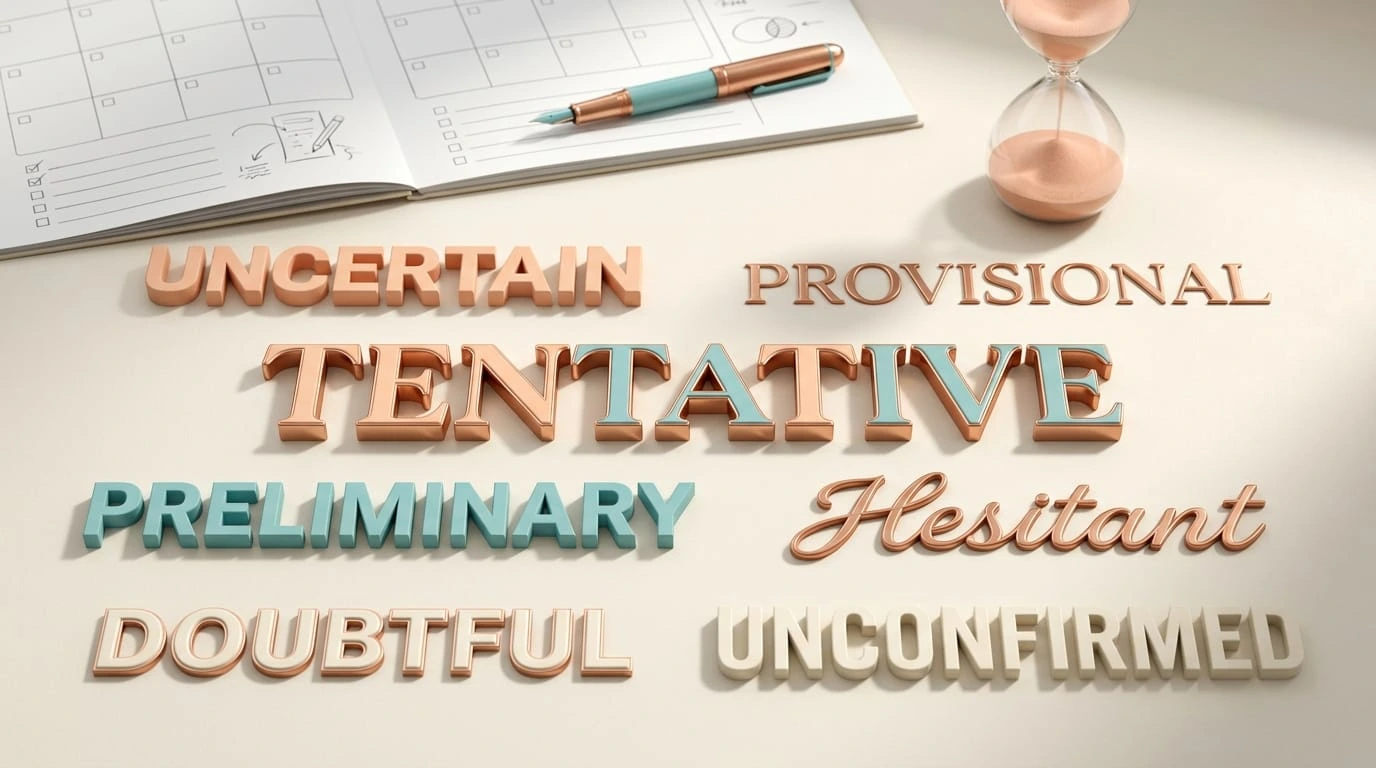
Discover synonyms for tentative, including provisional, uncertain, hesitant, cautious, preliminary, and undecided, to describe plans, choices, and decisions that may change.
Tentative means not yet certain, fixed, or final. Imagine that your friend plans a trip but has not chosen the date. They may say, “Friday is my tentative plan.” This means the plan could still change. We use this word in daily talks, schoolwork, business, and formal writing. It helps us show doubt, care, or a decision that is not final.
Learning synonyms for tentative helps you express these ideas in different ways. For example, uncertain shows doubt, while provisional often describes a plan that may change. The right word can make your writing clear and natural. In this guide, you will learn the meaning of tentative, useful synonyms, examples, pronunciation, word history, antonyms, and semantic categories. These words will help you speak and write with more confidence.
Meaning of Tentative
Definition
Tentative (Adjective): Not certain, final, or fully decided; done carefully because the result is not yet known.
Examples
- We made a tentative plan to meet on Friday.
- She gave a tentative answer because she was not sure.
- The team set a tentative date for the event.
- He took a tentative step into the dark room.
Connotative Meaning
Connotation (the feelings or ideas a word suggests): Tentative often suggests uncertainty, caution, or a decision that may change.
- Positive tone: A tentative suggestion can show that someone is open to other ideas.
- Negative tone: A tentative answer may sound unsure or weak.
- Neutral tone: A tentative date simply means that the date is not final.
Etymology of Tentative
The word tentative comes from the Latin word tentare, meaning “to try” or “to test.” It entered English through French.
- Old English (450–1100): Tentative was not an established Old English word.
- Middle English (1100–1500): The word developed through French and Latin forms as English vocabulary grew.
- Modern English (1500–Present): Tentative came to describe something done as a trial or something not yet settled. Today, it often describes plans, dates, decisions, and uncertain actions.
Pronunciation (IPA)
- IPA: /ˈten.tə.tɪv/
- Syllables: ten-ta-tive
- Stress: First syllable.
Affixation Pattern of Tentative
- Root: Related to Latin tentare, meaning “to try” or “to test.”
- Prefix: None in modern English.
- Suffix: -ive, which helps form adjectives.
Word Formations
- Tentative (adjective): Not final or certain.
- Tentatively (adverb): In an uncertain or provisional way.
- Tentativeness (noun): The quality of being tentative.
- Tentative plan (noun phrase): A plan that may change.
- Tentative agreement (noun phrase): An agreement that is not yet final.
25 Synonyms of Tentative With Meaning and Examples
The best synonym depends on the context. Some words describe doubt, while others describe plans or actions that are not final.
1. Uncertain (Adjective)
Meaning: Not sure about something.
Examples:
- I am uncertain about the meeting time.
- She felt uncertain about her answer.
2. Provisional (Adjective)
Meaning: Arranged for now but likely to change later.
Examples:
- We have a provisional date for the event.
- The school shared a provisional schedule.
3. Temporary (Adjective)
Meaning: Lasting for a limited time rather than forever.
Examples:
- This is a temporary solution.
- They moved into a temporary office.
4. Preliminary (Adjective)
Meaning: Happening before the main or final stage.
Examples:
- We held a preliminary meeting.
- The preliminary results look promising.
5. Provisional (Adjective)
Meaning: Not yet confirmed or fully approved.
Examples:
- She received provisional approval.
- The team announced a provisional plan.
6. Doubtful (Adjective)
Meaning: Not sure or not likely to happen.
Examples:
- I am doubtful that the plan will work.
- He gave a doubtful look.
7. Hesitant (Adjective)
Meaning: Slow to act or speak because of doubt.
Examples:
- She was hesitant to share her idea.
- He gave a hesitant reply.
8. Cautious (Adjective)
Meaning: Careful to avoid risk or mistakes.
Examples:
- The manager took a cautious approach.
- Be cautious when making promises.
9. Unsettled (Adjective)
Meaning: Not yet decided, resolved, or stable.
Examples:
- The final date is still unsettled.
- Several details remain unsettled.
10. Undecided (Adjective)
Meaning: Not having made a final choice.
Examples:
- I am undecided about which course to take.
- The group is still undecided about the venue.
11. Unconfirmed (Adjective)
Meaning: Not yet checked or officially accepted as true.
Examples:
- The meeting time is unconfirmed.
- We heard an unconfirmed report about the change.
12. Conditional (Adjective)
Meaning: Depending on something else happening first.
Examples:
- The offer is conditional on approval.
- Their agreement is conditional on the results.
13. Experimental (Adjective)
Meaning: Based on a test or a new method that is still being tried.
Examples:
- The team used an experimental design.
- This is an experimental teaching method.
14. Exploratory (Adjective)
Meaning: Intended to learn more about something before deciding what to do.
Examples:
- We had an exploratory discussion.
- The first visit was exploratory.
15. Trial (Adjective)
Meaning: Used for a test before a final decision.
Examples:
- The school introduced a trial program.
- He accepted a trial position at the company.
16. Provisionalized (Adjective)
Meaning: Made provisional or temporary; this is a rare and awkward form in general English.
Examples:
- The arrangement was provisionally approved.
- The dates were marked as provisional.
17. Indefinite (Adjective)
Meaning: Not clearly fixed, limited, or decided.
Examples:
- The meeting was postponed for an indefinite period.
- The end date remains indefinite.
18. Inconclusive (Adjective)
Meaning: Not giving a clear or final answer.
Examples:
- The test results were inconclusive.
- Their discussion ended with an inconclusive result.
19. Ambiguous (Adjective)
Meaning: Having more than one possible meaning or interpretation.
Examples:
- His reply was ambiguous.
- The instructions were too ambiguous to follow.
20. Vague (Adjective)
Meaning: Not clear or detailed.
Examples:
- She gave a vague answer.
- The plan is still vague.
21. Uncertainly (Adverb)
Meaning: In a way that shows doubt or a lack of confidence.
Examples:
- He smiled uncertainly at the suggestion.
- She answered uncertainly because she lacked the facts.
22. Tentatively (Adverb)
Meaning: In a way that is not final or fully confident.
Examples:
- We tentatively agreed to meet on Monday.
- She tentatively accepted the offer.
23. Cautiously (Adverb)
Meaning: In a careful way that avoids risk.
Examples:
- He cautiously shared his opinion.
- They cautiously moved forward with the plan.
24. Hesitantly (Adverb)
Meaning: In a way that shows doubt or reluctance.
Examples:
- She hesitantly raised her hand.
- He hesitantly agreed to join the team.
25. Probing (Adjective)
Meaning: Asking questions or examining something closely to discover more.
Examples:
- The reporter asked probing questions.
- The discussion began with a probing inquiry.
Usage note: These words are not exact substitutes in every sentence. Provisional and preliminary often work for plans and early stages. Hesitant and uncertain are better for feelings or responses. Vague describes a lack of clarity, which is different from something simply being tentative.
Prototype Meaning
The prototype meaning of tentative is something that is not yet final or certain. People often imagine a plan, date, or decision that may change after more information becomes available. For example, a tentative meeting date is chosen for now but has not been confirmed. The word can also describe a careful action or an unsure response. Its central idea is that a person has not fully settled on a choice or does not feel completely confident.
Prototype Categorization
| Semantic Category | Synonyms | Typical Meaning | Best Used When |
|---|---|---|---|
| Not Final Yet | Provisional, temporary, preliminary, trial | Subject to change or further review | Describing dates, plans, and arrangements |
| Doubt or Uncertainty | Uncertain, doubtful, undecided, unconfirmed | Not sure or not yet settled | Describing decisions, facts, or answers |
| Careful Action | Cautious, hesitantly, cautiously, hesitant | Acting carefully due to doubt or risk | Describing behavior and responses |
| Not Clearly Defined | Vague, ambiguous, indefinite, unsettled | Lacking clear details or a fixed outcome | Describing instructions, terms, or plans |
| Early Investigation | Exploratory, experimental, probing | Testing or examining before deciding | Describing research, questions, and new methods |
| No Clear Result | Inconclusive | Not providing a definite answer | Describing tests, discussions, or findings |
| Conditional Decisions | Conditional, provisional | Dependent on approval or another event | Describing offers and agreements |
This categorization helps writers choose a word that matches the intended meaning. For example, use provisional for a date that may change, hesitant for a person who is unsure, and inconclusive for a test that gives no clear result. Choosing the right word makes your writing more precise and natural.
Antonyms of Tentative
Antonyms are words with opposite or contrasting meanings. The best opposite depends on whether tentative describes a plan, a decision, or a person’s manner.
- Definite (Adjective): Clear and certain.
Example: We have a definite date for the event. - Final (Adjective): Complete and not expected to change.
Example: The manager shared the final schedule. - Certain (Adjective): Known or believed to be true without doubt.
Example: She is certain about her choice. - Decisive (Adjective): Showing the ability to make choices quickly and confidently.
Example: He took decisive action. - Firm (Adjective): Fixed, strong, or unlikely to change.
Example: We made a firm agreement. - Confirmed (Adjective): Officially checked or accepted as true.
Example: The booking is confirmed. - Conclusive (Adjective): Providing a clear and final result.
Example: The test gave conclusive evidence. - Confident (Adjective): Feeling sure about yourself or your choices.
Example: She gave a confident answer. - Settled (Adjective): Decided or resolved.
Example: The date is settled. - Permanent (Adjective): Intended to last for a long time or indefinitely.
Example: They found a permanent solution.
Short Questions and Answers
What does tentative mean?
Tentative means not yet certain, final, or fully decided. It can also describe an action done carefully because of doubt.
When should tentative be used?
Use tentative when a plan, date, decision, or idea may change. For example, “We have a tentative booking for Friday.”
Is tentative positive or negative?
It is usually neutral. It may suggest careful planning, but it can also show uncertainty or a lack of confidence.
How is tentative different from uncertain?
Tentative often describes something not yet final or an action done with care. Uncertain mainly describes a lack of confidence or knowledge.
What is the best synonym for tentative?
There is no single best synonym for every situation. Provisional works well for plans, hesitant for behavior, and uncertain for doubt.
What is the opposite of tentative?
Common opposites include definite, final, certain, and confirmed. The best choice depends on the sentence.
Conclusion
Learning synonyms for tentative helps you express uncertainty, caution, and unfinished decisions with greater care. Words such as provisional, preliminary, uncertain, and hesitant have related meanings, but each fits a different situation. A provisional date may change, a hesitant person may feel unsure, and an inconclusive test may fail to give a clear answer. Knowing these differences helps you avoid repetition and make your writing more precise.
You can build your vocabulary by learning a few words each day and using them in short sentences. Read examples, compare similar words, and practice them in daily conversations. With regular practice, you can improve your English writing, speak more clearly, and feel more confident when sharing your ideas.
Synonyms for Tentatively: 30 Words to Know

I’m an English language researcher and content writer focused on synonyms, vocabulary development, and word choice. Through clear and informative articles, I help readers expand their vocabulary and choose the right words with confidence.