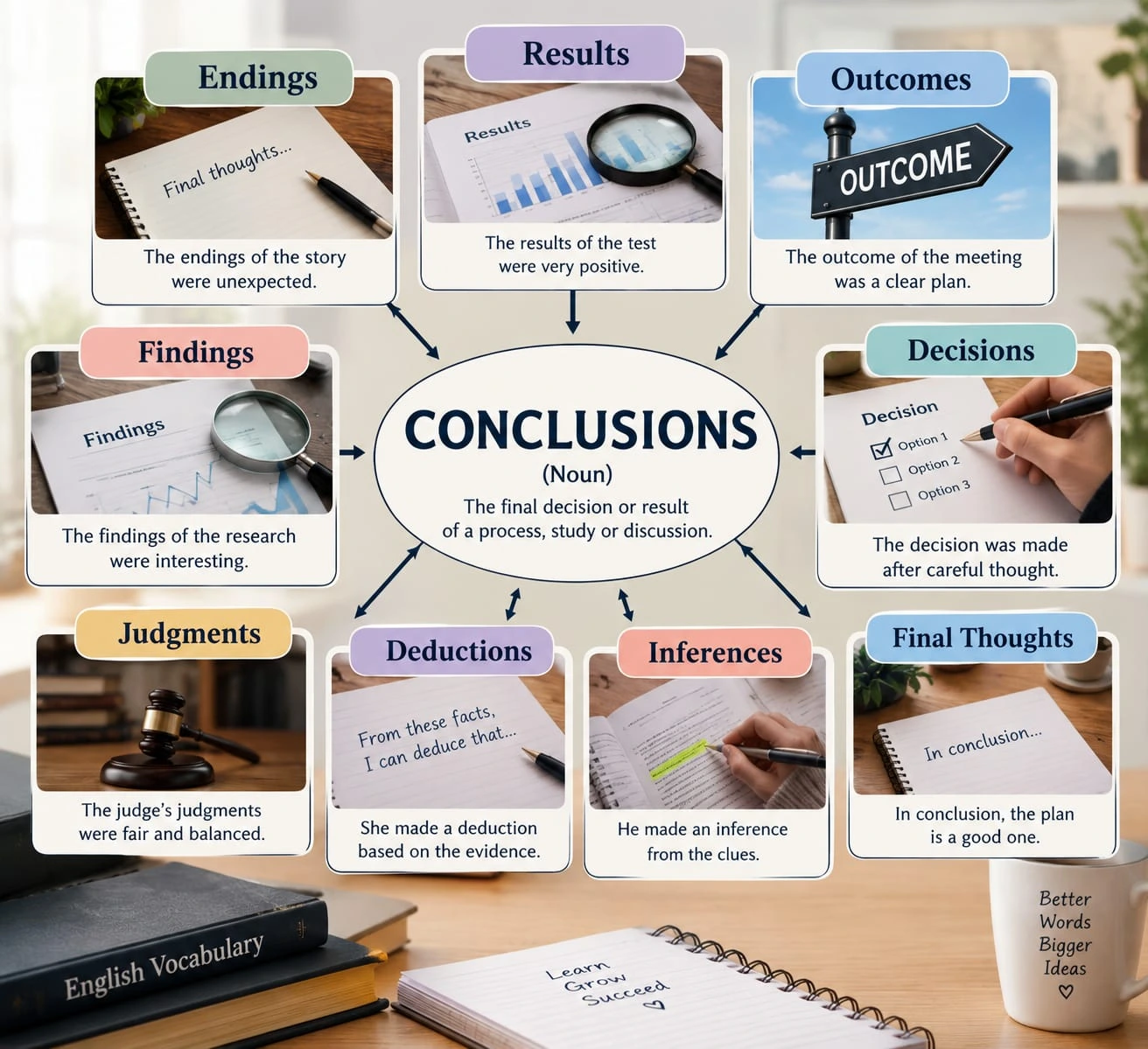
Common synonyms for conclusions include endings, summaries, outcomes, results, findings, deductions, inferences, judgments, decisions, final thoughts, closing remarks, and final statements.
Conclusions are the final parts of something, such as an essay, speech, report, or discussion. For example, after explaining your main ideas in an essay, you write a conclusion to bring those ideas together and give the reader a clear final thought. The word is common in academic writing, business reports, research, and everyday discussions.
However, using conclusions again and again can make your writing sound repetitive. Learning suitable synonyms can help English learners, students, and content writers make their writing clearer and more natural. Some alternatives refer to the end of a piece of writing, while others describe a result, finding, judgment, or idea reached after thinking about evidence.
In this guide, we will explore the meaning of conclusions, 24 useful alternatives, examples, grammar, word history, pronunciation, and the best synonym for different situations.
What Does “Conclusions” Mean?
Definition
Conclusions (noun): Final ideas, statements, results, or decisions reached after considering information or completing something.
The word conclusions is the plural form of conclusion.
Examples
- The student wrote strong conclusions for both essays.
- The researchers reached different conclusions after studying the data.
- We need to review the report before making any conclusions.
Different Meanings of “Conclusions”
The meaning can change slightly depending on context.
In writing:
A conclusion is the final section of an essay, article, report, or speech.
In research:
It is an idea or finding reached after studying evidence.
In reasoning:
It is a judgment or belief reached after thinking about facts.
In everyday use:
It can mean the final result or end of something.
Etymology of “Conclusions”
The word conclusion comes from Latin conclusio, meaning a closing, ending, or result. It is related to the Latin verb concludere, meaning “to shut together” or “to finish.”
- Old English (450–1100): The modern word was not part of Old English vocabulary in its present form. Older English used native words related to ending or finishing.
- Middle English (1100–1500): Conclusion entered English through Anglo-French and Latin influence and became associated with an ending, decision, or final statement.
- Modern English (1500–Present): The word developed its modern meanings, including the final part of writing and an idea reached through reasoning or evidence.
Pronunciation
- IPA: /kənˈkluːʒənz/
- Syllables: con-clu-sions
The stress falls on the second syllable of the singular form and remains easy to recognize in the plural.
Word Forms of “Conclusion”
The main root is related to the Latin idea of closing or finishing.
- Conclusion: noun
- Conclusions: plural noun
- Conclude: verb
- Concluded: past-tense verb / adjective
- Concluding: present participle / adjective
- Conclusive: adjective
- Conclusively: adverb
- Inconclusive: adjective
24 Useful Synonyms for Conclusions With Meaning & Examples
Not every alternative below is an exact synonym in every situation. Some are contextual alternatives that work better in specific types of writing.
1. Endings (Noun)
Meaning: The final parts of something.
Examples:
- The two stories have very different endings.
- Both essays have clear endings.
2. Summaries (Noun)
Meaning: Short versions that bring the main points together.
Examples:
- The report includes useful summaries of each section.
- Write brief summaries at the end of the chapters.
3. Outcomes (Noun)
Meaning: The results that happen after an action or event.
Examples:
- The study produced several important outcomes.
- We discussed the possible outcomes of the plan.
4. Results (Noun)
Meaning: The things that happen because of an action, test, or process.
Examples:
- The research produced surprising results.
- These results support the main argument.
5. Findings (Noun)
Meaning: Facts or information discovered through research or investigation.
Examples:
- The researchers shared their findings.
- The report presents several important findings.
6. Deductions (Noun)
Meaning: Ideas reached by using facts and logical thinking.
Examples:
- The detective made several careful deductions.
- Her deductions were based on strong evidence.
7. Inferences (Noun)
Meaning: Ideas formed from evidence rather than directly stated facts.
Examples:
- The reader can make several inferences from the passage.
- His inferences were supported by the evidence.
8. Judgments (Noun)
Meaning: Opinions or decisions formed after careful thought.
Examples:
- The panel made its final judgments.
- We should not make quick judgments.
9. Decisions (Noun)
Meaning: Choices made after considering information or options.
Examples:
- The committee announced its decisions.
- The evidence helped them make better decisions.
10. Final Thoughts (Noun Phrase)
Meaning: The last ideas or opinions expressed about a topic.
Examples:
- The speaker shared her final thoughts.
- Add your final thoughts at the end of the essay.
11. Closing Remarks (Noun Phrase)
Meaning: Statements made at the end of a speech, meeting, or discussion.
Examples:
- The manager gave a few closing remarks.
- His closing remarks thanked everyone for attending.
12. Final Statements (Noun Phrase)
Meaning: Statements given at the end of an argument, report, or discussion.
Examples:
- The lawyer prepared his final statements.
- The report ends with several final statements.
13. End Results (Noun Phrase)
Meaning: The final results of an action or process.
Examples:
- The end results were better than expected.
- We should focus on the end results.
14. Resolutions (Noun)
Meaning: Solutions or decisions reached after dealing with a problem.
Examples:
- The meeting ended with several resolutions.
- They found a peaceful resolution to the problem.
15. Verdicts (Noun)
Meaning: Formal decisions, especially in legal situations.
Examples:
- The jury reached its verdict.
- The court announced the final verdicts.
16. Judgments Reached (Noun Phrase)
Meaning: Opinions or decisions formed after considering evidence.
Examples:
- The experts reached different judgments.
- Their judgments were based on careful analysis.
17. Inferences Drawn (Noun Phrase)
Meaning: Ideas formed from available facts or evidence.
Examples:
- Several inferences were drawn from the results.
- The researchers explained the inferences drawn from the data.
18. Takeaways (Noun)
Meaning: The most important ideas that someone learns or remembers.
Examples:
- The presentation ended with three key takeaways.
- What are your main takeaways from the lesson?
19. Final Observations (Noun Phrase)
Meaning: Last comments or points based on what has been seen or studied.
Examples:
- The scientist added a few final observations.
- Her final observations were useful.
20. Closing Statements (Noun Phrase)
Meaning: Statements made at the end of a formal discussion, argument, or case.
Examples:
- The lawyers presented their closing statements.
- His closing statement was brief and clear.
21. Endpoints (Noun)
Meaning: Final points or stages of a process.
Examples:
- The researchers compared the study’s main endpoints.
- The project has several important endpoints.
22. Final Results (Noun Phrase)
Meaning: The results known at the end of a process or study.
Examples:
- The team announced the final results.
- We are waiting for the final results.
23. Final Decisions (Noun Phrase)
Meaning: Choices or judgments made after considering all relevant information.
Examples:
- The board made its final decisions.
- We will announce the final decisions tomorrow.
24. Closing Thoughts (Noun Phrase)
Meaning: The last ideas shared before finishing a discussion or piece of writing.
Examples:
- The author included some closing thoughts.
- Let me share a few closing thoughts before we finish.
Synonyms for “Conclusions” by Context
The best alternative depends on what conclusions means in your sentence.
| Context | Best Alternatives |
| Essay or article | Endings, summaries, final thoughts, closing thoughts |
| Research | Findings, results, outcomes |
| Logical reasoning | Deductions, inferences, judgments |
| Formal discussion | Closing remarks, closing statements |
| Decision-making | Decisions, judgments, resolutions |
| General ending | Endings, final results, closing thoughts |
| Presentation | Takeaways, closing remarks, final thoughts |
| Legal context | Verdicts, decisions, closing statements |
This grouping helps writers avoid choosing a word simply because it looks similar. For example, findings works well in research, while closing remarks fits a speech better.
Conclusion vs. Summary vs. Ending vs. Outcome
These words are related, but they are not always interchangeable.
| Word | Main Meaning | Common Context |
| Conclusion | Final idea or section | Essays, reasoning, reports |
| Summary | Short version of main points | Writing, reports, lessons |
| Ending | Final part of something | Stories, films, events |
| Outcome | Result of an action or event | Research, plans, situations |
For example, an essay may have a conclusion, but a story usually has an ending. A research project may have findings and outcomes.
Best Synonyms for “Conclusions” in an Essay
If you are writing an essay, the most natural alternatives are:
- Final thoughts
- Closing thoughts
- Final statements
- Summary
- Closing section
- Ending
However, conclusion is usually the clearest and most standard word for the final section of an academic essay.
Instead of replacing it every time, you can vary your wording naturally within the article or essay.
Common Usage Tips
Use “findings” for research.
Research papers often present findings rather than simply “conclusions.”
Use “outcomes” for results.
When discussing what happened after an action or project, outcomes is often more precise.
Use “closing remarks” for speeches.
This phrase sounds natural in meetings, presentations, and formal talks.
Use “deductions” for logical reasoning.
When someone reaches an idea by using facts, deductions may be more accurate.
Use “endings” for stories.
For books, films, and stories, ending is usually more natural than conclusion.
Antonyms of “Conclusions”
There is no single perfect antonym for conclusions because the word has several meanings. Depending on context, useful opposites include:
Beginnings (Noun)
The starting points of something.
Openings (Noun)
The first parts of a speech, story, event, or discussion.
Introductions (Noun)
The opening sections that present a topic or subject.
Questions (Noun)
Things that still need answers or explanation.
Uncertainty (Noun)
A state of not knowing what is true or what will happen.
Premises (Noun)
Statements or facts used as the starting point for reasoning.
Short Questions and Answers
What is another word for conclusions?
Common alternatives include endings, summaries, findings, outcomes, results, deductions, final thoughts, and closing remarks.
What is a synonym for conclusion in an essay?
Final thoughts, closing thoughts, summary, and final statement can work in some contexts. However, conclusion remains the most standard academic term.
Can “ending” replace “conclusion”?
Sometimes. Ending usually refers to the final part of a story, event, or process, while conclusion can also mean a final idea or judgment.
What is the difference between a conclusion and a summary?
A summary repeats the main points in a short form. A conclusion usually brings the discussion to a final idea, judgment, or closing point.
What is another word for conclusion in research?
Depending on the sentence, findings, results, outcomes, deductions, or inferences may be suitable.
Are “results” and “conclusions” the same?
No. Results are the information or effects produced by a study or action. A conclusion is an idea or judgment based on those results.
Which synonym for conclusions is best?
There is no single best synonym. Choose the word that matches your context. Findings suits research, final thoughts suit writing, and closing remarks suit speeches.
Conclusion
Learning synonyms for conclusions can make your English more flexible and precise. Words such as endings, summaries, findings, outcomes, deductions, final thoughts, and closing remarks may look similar, but they do not always have the same meaning. The right choice depends on the context and the type of writing you are doing. Students can use these alternatives to make essays clearer, while writers can use them to avoid unnecessary repetition. English learners can also build confidence by learning how related words differ. Instead of memorizing every synonym, focus on learning a few useful words and using them in real sentences. Regular vocabulary practice will help you choose stronger and more natural words over time.
Synonyms for Nomadic: 20 Powerful Alternatives

I am a language content specialist focused on English synonyms, vocabulary development, and word meanings. I create clear, practical guides that help readers choose the right words and communicate with confidence.