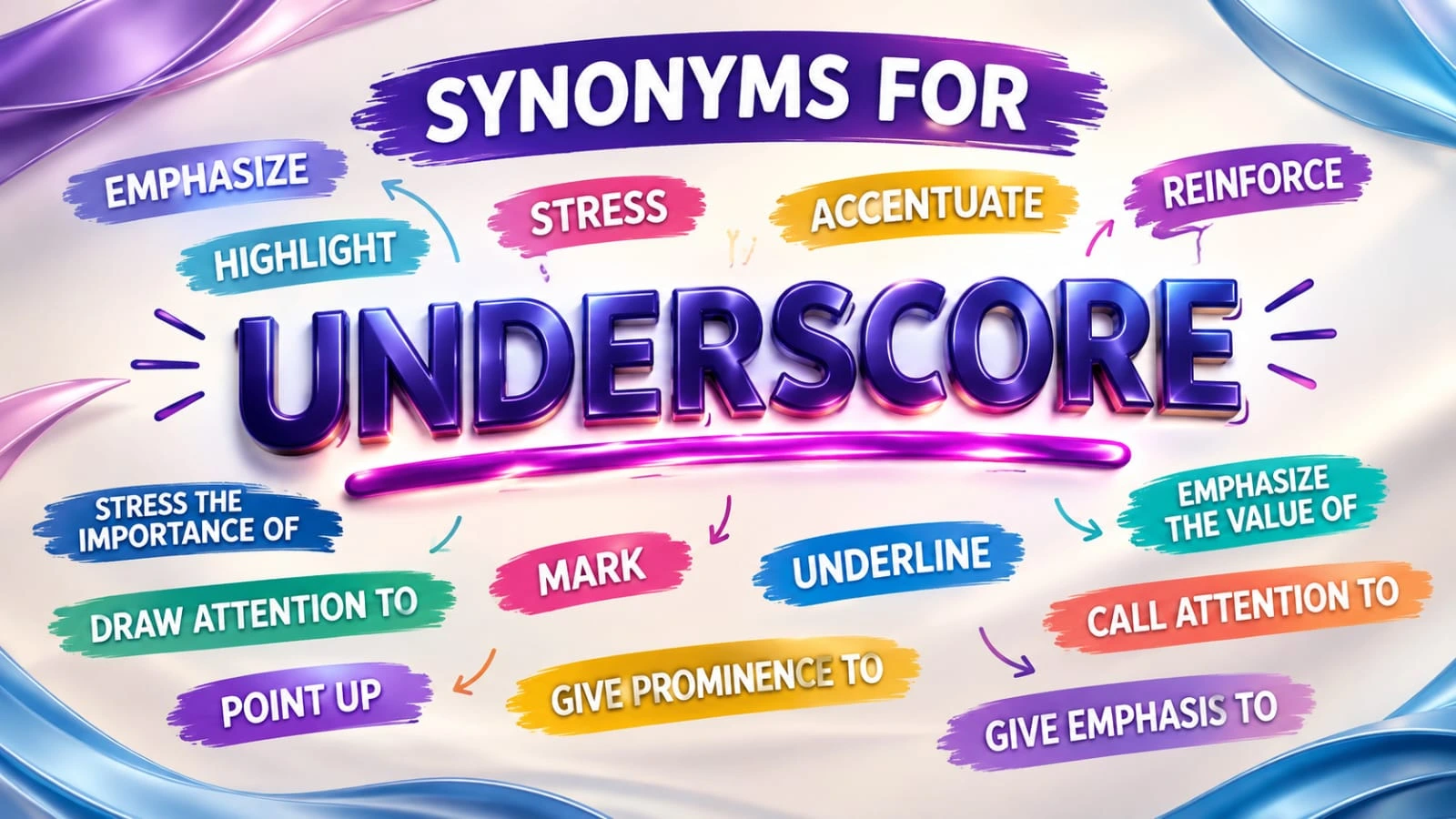
Discover 30 synonyms for underscore, with clear meanings and examples to help you emphasize ideas and improve your English writing.
Underscore means to emphasize, stress, or show that something is important. It can also refer to the line placed beneath text, especially in writing or computing. I often see this word in articles, reports, and academic writing when a writer wants to point out an important fact. For example, a sentence may say that new results “underscore the need for better planning.” Learning synonyms for underscore helps English learners and content writers avoid repeating the same word and choose language that fits the exact context. Some alternatives sound formal, while others are simple and direct. In this article, we will explore the meaning, pronunciation, history, grammar, and semantic categories of underscore, followed by 30 useful synonyms and contextual alternatives with clear examples.
Meaning of Underscore
Definition
Underscore (verb/noun): As a verb, underscore means to emphasize or show that something is important. As a noun, it can mean a line drawn beneath something or the character _ used in writing and computing.
Examples
- The study underscores the importance of regular exercise.
- These results underscore the need for careful planning.
Connotative Meaning
Connotation: the feeling or idea that a word suggests beyond its basic meaning.
- Positive tone: Can suggest that an important fact is being clearly recognized.
- Negative tone: May suggest that a serious problem or concern needs attention.
- Neutral tone: Simply indicates that something is being emphasized or highlighted.
Etymology
The word underscore combines under and score. Its original literal sense was connected with marking or scoring beneath written words.
- Old English (450–1100): Under was an Old English word meaning beneath or below. Score has Germanic roots connected with cutting or making a mark.
- Middle English (1100–1500): The parts developed into forms related to marking, cutting, and placing something underneath.
- Modern English (1500–Present): Underscore developed as a verb meaning to mark beneath written text and later gained its common figurative meaning, “to emphasize or stress.” It also became the name of the
_character.
Pronunciation (IPA)
underscore (/ˌʌndərˈskɔːr/)
- IPA: /ˌʌndərˈskɔːr/
- Syllables: un-der-score
Affixation Pattern of Underscore
- Root: score
- Prefix: under-
- Suffix: None
- Word formations:
- underscore: verb/noun
- underscored: verb/adjective
- underscoring: noun/verb form
- underscores: verb/noun plural form
30 Synonyms of Underscore With Meaning & Examples
1. Emphasize (Verb)
Meaning: To give special importance or attention to something.
Examples:
- The teacher emphasized the value of practice.
- The report emphasizes the need for reform.
2. Stress (Verb)
Meaning: To state clearly that something is especially important.
Examples:
- The doctor stressed the importance of rest.
- She stressed the need for accurate data.
3. Highlight (Verb)
Meaning: To draw attention to an important point.
Examples:
- The article highlights several major problems.
- The results highlight the value of teamwork.
4. Accentuate (Verb)
Meaning: To make something more noticeable or important.
Examples:
- The design accentuates the building’s modern features.
- Her speech accentuated the seriousness of the issue.
5. Reinforce (Verb)
Meaning: To make an idea, message, or point stronger.
Examples:
- The example reinforces the main argument.
- The findings reinforce the need for change.
6. Spotlight (Verb)
Meaning: To give special public attention to something.
Examples:
- The campaign spotlights environmental concerns.
- The documentary spotlights local artists.
7. Point Out (Phrasal Verb)
Meaning: To draw someone’s attention to a particular fact or detail.
Examples:
- The teacher pointed out the common mistake.
- She pointed out an important difference.
8. Draw Attention To (Phrase)
Meaning: To make people notice something.
Examples:
- The study draws attention to workplace safety.
- The article draws attention to rising costs.
9. Call Attention To (Phrase)
Meaning: To deliberately make something noticeable.
Examples:
- The report calls attention to the growing problem.
- Her speech called attention to unfair treatment.
10. Bring to Light (Phrase)
Meaning: To reveal or make an important fact known.
Examples:
- The investigation brought the problem to light.
- The research brought several issues to light.
11. Stress the Importance of (Phrase)
Meaning: To clearly show that something matters.
Examples:
- The teacher stressed the importance of reading.
- The report stresses the importance of planning.
12. Underscore the Significance of (Phrase)
Meaning: To show why something is important or meaningful.
Examples:
- The results underscore the significance of early action.
- The event underscored the significance of public support.
13. Magnify (Verb)
Meaning: To make an issue or feature appear more important or noticeable.
Examples:
- Social media can magnify small problems.
- The image magnifies the smallest details.
14. Intensify (Verb)
Meaning: To make something stronger or more noticeable.
Examples:
- The new evidence intensified concerns about safety.
- The announcement intensified public interest.
15. Elevate (Verb)
Meaning: To raise something to a higher level of importance or attention.
Examples:
- The award elevated her work in the public eye.
- The discussion elevated education as a major concern.
16. Feature (Verb)
Meaning: To give something a prominent place or position.
Examples:
- The website features local businesses.
- The report features several successful projects.
17. Showcase (Verb)
Meaning: To display something prominently so its qualities can be noticed.
Examples:
- The exhibition showcases modern artwork.
- The event showcases young talent.
18. Illustrate (Verb)
Meaning: To make an idea clear by using an example or evidence.
Examples:
- The story illustrates the dangers of poor planning.
- These figures illustrate the scale of the problem.
19. Demonstrate (Verb)
Meaning: To show something clearly through evidence or action.
Examples:
- The results demonstrate the value of preparation.
- Her work demonstrates strong leadership skills.
20. Reveal (Verb)
Meaning: To make something previously unknown or unnoticed known.
Examples:
- The survey revealed a major concern.
- The results reveal a clear pattern.
21. Indicate (Verb)
Meaning: To show or suggest that something is true.
Examples:
- The figures indicate steady growth.
- The results indicate a need for further research.
22. Show (Verb)
Meaning: To make a fact or idea clear or visible.
Examples:
- The results show the value of regular practice.
- These examples show why the rule matters.
23. Mark (Verb)
Meaning: To identify or signal something as important or significant.
Examples:
- The event marked a major change.
- This decision marked a new stage in the project.
24. Emblemize (Verb)
Meaning: To represent an idea or quality clearly through a person or thing.
Examples:
- The building emblemizes the city’s cultural history.
- The design emblemizes the company’s values.
25. Stress the Point (Phrase)
Meaning: To repeat or strengthen an important idea.
Examples:
- She used an example to stress the point.
- The speaker repeated the fact to stress the point.
26. Drive Home (Phrasal Verb)
Meaning: To make an idea very clear and memorable.
Examples:
- The story drives home the need for caution.
- The example drove home the importance of preparation.
27. Underscore Further (Phrase)
Meaning: To provide additional emphasis to an already important point.
Examples:
- The new evidence underscores further the need for action.
- These results underscore further concerns about the plan.
28. Confirm (Verb)
Meaning: To provide evidence that supports or strengthens an existing idea.
Examples:
- The new data confirm the earlier findings.
- The survey confirmed the importance of customer feedback.
29. Support (Verb)
Meaning: To provide evidence or reasons that strengthen an idea.
Examples:
- The evidence supports the main argument.
- These results support the proposed theory.
30. Emphasize Again (Phrase)
Meaning: To stress an idea that has already been mentioned.
Examples:
- The speaker emphasized again the need for patience.
- The report emphasizes again the importance of safety.
Prototype Meaning
The most typical meaning of underscore is to emphasize or stress an important idea. When readers see this word in formal writing, they usually understand that the writer is drawing attention to a fact, result, problem, or need. For example, “The findings underscore the need for action” means that the findings make the need for action especially clear.
Prototype Categorization
The 30 alternatives can be grouped by their core meaning:
- Direct emphasis: emphasize, stress, highlight, accentuate, spotlight: best when you want to clearly focus attention on an important point.
- Strengthening an idea: reinforce, intensify, elevate, confirm, support: useful when evidence or information makes an existing point stronger.
- Drawing attention: point out, draw attention to, call attention to, feature, showcase: suitable when your goal is to make something noticeable.
- Showing or explaining: illustrate, demonstrate, indicate, show, reveal: useful when evidence helps make a fact or idea clear.
- Strong emphasis: drive home, stress the point, magnify: useful when you want to show that an idea has a powerful or memorable effect.
- Formal expressions: underscore the significance of, stress the importance of, bring to light: useful in academic, professional, and formal writing.
This grouping helps writers choose a synonym based on meaning and context, rather than replacing underscore with a random similar word.
Antonyms of Underscore
1. Downplay (Verb)
To make something seem less important than it really is.
2. Minimize (Verb)
To reduce the importance or seriousness of something.
3. Ignore (Verb)
To give no attention to something.
4. Overlook (Verb)
To fail to notice or consider something.
5. Conceal (Verb)
To keep something hidden from view or knowledge.
6. Suppress (Verb)
To prevent something from being expressed, revealed, or noticed.
Short Questions and Answers
What does underscore mean?
Underscore usually means to emphasize, stress, or show that something is important.
When should underscore be used?
Use underscore when you want to emphasize a fact, result, need, problem, or idea. It is especially common in formal and academic writing.
Is underscore positive or negative?
Underscore is neutral. Its tone depends on what is being emphasized. It can emphasize a success, a benefit, a problem, or a concern.
How is it different from similar words?
Emphasize and stress are close general alternatives. Highlight often focuses attention on a particular point, while reinforce suggests making an existing idea stronger. Indicate is weaker because it usually means simply showing or suggesting something.
Conclusion
Learning underscore and its synonyms can make your English more flexible and precise. Words such as emphasize, stress, highlight, and accentuate help you avoid repeating the same expression. Other alternatives, such as reinforce, demonstrate, and indicate, work better when you want to show evidence or strengthen an idea. The best synonym depends on the sentence, tone, and meaning you want to express. Understanding these differences can improve both academic and everyday writing. It can also make your speaking sound more natural because you will have more ways to express importance and attention. Try learning a few alternatives each day and use them in your own sentences. With regular practice, you can build a stronger vocabulary and communicate your ideas with greater confidence.
Synonyms for Conclusions: 24 Better Words to Use

I’m Daniel Carter, specialize in helping readers discover synonyms, expand their vocabulary, and choose the perfect word with confidence. My content helps readers improve their English, avoid common mistakes, and write with confidence. My goal is to provide accurate, reliable, and easy-to-understand language resources