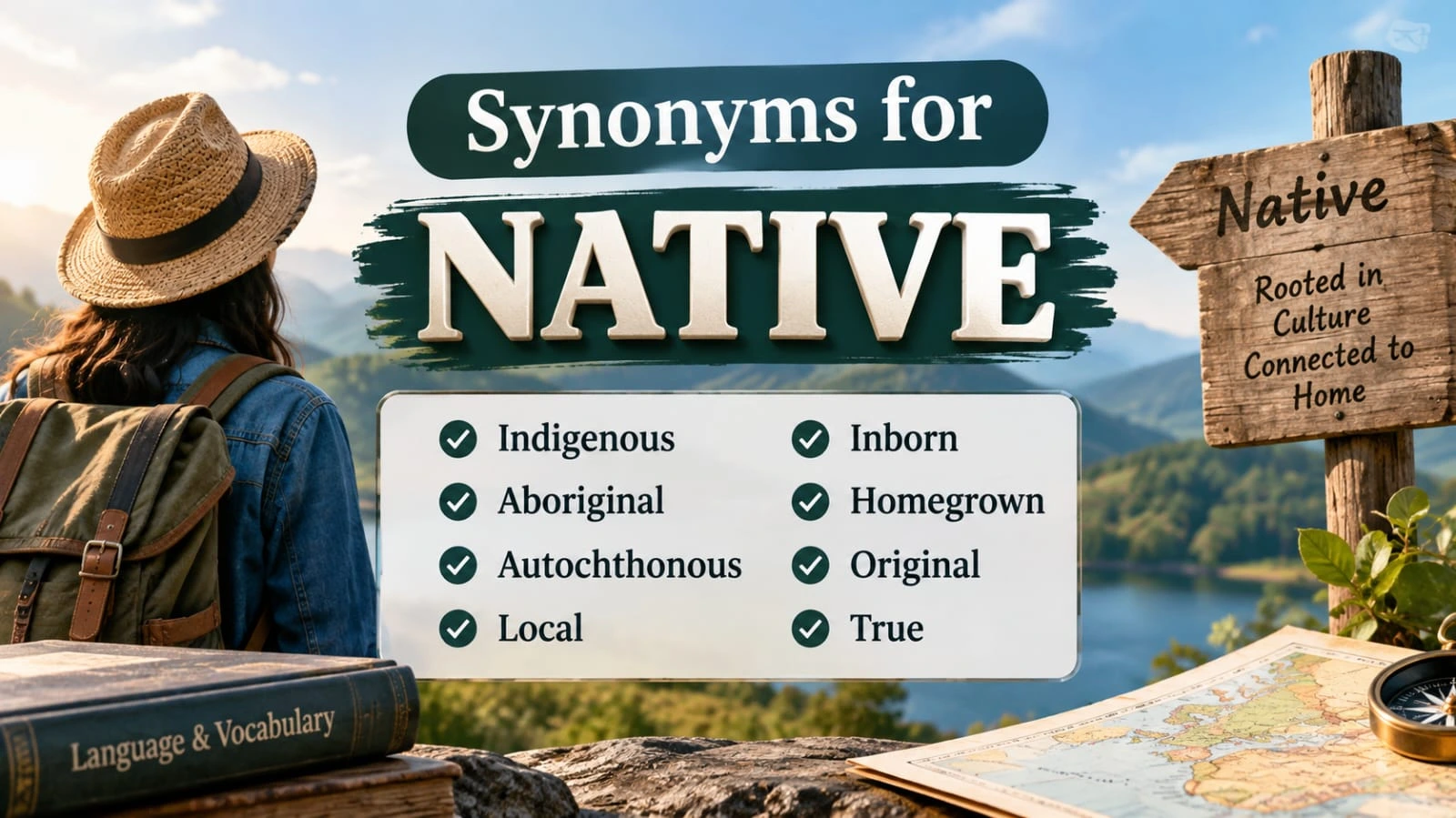
synonyms for native, including indigenous, local, endemic, aboriginal, innate, natural, and homegrown, with clear meanings and examples.
Native is a common English word used to describe someone born in a particular place or something that naturally belongs to a place. For example, a person born in Lahore may say, “I am a native of Lahore.” The word is also used for plants, animals, languages, skills, and ideas. Because native has several meanings, using the right synonym can make your writing clearer and more precise. Learning synonyms helps English learners build stronger vocabulary and helps content writers avoid using the same word again and again. In this guide, you will learn the meaning of native, its synonyms, examples, grammar, pronunciation, word history, and semantic categories. You will also see how different alternatives fit different contexts, from people and places to natural qualities and language.
Meaning of Native
Definition
Native (Adjective/Noun):
Native means belonging to a particular place by birth, origin, or natural development. As a noun, it can refer to a person born in a particular place.
Examples
- She is a native speaker of English.
- This plant is native to South Asia.
Connotative Meaning
Connotation: The feeling or idea that a word suggests beyond its basic meaning.
- Positive tone: Native can suggest belonging, authenticity, natural origin, or a strong connection to a place.
- Negative tone: In some historical or social contexts, the noun native can sound outdated or insensitive when used for Indigenous people.
- Neutral tone: In phrases such as native language, native species, or native to Canada, it is usually neutral and factual.
Etymology
The word native entered English in the late 14th century from Old French natif, meaning “born in” or “natural.” It came directly from Latin nativus, meaning “innate” or “produced by birth,” from nasci, meaning “to be born.”
Old English (450–1100)
The modern word native was not directly used in Old English. However, English already had native Germanic words connected with birth, family, origin, and natural belonging.
Middle English (1100–1500)
In the late 14th century, natif appeared in English with meanings connected to being natural, inborn, hereditary, or connected to birth. By the early 15th century, native was used for people born in a particular place and for things naturally belonging to a region.
Modern English (1500–Present)
Modern English expanded native to describe people, plants, animals, languages, minerals, and other things that originate naturally in a place. The word can also describe qualities that exist from birth, such as a native ability.
Pronunciation (IPA)
- IPA: /ˈneɪ.tɪv/
- Syllables: na-tive
Affixation Pattern of Native
- Root: nat- related to Latin nasci, “to be born”
- Prefix: None
- Suffix: -ive forms adjectives connected with a quality or relation
- Word formations:
- native: adjective/noun
- natively: adverb
- nativeness: noun
- nativity: noun
- nativism: noun
- nativist: noun/adjective
- nativize: verb
The historical root is connected with the Latin idea of birth and origin. Nativeness is recorded from the 1630s, while related forms such as nativism and nativize developed later.
20 Synonyms of Native With Meaning & Examples
1. Indigenous (Adjective)
Meaning: Naturally originating in a particular place.
Examples:
- These trees are indigenous to the region.
- The island has many indigenous plants.
2. Aboriginal (Adjective/Noun)
Meaning: Existing in a place from the earliest known period or referring to its original inhabitants.
Examples:
- The museum displays Aboriginal art.
- These plants are aboriginal to the area.
3. Local (Adjective/Noun)
Meaning: Belonging to or coming from a particular area.
Examples:
- She is a local resident.
- We bought local fruit from the market.
4. Autochthonous (Adjective)
Meaning: Originating in the place where it is found.
Examples:
- The region has several autochthonous species.
- Researchers studied autochthonous traditions.
5. Endemic (Adjective)
Meaning: Naturally found only in a particular place or region.
Examples:
- This bird is endemic to the island.
- The forest contains several endemic species.
6. Original (Adjective)
Meaning: Existing first or belonging to the earliest form or source.
Examples:
- These are the original inhabitants of the area.
- The original species has survived for centuries.
7. Indigenous-born (Adjective)
Meaning: Born in and naturally belonging to a particular region.
Examples:
- The program supports indigenous-born residents.
- Indigenous-born communities have preserved local traditions.
8. Homegrown (Adjective)
Meaning: Developed or produced within one’s own country or community.
Examples:
- The country has a strong homegrown music scene.
- The company promotes homegrown talent.
9. Domestic (Adjective)
Meaning: Belonging to or produced within a particular country.
Examples:
- The company uses domestic materials.
- Domestic products are popular with local buyers.
10. Natural (Adjective)
Meaning: Existing or developing without being made artificially.
Examples:
- She has a natural talent for languages.
- The area has natural vegetation.
11. Inborn (Adjective)
Meaning: Present from birth rather than learned.
Examples:
- He has an inborn ability to communicate.
- Her inborn talent became clear early.
12. Innate (Adjective)
Meaning: Existing naturally from birth.
Examples:
- She has an innate sense of rhythm.
- Curiosity is an innate human quality.
13. Inherent (Adjective)
Meaning: Naturally existing as a basic part of something.
Examples:
- Risk is inherent in the activity.
- The design has an inherent strength.
14. Born (Adjective)
Meaning: Having been brought into the world in a particular place or condition.
Examples:
- He is a London-born writer.
- She is a Pakistan-born researcher.
15. Resident (Noun/Adjective)
Meaning: A person who lives in a particular place.
Examples:
- She is a resident of the city.
- Local residents welcomed the visitors.
16. Country-born (Adjective)
Meaning: Born in a particular country.
Examples:
- He is a country-born citizen.
- The study focused on country-born children.
17. Vernacular (Adjective/Noun)
Meaning: The language or speech naturally used by people in a particular place or community.
Examples:
- The writer uses vernacular expressions.
- The local vernacular is still widely spoken.
18. Homebred (Adjective)
Meaning: Produced or developed within one’s own home, country, or group.
Examples:
- The team relies on homebred talent.
- The farm raises homebred animals.
19. Naturalized (Adjective)
Meaning: Given legal citizenship in a country after being born elsewhere.
Examples:
- He is a naturalized citizen.
- The naturalized player has lived there for many years.
20. Nativist (Adjective/Noun)
Meaning: Relating to the belief that native-born people should receive preference over immigrants.
Examples:
- The historian studied nativist movements.
- The book discusses nativist political ideas.
Note: These synonyms are not interchangeable in every sentence. Indigenous, local, endemic, innate, and naturalized each have different meanings and should be chosen according to context.
Prototype Meaning
The most typical meaning of native is “belonging naturally to a particular place.” When people hear the word, they often think of a person who was born in a place, a plant or animal that naturally grows there, or a language learned from birth. The central idea is birth, origin, or natural belonging.
Prototype Categorization
The 20 synonyms can be grouped into several semantic categories:
- Place and origin: indigenous, aboriginal, local, autochthonous, original, best for people, cultures, plants, animals, and things connected to a particular place.
- Species and nature: endemic, natural, indigenous useful when discussing plants, animals, ecosystems, and natural features.
- Birth and natural qualities: inborn, innate, inherent, born best when native means something present from birth or naturally possessed.
- Country and community: homegrown, domestic, homebred, resident, useful for people, products, businesses, talent, and local communities.
- Language and speech: vernacular, useful when discussing the everyday language of a local community.
- Citizenship and social identity: naturalized, nativist . these have specialized meanings and should not be treated as direct replacements in ordinary sentences.
This categorization helps writers select a synonym based on meaning instead of simply replacing native with any similar-looking word.
Antonyms of Native
1. Foreign (Adjective)
Meaning: Coming from another country or place.
2. Non-native (Adjective)
Meaning: Not originally from a particular place.
3. Imported (Adjective)
Meaning: Brought into a country from another country.
4. Alien (Adjective/Noun)
Meaning: Coming from or belonging to another place; in some contexts, the word can sound formal or negative.
5. Unfamiliar(Adjective)
Meaning: Coming from a distant or unfamiliar place.
6. Introduced (Adjective)
Meaning: Brought into a place where a species or thing did not originally occur.
7. Artificial (Adjective)
Meaning: Made by people rather than occurring naturally.
8. Acquired (Adjective)
Meaning: Developed or learned after birth rather than being present naturally.
Short Questions and Answers
What does native mean?
Native means belonging to a particular place by birth, origin, or natural development.
When should native be used?
Use native when you want to describe a person, plant, animal, language, or quality that naturally belongs to a place or exists from birth.
Is native positive or negative?
Native is usually neutral. Its tone depends on context. It can suggest natural belonging or authenticity, but some uses of the noun can sound outdated or insensitive.
How is it different from similar words?
Native is a broad word. Indigenous focuses on original inhabitants or naturally occurring things, endemic often means limited to a specific region, and innate refers to qualities present from birth.
Bilkul. “Synonyms for native” article ke liye ek opposite/antonym FAQ add kar sakti hain:
What is the opposite of native?
The most common opposite of native is foreign or non-native. For example, a native plant grows naturally in a region, while a foreign or non-native plant comes from another region.
Conclusion
Learning native and its synonyms can greatly improve your English vocabulary. Words such as indigenous, local, endemic, innate, and homegrown help you express specific ideas instead of using the same word repeatedly. They also make writing clearer and more natural. However, remember that synonyms often have slightly different meanings, so the best choice depends on the sentence and context. Understanding these differences can strengthen both your speaking and writing skills. It can also help English learners communicate with more confidence and precision. Try learning a few new synonyms each day and use them in your own sentences. With regular practice, your vocabulary will become richer, more flexible, and more effective.
Synonyms for Quaint: 23 Charming Words to Know

I’m Daniel Carter, specialize in helping readers discover synonyms, expand their vocabulary, and choose the perfect word with confidence. My content helps readers improve their English, avoid common mistakes, and write with confidence. My goal is to provide accurate, reliable, and easy-to-understand language resources