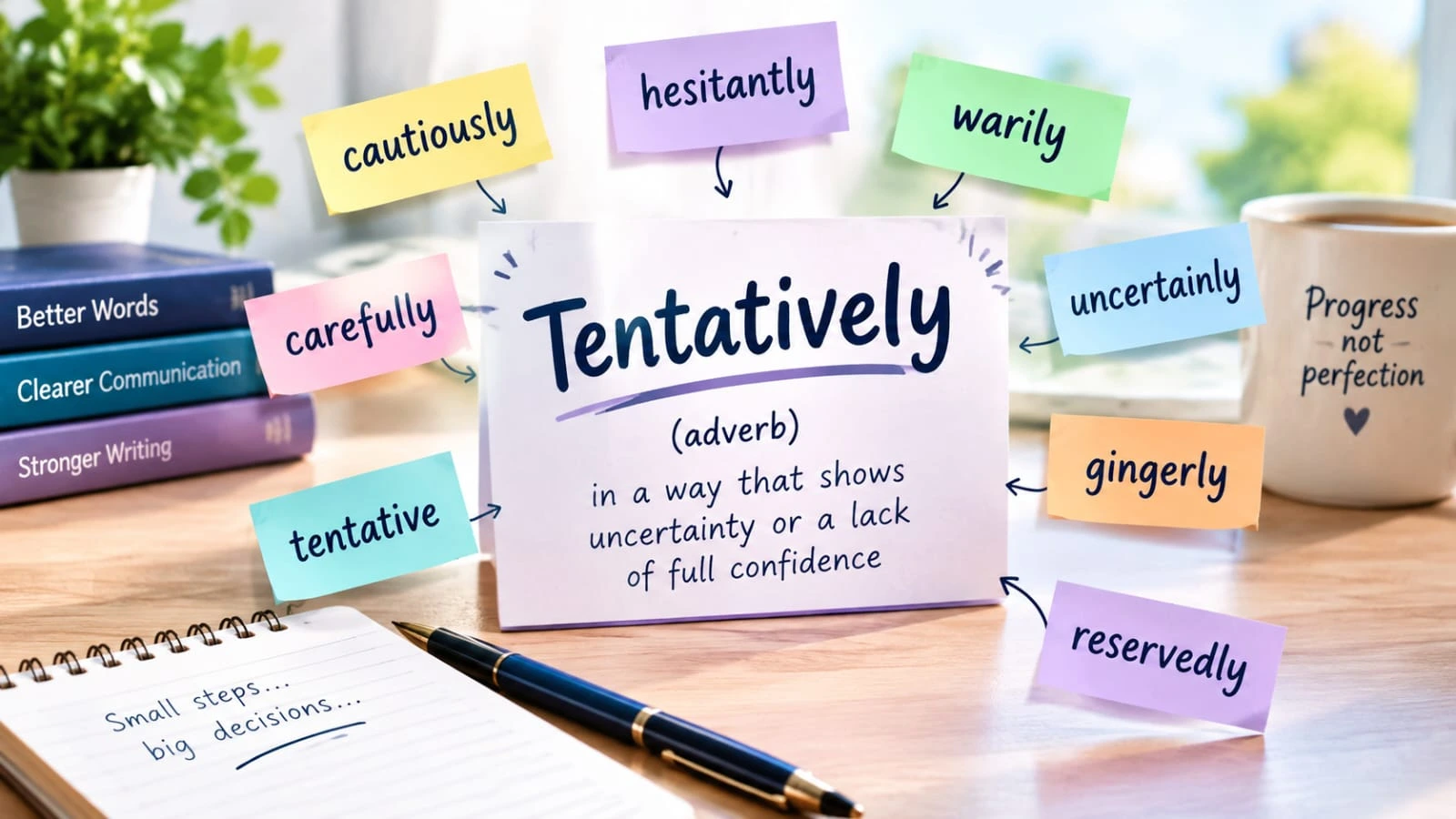
Synonyms for tentatively include cautiously, hesitantly, uncertainly, provisionally, conditionally, experimentally, doubtfully, and warily.
Tentatively means doing something with caution because you are not fully sure about the result. For example, you might tentatively accept a job offer while waiting for more details, or tentatively plan a trip before confirming the dates. The word is common in everyday speech, business, academic writing, and professional communication because it helps show uncertainty without completely rejecting an idea. Learning synonyms for tentatively can help English learners express different levels of doubt, caution, and uncertainty. It also helps writers avoid repeating the same word in articles, emails, and essays. In this guide, we will explore the meaning of tentatively, its pronunciation, history, grammar, word formation, and 30 useful synonyms. We will also look at examples, semantic categories, antonyms, and common usage questions.
Meaning of Tentatively
Definition
Tentatively (Adverb):
In a careful or uncertain way because something has not yet been confirmed or decided.
Examples
- We tentatively agreed to meet next Friday.
- She tentatively accepted the proposal while waiting for more information.
Connotative Meaning
Connotation (the feeling or idea a word suggests beyond its basic meaning):
- Positive tone: It can suggest careful thinking and openness.
- Negative tone: It may suggest doubt, hesitation, or a lack of confidence.
- Neutral tone: It can simply show that something is not final.
Etymology
Tentatively comes from tentative, which is related to the Latin verb tentare, meaning “to try” or “to test.”
- Old English (450–1100): The modern word did not exist in Old English in its current form.
- Middle English (1100–1500): Related Latin-derived forms entered English through French and scholarly usage.
- Modern English (1500–Present): Tentative developed the sense of something done provisionally or without final certainty. Tentatively became the adverbial form meaning “in a tentative manner.”
Pronunciation (IPA)
- IPA: /ˈtɛn.tə.tɪv.li/
- Syllables: ten-ta-tive-ly
Affixation Pattern of Tentatively
- Root: tent
- Prefix: none
- Suffix: -ative, -ly
- Word formations:
- tentative: adjective
- tentatively: adverb
- tentativeness: noun
- tentative decision: noun phrase
- tentative agreement: noun phrase
30 Synonyms of Tentatively With Meaning & Examples
1. Cautiously (Adverb)
Meaning: In a careful way because there may be risks or problems.
Examples:
- She cautiously accepted the offer.
- He cautiously approached the unfamiliar situation.
2. Hesitantly (Adverb)
Meaning: In a way that shows uncertainty or reluctance.
Examples:
- He hesitantly raised his hand.
- She hesitantly agreed to the plan.
3. Uncertainly (Adverb)
Meaning: In a way that shows a lack of certainty.
Examples:
- She uncertainly answered the question.
- He uncertainly suggested another option.
4. Provisionally (Adverb)
Meaning: For now, until a final decision is made.
Examples:
- The meeting was provisionally scheduled for Monday.
- She was provisionally offered the position.
5. Experimentally (Adverb)
Meaning: In a way that involves trying something to see what happens.
Examples:
- The team experimentally introduced the new method.
- We experimentally tested the design.
6. Warily (Adverb)
Meaning: In a careful way because you are aware of possible danger or problems.
Examples:
- He warily accepted the unusual offer.
- She warily entered the unfamiliar room.
7. Doubtfully (Adverb)
Meaning: In a way that shows doubt or disbelief.
Examples:
- She doubtfully looked at the figures.
- He doubtfully considered the explanation.
8. Reluctantly (Adverb)
Meaning: In a way that shows unwillingness.
Examples:
- He reluctantly accepted the decision.
- She reluctantly agreed to help.
9. Timidly (Adverb)
Meaning: In a shy or lacking-confidence way.
Examples:
- The student timidly offered an answer.
- She timidly suggested a new idea.
10. Guardedly (Adverb)
Meaning: In a careful way that avoids revealing too much.
Examples:
- He guardedly responded to the question.
- She guardedly discussed the sensitive issue.
11. Circumspectly (Adverb)
Meaning: In a careful way that considers possible consequences.
Examples:
- The manager circumspectly reviewed the proposal.
- She circumspectly responded to the criticism.
12. Cautiously Optimistically (Adverbial Phrase)
Meaning: With hope while still being careful about the possible outcome.
Examples:
- The company cautiously optimistically viewed the results.
- We are cautiously optimistic about the project’s future.
13. Indecisively (Adverb)
Meaning: In a way that shows difficulty making a decision.
Examples:
- He indecisively looked between the two choices.
- She indecisively considered both proposals.
14. Warily (Adverb)
Meaning: With careful attention because something may be risky.
Examples:
- The workers warily approached the damaged structure.
- She warily accepted his suggestion.
15. Softly (Adverb)
Meaning: In a gentle or restrained manner.
Examples:
- He softly suggested changing the schedule.
- She softly introduced the idea.
16. Uncommittedly (Adverb)
Meaning: Without making a firm decision or promise.
Examples:
- He uncommittedly discussed the possible changes.
- She uncommittedly responded to the proposal.
17. Tentatively (Adverb)
Meaning: In a way that is not final or fully certain.
Examples:
- They tentatively planned the event for June.
- She tentatively agreed with the suggestion.
18. Provisionally (Adverb)
Meaning: Temporarily or subject to later confirmation.
Examples:
- The date was provisionally selected.
- He was provisionally appointed to the role.
19. Conditionally (Adverb)
Meaning: Only if certain requirements or conditions are met.
Examples:
- The offer was conditionally accepted.
- They conditionally approved the proposal.
20. Speculatively (Adverb)
Meaning: Based on guesses rather than confirmed facts.
Examples:
- The article speculatively discussed future changes.
- Analysts speculatively predicted the company’s next move.
21. Doubtingly (Adverb)
Meaning: In a way that expresses doubt.
Examples:
- She doubtingly questioned the explanation.
- He doubtingly examined the claim.
22. Gingerly (Adverb)
Meaning: With extreme care because something may be delicate or risky.
Examples:
- He gingerly touched the damaged object.
- She gingerly raised the difficult subject.
23. Delicately (Adverb)
Meaning: In a careful and sensitive way.
Examples:
- He delicately raised the issue.
- She delicately handled the disagreement.
24. Mindfully (Adverb)
Meaning: With careful attention and awareness.
Examples:
- She mindfully considered the consequences.
- He mindfully reviewed each option.
25. Prudently (Adverb)
Meaning: In a wise and careful way.
Examples:
- The company prudently avoided unnecessary spending.
- He prudently waited for more evidence.
26. Deliberately (Adverb)
Meaning: In a carefully considered way.
Examples:
- She deliberately waited before responding.
- He deliberately considered every option.
27. Reservedly (Adverb)
Meaning: In a restrained way that does not show strong feelings.
Examples:
- He reservedly supported the proposal.
- She reservedly welcomed the announcement.
28. Guardedly (Adverb)
Meaning: With caution and limited openness.
Examples:
- The politician guardedly answered the question.
- She guardedly discussed the negotiations.
29. Temporarily (Adverb)
Meaning: For a limited time rather than permanently.
Examples:
- The office was temporarily closed.
- They temporarily postponed the meeting.
30. On Trial (Adverbial Phrase)
Meaning: As a test or experiment before making a final choice.
Examples:
- The company introduced the software on trial.
- We used the new system on trial before adopting it fully.
Note: Some alternatives above are contextual rather than exact replacements. For example, provisionally, hesitantly, and cautiously are often closer synonyms than temporarily or deliberately.
Prototype Meaning
The most typical meaning of tentatively is “in an uncertain or provisional way.” When people hear this word, they usually imagine someone making a plan, suggestion, agreement, or decision that is not final yet. It often shows that a person is willing to proceed but wants to wait for confirmation before treating something as certain.
Prototype Categorization
- Caution: cautiously, warily, prudently, gingerly, circumspectly
- Hesitation: hesitantly, reluctantly, timidly, indecisively
- Uncertainty: uncertainly, doubtfully, doubtingly, speculatively
- Temporary or non-final decisions: provisionally, conditionally, temporarily, uncommittedly
- Careful consideration: deliberately, mindfully, delicately, guardedly
- Testing or trying: experimentally, on trial
This grouping helps writers select a synonym based on the exact idea they want to express. Hesitantly focuses on personal doubt, while provisionally focuses on a decision that is not final.
Antonyms of Tentatively
1. Certainly (Adverb)
Meaning: In a way that shows complete confidence or certainty.
2. Confidently (Adverb)
Meaning: In a way that shows strong belief in an outcome.
3. Decisively (Adverb)
Meaning: In a firm way without hesitation.
4. Definitely (Adverb)
Meaning: Without doubt or uncertainty.
5. Firmly (Adverb)
Meaning: In a strong and definite way.
6. Absolutely (Adverb)
Meaning: Completely and without qualification.
Short Questions and Answers
What does tentatively mean?
Tentatively means doing something carefully or uncertainly because it is not final or fully confirmed.
When should tentatively be used?
Use tentatively when describing a plan, decision, suggestion, or agreement that may change later.
Is tentatively positive or negative?
It is usually neutral. The tone depends on the situation. It can show sensible caution or a lack of confidence.
How is it different from similar words?
Tentatively usually means something is not final. Hesitantly focuses more on personal doubt, while cautiously focuses on avoiding risk and provisionally focuses on temporary decisions.
Final Verdict
Learning tentatively and its synonyms can make your English more precise and flexible. While tentatively describes something uncertain or not yet final, related words can express more specific ideas. Hesitantly highlights doubt, cautiously highlights care, and provisionally shows that a decision is temporary. Other words, such as prudently, guardedly, and speculatively, add different shades of meaning. Knowing these differences helps English learners choose the right word for conversations, essays, emails, and professional writing. It also prevents repeated vocabulary and makes your writing sound more natural. Try using a few new synonyms each day in your own sentences. With regular practice, you can build stronger vocabulary, communicate ideas more clearly, and become more confident in both spoken and written English.
Synonyms for Harder: 25 Smarter Word Choice

I’m an English language researcher and content writer focused on synonyms, vocabulary development, and word choice. Through clear and informative articles, I help readers expand their vocabulary and choose the right words with confidence.