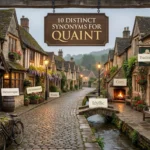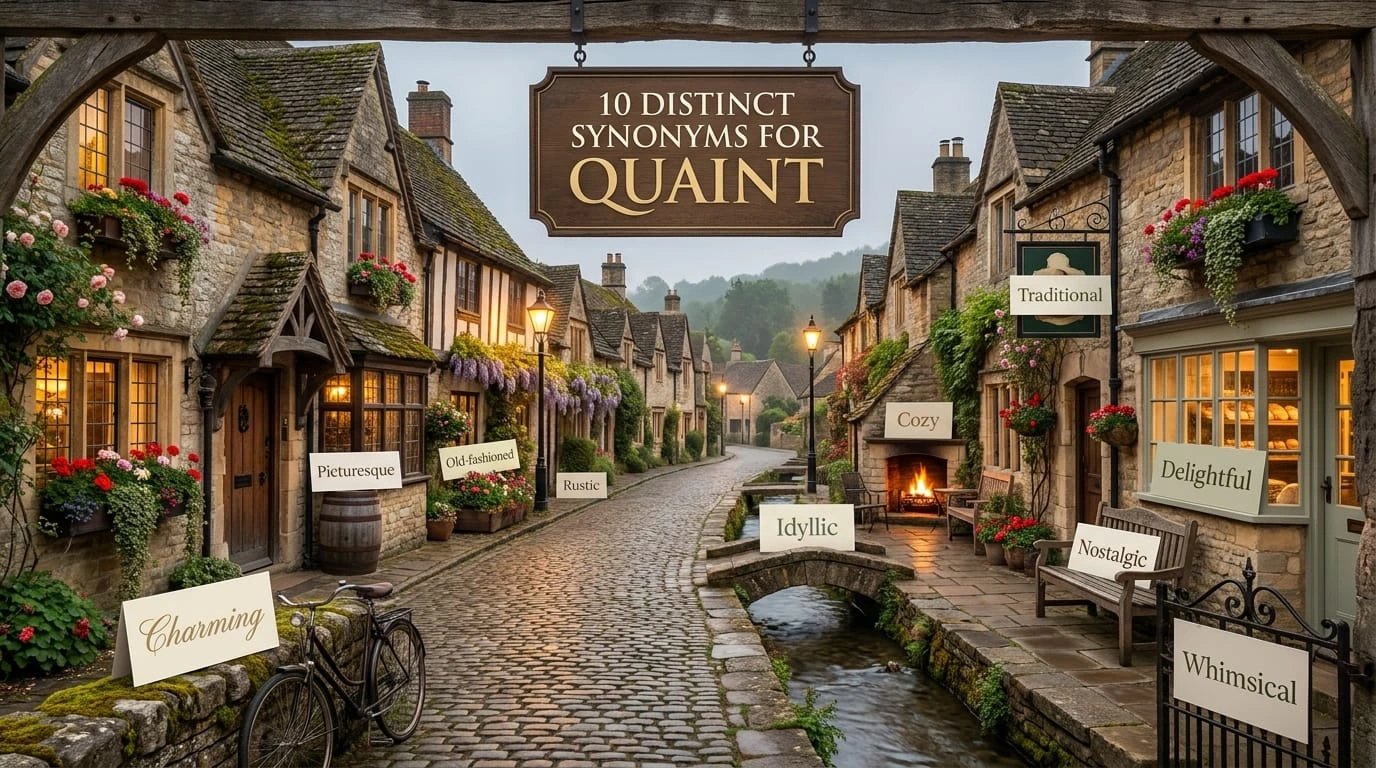
The synonyms of quaint can be grouped by their core meaning, such as charm, beauty, old-fashioned style, rural character, comfort, tradition, nostalgia, and unusual appeal.
Quaint means pleasantly unusual, old-fashioned, or charming in a simple way. Imagine walking through a small village with stone houses, flower boxes, and a tiny old shop with a wooden sign. You might call the village quaint because it feels charming and different from modern city life. The word is common in English because it describes places, homes, objects, customs, and even styles that have a special old-world appeal. Learning synonyms for quaint helps English learners choose words that match the exact feeling they want to express. It also helps content writers avoid repetition and make their writing more vivid. In this guide, we will explore the meaning of quaint, its synonyms, examples, grammar, history, pronunciation, word formation, antonyms, and semantic categories. These examples will help you use each word naturally and confidently.
Meaning of Quaint
Definition
Quaint (Adjective):
Quaint means pleasantly unusual, attractive, or old-fashioned in a charming way.
Examples
- We stayed in a quaint little cottage near the lake.
- The town has quaint streets filled with old shops and cafés.
Connotative Meaning
Connotation: The feeling or idea that a word suggests beyond its basic meaning.
- Positive tone: Charming, cozy, attractive, and pleasantly old-fashioned.
- Negative tone: Sometimes it can suggest something old, odd, or outdated.
- Neutral tone: It can simply describe something noticeably old-fashioned or unusual without strong emotion.
Etymology
The word quaint has an interesting history. It did not come directly from Old English. It entered English through French and changed meaning over time.
- Old English (450–1100): There was no direct form of quaint in Old English. Its deeper root can be traced to Latin cognitus, meaning “known” or “recognized.”
- Middle English (1100–1500): Quaint came into Middle English through Old French forms such as coint, which could mean clever, skillful, elegant, or attractive.
- Modern English (1500–Present): Its meaning gradually moved toward “unusually attractive,” “old-fashioned,” and “charmingly unusual.” Today, it often describes villages, houses, shops, objects, and customs.
Pronunciation (IPA)
- IPA: /kweɪnt/
- Syllables: quaint one syllable
Affixation Pattern of Quaint
- Root: quaint
- Prefix: None
- Suffix: None in the base word
- Word formations:
- quaint: adjective
- quaintly: adverb
- quaintness: noun
23 Synonyms of Quaint With Meaning & Examples
1. Charming (Adjective)
Meaning: Pleasant and attractive in a way that makes people like it.
Examples:
- We found a charming cottage beside the river.
- The village has a charming old market square.
2. Picturesque (Adjective)
Meaning: Visually attractive and suitable for a beautiful picture.
Examples:
- They visited a picturesque mountain village.
- The hotel overlooks a picturesque lake.
3. Old-fashioned (Adjective)
Meaning: Typical of an earlier time rather than modern life.
Examples:
- The shop has an old-fashioned wooden counter.
- Her grandmother lives in an old-fashioned house.
4. Rustic (Adjective)
Meaning: Simple and traditional, often connected with the countryside.
Examples:
- We stayed in a rustic cabin in the woods.
- The restaurant has a warm, rustic design.
5. Idyllic (Adjective)
Meaning: Extremely peaceful, beautiful, and happy.
Examples:
- They spent a week in an idyllic village.
- The farm offers an idyllic escape from city life.
6. Charming-looking (Adjective)
Meaning: Having an attractive and pleasant appearance.
Examples:
- The town has several charming-looking houses.
- We found a charming-looking café near the station.
7. Attractive (Adjective)
Meaning: Pleasant or appealing to look at or experience.
Examples:
- The old building has an attractive design.
- It is an attractive little town for tourists.
8. Delightful (Adjective)
Meaning: Very pleasant, enjoyable, or charming.
Examples:
- We had a delightful afternoon in the village.
- The hotel is a delightful place to stay.
9. Cozy (Adjective)
Meaning: Comfortable, warm, and pleasant, especially in a small space.
Examples:
- They rented a cozy cottage for the weekend.
- The café has a cozy and welcoming atmosphere.
10. Nostalgic (Adjective)
Meaning: Bringing back warm or emotional memories of the past.
Examples:
- The old cinema has a nostalgic charm.
- The street made me feel nostalgic for my childhood.
11. Traditional (Adjective)
Meaning: Following customs, styles, or practices from the past.
Examples:
- We visited a traditional village market.
- The house has a traditional country design.
12. Antique (Adjective)
Meaning: Old and valuable because of its age, history, or craftsmanship.
Examples:
- She bought an antique wooden table.
- The room was decorated with antique furniture.
13. Vintage (Adjective)
Meaning: From an earlier period and often valued for its style or quality.
Examples:
- He collects vintage posters.
- The café has a beautiful vintage interior.
14. Rustic-looking (Adjective)
Meaning: Having a simple, natural, or countryside appearance.
Examples:
- The cabin has a rustic-looking exterior.
- We chose a rustic-looking table for the dining room.
15. Old-world (Adjective)
Meaning: Showing the beauty or style of an earlier period.
Examples:
- The hotel has an old-world atmosphere.
- We enjoyed the town’s old-world charm.
16. Unusual (Adjective)
Meaning: Different from what is common or expected.
Examples:
- The village has an unusual architectural style.
- We stayed in an unusual little house.
17. Peculiar (Adjective)
Meaning: Strange or unusual, sometimes in an interesting way.
Examples:
- The shop has a peculiar old sign.
- There was something peculiar about the tiny house.
18. Characterful (Adjective)
Meaning: Having interesting and distinctive qualities.
Examples:
- The apartment is small but very characterful.
- They restored the characterful old building.
19. Quaint-looking (Adjective)
Meaning: Having an appearance that seems charmingly old-fashioned or unusual.
Examples:
- We walked past several quaint-looking cottages.
- The street is full of quaint-looking shops.
20. Bucolic (Adjective)
Meaning: Relating to a peaceful and attractive rural setting.
Examples:
- The painting shows a bucolic countryside scene.
- They enjoyed a bucolic weekend in the hills.
21. Charming and old-fashioned (Adjective phrase)
Meaning: Pleasantly attractive because of its traditional or old-style appearance.
Examples:
- The village is charming and old-fashioned.
- We stayed at a charming and old-fashioned inn.
22. Whimsical (Adjective)
Meaning: Playfully unusual, imaginative, or different from normal.
Examples:
- The garden has a whimsical design.
- She decorated her room with whimsical objects.
23. Delightfully old-fashioned (Adjective phrase)
Meaning: Pleasantly traditional in a way that feels attractive rather than outdated.
Examples:
- The small bookstore is delightfully old-fashioned.
- We loved the restaurant’s delightfully old-fashioned style.
Prototype Meaning
The most typical meaning of quaint is pleasantly old-fashioned and charming. When people hear the word, they often imagine a small village, cottage, café, shop, or street that looks different from modern places. Think of stone walls, narrow roads, wooden doors, flower boxes, handmade signs, and traditional buildings. The word usually suggests that the unusual or old-fashioned quality is attractive rather than unpleasant.
Prototype Categorization
The 23 synonyms can be grouped by the kind of meaning they emphasize:
- Charm and beauty: charming, attractive, delightful, picturesque , use these when the main idea is beauty or appeal.
- Old age and history: old-fashioned, antique, vintage, old-world ; use these when something strongly reflects an earlier period.
- Rural and natural settings: rustic, bucolic, idyllic, rustic-looking ; these work well for countryside places, homes, and landscapes.
- Comfort and warmth: cozy ; use this when the main idea is a pleasant, comfortable feeling.
- Tradition and memory: traditional, nostalgic ; these emphasize customs or feelings connected with the past.
- Unusual qualities: unusual, peculiar, whimsical ; use these when something stands out because it is different or slightly strange.
- Distinctive character: characterful, quaint-looking, charming-looking ; these describe appearance and personality more directly.
- Strong descriptive phrases: charming and old-fashioned, delightfully old-fashioned ; these are useful when one simple synonym does not fully express the intended meaning.
This categorization helps writers select a synonym based on the exact idea they want to communicate instead of replacing quaint with a word that has a different emotional meaning.
Quaint Synonyms by Context
This is probably the most valuable addition. Searchers want to know which synonym fits a specific situation.
For example:
- For a place: picturesque, charming, idyllic
- For a house: cozy, rustic, old-fashioned
- For an object: vintage, antique
- For a feeling: nostalgic
- For a strange but charming thing: whimsical, peculiar
- For countryside settings: rustic, bucolic
This gives Google more context while making the article genuinely useful.
Antonyms of Quaint
1. Modern (Adjective)
Meaning: Relating to the present time or recent developments.
2. Contemporary (Adjective)
Meaning: Existing or happening in the present period.
3. Modernistic (Adjective)
Meaning: Designed according to modern ideas or styles.
4. Ordinary (Adjective)
Meaning: Common and not unusual or distinctive.
5. Unattractive (Adjective)
Meaning: Not pleasant or appealing in appearance.
6. Industrial (Adjective)
Meaning: Connected with large-scale manufacturing or industry.
7. Urban (Adjective)
Meaning: Relating to a city or town rather than the countryside.
Short Questions and Answers
What does quaint mean?
Quaint means pleasantly unusual, charming, or old-fashioned.
What is the opposite of quaint?
The opposite of quaint is usually modern, contemporary, or ordinary, depending on the context. While quaint describes something charmingly old-fashioned or unusual, modern describes something new, current, and up-to-date.
When should quaint be used?
Use quaint when something has an attractive old-fashioned or unusual quality. It is common for describing villages, houses, streets, shops, cafés, and traditions.
Is quaint positive or negative?
It is usually positive. However, depending on context, it can sometimes suggest that something is old, odd, or outdated.
How is it different from similar words?
Quaint combines ideas of unusualness, old-fashioned style, and charm. Rustic focuses more on rural simplicity, vintage focuses on an earlier period and style, and picturesque focuses mainly on visual beauty.
What is the best synonym for quaint?
The best synonym for quaint is charming because both words describe something pleasantly attractive and appealing. However, picturesque, rustic, or old-fashioned may be better depending on the context.
Conclusion
Learning quaint and its synonyms can make your English more precise, natural, and interesting. Instead of using the same word again and again, you can choose charming, picturesque, rustic, nostalgic, vintage, or another word that matches your exact meaning. This improves both writing and speaking because you learn to express small differences in feeling and style. Understanding connotation also helps you avoid words that may sound too negative, formal, or unusual for a certain situation. For English learners, studying synonyms builds a stronger vocabulary and greater confidence. For content writers, it makes descriptions richer and easier to read. Try learning two or three new words each day and use them in your own sentences. With regular practice, choosing the right synonym will become much easier.
Synonyms for Butter: 30 Useful Alternatives

I’m a language enthusiast and content writer specializing in English vocabulary, synonyms, word meanings, and alternative word choices. My goal is to help readers expand their vocabulary and express themselves with greater clarity through simple, accurate, and easy-to-understand language guides.