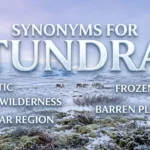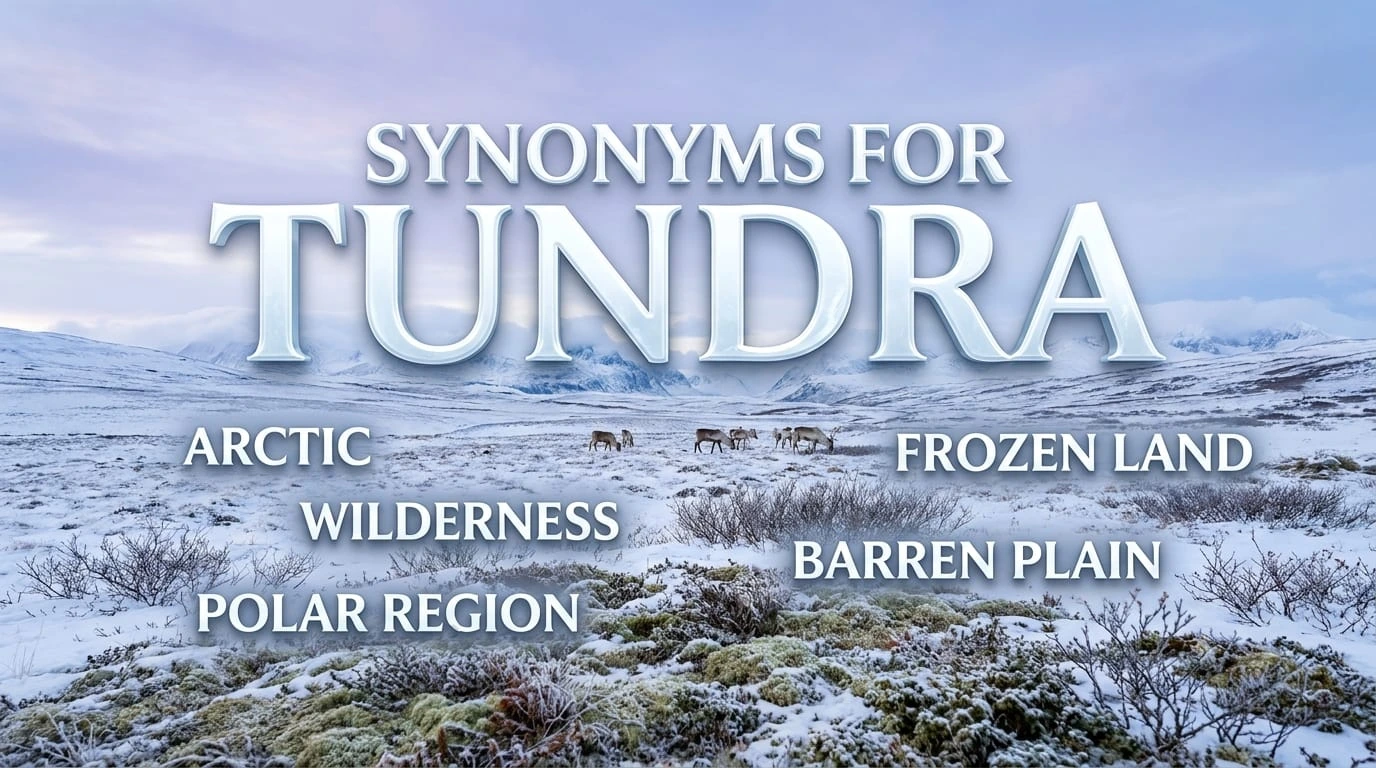
Tundra synonyms include arctic plain, frozen plain, polar region, icy wilderness, treeless plain, and cold desert.
Tundra is a cold, mostly treeless region where plants grow close to the ground. Imagine walking across a wide northern landscape with frozen soil, low grasses, mosses, and small shrubs. This is the kind of place we call tundra. The word is common in geography, climate science, environmental studies, and nature writing. Learning synonyms and contextual alternatives for tundra can help English learners avoid repetition and choose more precise words. For writers, these alternatives can make descriptions clearer and more vivid. In this guide, you will learn what tundra means, where the word comes from, how to pronounce it, and which related terms can describe tundra environments. You will also see these words in natural sentences and learn how their meanings differ.
Meaning of Tundra
Definition
Tundra (noun): A cold, mostly treeless biome with low-growing vegetation and, in many regions, permanently frozen ground.
Examples
- The Arctic tundra supports mosses, grasses, and small shrubs.
- Many animals migrate across the tundra during the warmer months.
Connotative Meaning
- Positive tone: Can suggest wild beauty, natural purity, and untouched landscapes.
- Negative tone: Can suggest harsh cold, isolation, and difficult living conditions.
- Neutral tone: Usually refers objectively to a specific cold biome.
Connotation: The feeling or idea that a word suggests beyond its basic meaning.
Etymology
The word tundra was borrowed into English from Russian tundra, which is related to Finnish and other northern languages. It ultimately connects with a term referring to a treeless upland or high, barren land.
- Old English (450–1100): Tundra was not an Old English word.
- Middle English (1100–1500): The word was still not part of Middle English vocabulary.
- Modern English (1500–Present): English adopted tundra as a geographical and ecological term, especially as scientific knowledge of northern regions developed.
Unlike many common English words, tundra does not have a long Old English → Middle English → Modern English development in English.
Pronunciation (IPA)
- IPA: /ˈtʌn.drə/
- Syllables: tun-dra
Affixation Pattern of Tundra
- Root: tundra
- Prefix: None
- Suffix: None
- Word formations:
- tundra biome: noun phrase
- tundra ecosystem: noun phrase
- tundra region: noun phrase
- tundra vegetation; noun phrase
- tundra climate: noun phrase
- tundra-like: adjective
These are combinations built around tundra, rather than words created by adding English prefixes or suffixes to the root.
22 Synonyms and Contextual Alternatives for Tundra With Meaning & Examples
Important: Tundra is a specific biome, so it has relatively few exact synonyms. The list below includes close synonyms, descriptive alternatives, and context-specific terms that writers may use when referring to tundra environments.
1. Arctic tundra (Noun)
Meaning: Tundra found in the far northern Arctic regions.
Examples:
- Polar bears live near the Arctic tundra.
- The Arctic tundra has a very short growing season.
2. Polar tundra (Noun)
Meaning: A cold tundra environment associated with polar regions.
Examples:
- The polar tundra has very limited tree growth.
- Researchers studied vegetation across the polar tundra.
3. Treeless plain (Noun)
Meaning: A broad, open area without trees, often used descriptively for tundra.
Examples:
- The explorers crossed a vast treeless plain.
- The northern treeless plain was covered with low vegetation.
4. Treeless landscape (Noun)
Meaning: A landscape where trees are largely absent.
Examples:
- The region has a beautiful treeless landscape.
- Strong winds help maintain the area’s treeless landscape.
5. Arctic plain (Noun)
Meaning: A broad, flat northern landscape, often containing tundra.
Examples:
- The researchers traveled across the Arctic plain.
- The Arctic plain becomes greener during summer.
6. Polar plain (Noun)
Meaning: A flat landform located in a polar environment.
Examples:
- The expedition crossed a remote polar plain.
- Few tall plants survive on the polar plain.
7. Arctic landscape (Noun)
Meaning: The natural scenery and terrain of the Arctic.
Examples:
- The photographer captured the beauty of the Arctic landscape.
- Melting ice is changing the Arctic landscape.
8. Polar landscape (Noun)
Meaning: A landscape shaped by extremely cold polar conditions.
Examples:
- The polar landscape is home to specially adapted animals.
- Scientists monitor changes in the polar landscape.
9. Frozen plain (Noun)
Meaning: A plain characterized by frozen ground or extremely cold conditions.
Examples:
- The travelers moved slowly across the frozen plain.
- Snow covered much of the frozen plain.
10. Barren plain (Noun)
Meaning: A plain with little vegetation or few visible resources.
Examples:
- They saw a wide barren plain stretching toward the horizon.
- The barren plain looked almost empty from a distance.
11. Cold desert (Noun)
Meaning: A very dry, cold environment with sparse vegetation; sometimes used descriptively for harsh tundra areas.
Examples:
- Some polar environments resemble a cold desert.
- The region has conditions similar to a cold desert.
Usage note: This is a contextual comparison, not a perfect synonym for tundra.
12. Subarctic plain (Noun)
Meaning: A broad landscape in the subarctic zone that may contain tundra vegetation.
Examples:
- The subarctic plain supports low shrubs and grasses.
- Wildlife moves across the subarctic plain in search of food.
13. Alpine tundra (Noun)
Meaning: Tundra-like vegetation and terrain found at high elevations above the tree line.
Examples:
- Mountain goats live in areas of alpine tundra.
- The hikers reached the alpine tundra above the forest.
14. High-altitude tundra (Noun)
Meaning: Tundra occurring at high elevations where trees cannot grow.
Examples:
- The mountain has extensive high-altitude tundra.
- Plants in high-altitude tundra must survive strong winds.
15. Permafrost region (Noun)
Meaning: An area where ground remains frozen for long periods, often associated with Arctic tundra.
Examples:
- Buildings in the permafrost region require special foundations.
- Climate change is affecting the permafrost region.
16. Periglacial landscape (Noun)
Meaning: A cold landscape strongly influenced by freezing and thawing processes.
Examples:
- The scientists studied the periglacial landscape.
- Ice-related processes shape the periglacial landscape.
17. Northern wilderness (Noun)
Meaning: A remote natural area in a northern region.
Examples:
- The expedition entered the northern wilderness.
- Few roads cross this remote northern wilderness.
18. Polar wilderness (Noun)
Meaning: A remote natural environment in a polar region.
Examples:
- The researchers spent months in the polar wilderness.
- The polar wilderness supports highly adapted wildlife.
19. Subpolar landscape (Noun)
Meaning: A landscape located near but not directly within the polar zone.
Examples:
- The subpolar landscape changes dramatically between seasons.
- Low shrubs dominate parts of the subpolar landscape.
20. Treeline-free zone (Noun)
Meaning: An area where environmental conditions prevent trees from growing.
Examples:
- The hikers reached the treeline-free zone above the forest.
- Wind and cold create a treeline-free zone on the mountain.
21. Low-vegetation landscape (Noun)
Meaning: A landscape dominated by short plants rather than tall trees.
Examples:
- The island has a striking low-vegetation landscape.
- Mosses and grasses dominate the low-vegetation landscape.
22. Tundra biome (Noun)
Meaning: The ecological system made up of tundra climate, plants, animals, and soil.
Examples:
- The tundra biome contains species adapted to extreme cold.
- Scientists are monitoring changes in the tundra biome.
Prototype Meaning
When people hear tundra, they usually imagine a vast, cold, open landscape with no tall trees. Low grasses, mosses, lichens, and small shrubs grow close to the ground. Snow, frozen soil, strong winds, and a short growing season are also common features.
Prototype Categorization
| Category | Synonyms / Related Terms |
|---|---|
| Direct Ecological Terms | Arctic tundra, polar tundra, alpine tundra, tundra biome |
| Landscape Descriptions | treeless plain, treeless landscape, Arctic plain, polar plain, frozen plain |
| Climate-Based Terms | cold desert, permafrost region, subarctic plain |
| Geographical Descriptions | Arctic landscape, polar landscape, subpolar landscape |
| Descriptive Writing Terms | northern wilderness, polar wilderness, low-vegetation landscape |
| Mountain-Related Terms | alpine tundra, high-altitude tundra |
This grouping helps writers choose a word based on the exact feature they want to emphasize rather than treating every alternative as a perfect synonym.
Antonyms of Tundra
Tundra is a biome rather than a quality or action, so it does not have a true antonym. However, contrasting environments include:
- Tropical rainforest (Noun): A warm, wet biome with dense tree growth.
- Temperate forest (Noun): A forest found in regions with moderate seasonal climates.
- Woodland (Noun): Land dominated by trees and other woody plants.
- Savanna (Noun): A warm grassland with scattered trees.
- Tropical grassland (Noun): A warm grassland ecosystem with seasonal rainfall.
Short Questions and Answers
What does tundra mean?
Tundra means a cold, mostly treeless biome where low-growing plants survive under harsh environmental conditions.
When should tundra be used?
Use tundra when referring specifically to a cold biome with low vegetation and little or no tree growth, especially in Arctic or high-mountain environments.
Is tundra positive or negative?
Tundra is a neutral geographical and ecological term. Its surrounding description can create positive feelings of natural beauty or negative ideas of harshness and isolation.
How is tundra different from similar words?
Tundra identifies a specific biome. Terms such as treeless plain, Arctic landscape, and polar wilderness are broader descriptive expressions and may not always mean tundra.
Conclusion
Learning the meaning and alternatives of tundra can make your English more precise and interesting. The word refers to a special cold biome, so it does not have many exact synonyms. However, terms such as Arctic tundra, alpine tundra, treeless plain, Arctic landscape, polar wilderness, and permafrost region can help describe different features or settings. Understanding these differences is important for students, teachers, researchers, and content writers. Using the right contextual alternative also prevents repetition and makes descriptions more natural. Try using a few of these terms when writing about geography, climate, wildlife, or the environment. Regular vocabulary practice will help you build stronger writing and speaking skills and become more confident when choosing precise English words.
Synonyms for pizza: 25 Tasty Alternatives

I’m a language enthusiast and content writer specializing in English vocabulary, synonyms, word meanings, and alternative word choices. My goal is to help readers expand their vocabulary and express themselves with greater clarity through simple, accurate, and easy-to-understand language guides.