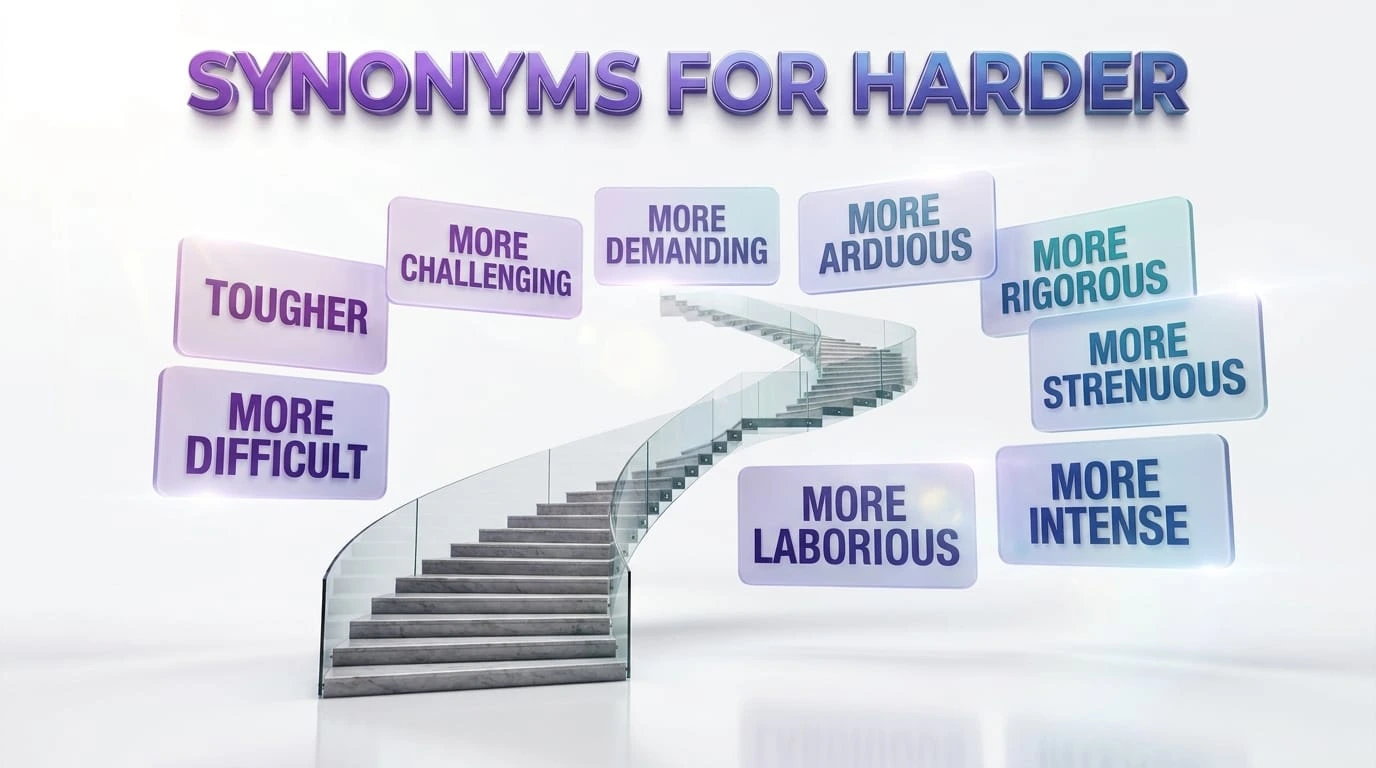
Synonyms for harder include more difficult, tougher, more challenging, more demanding, and more strenuous. The best choice depends on the context.
The word harder is common in everyday English. You may use it when a task becomes more difficult, a workout becomes more demanding, or a problem takes more effort to solve. For example, a student may say, “This math question is harder than the last one.”
But using the same word again and again can make your writing feel plain. This is where synonyms help. Words such as tougher, more difficult, more challenging, demanding, and strenuous can add more detail and variety.
As an English learner or content writer, learning these alternatives can help you express small differences in meaning. A difficult exam is not always the same as a strenuous workout. A tough decision is not exactly the same as a demanding job.
This guide explains 25 synonyms for harder, along with their meanings, examples, grammar, pronunciation, history, and semantic categories. By the end, you will know which alternative fits your sentence best.
Meaning of Harder
Definition
Harder (comparative adjective/adverb): means more difficult, more demanding, or requiring more effort than something else.
It is the comparative form of hard.
Examples
- This test is harder than the previous one.
- You need to work harder if you want to improve.
- The second exercise was harder than the first.
Connotative Meaning
Connotation (the feeling or idea a word suggests beyond its basic meaning) can change with context.
- Positive tone: harder can suggest greater effort, growth, or determination.
- Negative tone: it can suggest stress, difficulty, or struggle.
- Neutral tone: it can simply describe something that requires more effort.
Etymology
The word hard has a long history in English.
- Old English (450–1100): heard meant firm, solid, severe, or difficult.
- Middle English (1100–1500): forms such as hard developed and were used for physical and figurative difficulty.
- Modern English (1500–Present): hard gained many meanings, including difficult, firm, severe, and requiring effort. Harder developed as its comparative form.
Pronunciation (IPA)
- IPA: /ˈhɑːrdər/ in many varieties of English
- Syllables: hard-er
Affixation Pattern of Harder
- Root: hard
- Prefix: none
- Suffix: -er — comparative suffix
Word Formations
- Hard: adjective/adverb
- Harder: comparative adjective/adverb
- Hardest: superlative adjective/adverb
- Hardness: noun
- Harden: verb
- Hardened: adjective/verb
- Hardening: noun/verb form
- Hardship: noun
25 Synonyms of Harder With Meaning & Examples
1. More Difficult (Comparative Adjective)
Meaning: More difficult to understand, complete, or deal with.
Examples:
- This question is more difficult than the first one.
- The advanced course is more difficult for beginners.
2. Tougher (Comparative Adjective)
Meaning: More difficult to handle, complete, or overcome.
Examples:
- The final match was tougher than expected.
- She faced a tougher challenge this year.
3. More Challenging (Comparative Adjective)
Meaning: Requiring more skill, thought, or effort.
Examples:
- The new project is more challenging.
- This puzzle is more challenging than the last one.
4. More Demanding (Comparative Adjective)
Meaning: Requiring more time, energy, skill, or attention.
Examples:
- My new job is more demanding.
- The second course is more demanding academically.
5. More Difficult to Manage (Phrase)
Meaning: More difficult to control or deal with.
Examples:
- The new system is more difficult to manage.
- Large groups can be more difficult to manage.
6. More Arduous (Comparative Adjective)
Meaning: Requiring a lot of effort and energy.
Examples:
- The journey became more arduous after sunset.
- They faced a more arduous climb.
7. More Strenuous (Comparative Adjective)
Meaning: Requiring greater physical effort.
Examples:
- The second workout was more strenuous.
- We chose a more strenuous hiking route.
8. More Laborious (Comparative Adjective)
Meaning: Requiring a lot of time and effort.
Examples:
- The manual process is more laborious.
- Data entry became more laborious as the project grew.
9. More Complicated (Comparative Adjective)
Meaning: More difficult because it has many connected parts.
Examples:
- The new problem is more complicated.
- The process became more complicated than expected.
10. More Complex (Comparative Adjective)
Meaning: More difficult to understand because of many parts or ideas.
Examples:
- The theory is more complex than it first appears.
- This case is more complex than the previous one.
11. More Grueling (Comparative Adjective)
Meaning: Requiring extreme effort and causing tiredness.
Examples:
- The training was more grueling than expected.
- They completed a more grueling schedule.
12. More Intense (Comparative Adjective)
Meaning: Stronger or more extreme in degree.
Examples:
- The second round was more intense.
- The competition became more intense.
13. More Severe (Comparative Adjective)
Meaning: More serious, harsh, or extreme.
Examples:
- The storm became more severe overnight.
- The patient experienced more severe symptoms.
14. More Formidable (Comparative Adjective)
Meaning: More difficult to deal with or overcome.
Examples:
- The team faced a more formidable opponent.
- The second obstacle looked more formidable.
15. More Daunting (Comparative Adjective)
Meaning: More difficult or frightening to face.
Examples:
- The task seemed more daunting at first.
- Starting a new career can feel more daunting.
16. More Challenging to Overcome (Phrase)
Meaning: Requiring greater effort to defeat or solve.
Examples:
- This obstacle is more challenging to overcome.
- The second problem was more challenging to overcome.
17. More Taxing (Comparative Adjective)
Meaning: Requiring more mental or physical energy.
Examples:
- The long meeting was more taxing than expected.
- The new role is more taxing mentally.
18. More Trying (Comparative Adjective)
Meaning: More difficult or stressful to deal with.
Examples:
- The past few weeks were more trying.
- It was a more trying experience than expected.
19. More Exacting (Comparative Adjective)
Meaning: Requiring a very high level of skill, care, or effort.
Examples:
- The new position has more exacting standards.
- This task requires more exacting attention.
20. More Labor-Intensive (Comparative Adjective)
Meaning: Requiring more human work and effort.
Examples:
- The traditional method is more labor-intensive.
- Farming can become more labor-intensive during harvest.
21. More Strenuous to Perform (Phrase)
Meaning: Requiring greater physical effort to complete.
Examples:
- The second exercise is more strenuous to perform.
- This activity is more strenuous to perform for beginners.
22. More Effortful (Comparative Adjective)
Meaning: Requiring more effort than something else.
Examples:
- The second task was more effortful.
- Reading the full report is more effortful than reading the summary.
23. More Rigorous (Comparative Adjective)
Meaning: Requiring greater care, accuracy, or strict effort.
Examples:
- The new test uses more rigorous standards.
- Researchers followed a more rigorous process.
24. More Challenging to Master (Phrase)
Meaning: Requiring more time and practice to learn fully.
Examples:
- Advanced grammar is more challenging to master.
- This skill is more challenging to master than basic writing.
25. More Onerous (Comparative Adjective)
Meaning: More difficult or burdensome to deal with.
Examples:
- The new rules are more onerous for small businesses.
- The paperwork became more onerous over time.
Prototype Meaning
The most typical meaning of harder is more difficult or requiring more effort.
When people hear harder, they usually imagine a task, problem, test, or activity that needs more work than another one. For example, if one exam requires more study than another, you may describe it as harder.
The exact synonym depends on what makes something difficult.
Prototype Categorization
The 25 alternatives can be grouped by their core meaning.
- General difficulty: more difficult, tougher, more challenging
- Effort and workload: more demanding, more arduous, more laborious, more taxing, more effortful
- Physical difficulty: more strenuous, more grueling, more strenuous to perform
- Complexity: more complicated, more complex
- Emotional or psychological difficulty: more daunting, more trying, more formidable
- Severity or intensity: more intense, more severe
- High standards or strict requirements: more exacting, more rigorous
- Burden or responsibility: more onerous
- Work-related effort: more labor-intensive
- Mastery and overcoming challenges: more challenging to overcome, more challenging to master
This grouping helps writers choose a synonym based on why something is harder rather than simply replacing the word with another word.
Antonyms of Harder
1. Easier (Comparative Adjective)
Means requiring less effort or difficulty.
2. Simpler (Comparative Adjective)
Means less complicated or easier to understand.
3. Less Difficult (Comparative Phrase)
Means requiring less effort or skill.
4. More Manageable (Comparative Adjective)
Means easier to control or deal with.
5. Effortless (Adjective)
Means requiring little or no effort.
Short Questions and Answers
What does harder mean?
Harder is the comparative form of hard. It usually means more difficult or requiring more effort.
When should harder be used?
Use harder when comparing two things and one requires more effort, skill, strength, or difficulty than the other.
Is harder positive or negative?
Harder is usually neutral. Its tone depends on context. A harder task may be negative when it causes stress, but it can be positive when it encourages growth.
How is harder different from more difficult?
Both can mean that something requires more effort. Harder is more common in everyday English, while more difficult can sound slightly more formal or precise.
Which synonym is best for physical effort?
More strenuous is a strong choice when talking about physical effort. More grueling also works when the activity is extremely tiring.
Which synonym works best for a difficult decision?
Tougher, more challenging, or more difficult can work well. More daunting is useful when the decision also feels intimidating.
Can harder mean physically stronger?
Yes. Harder can describe physical force or firmness depending on context. For example, “He hit the ball harder” describes greater force.
Conclusion
Learning synonyms for harder gives you more ways to express difficulty, effort, intensity, and challenge. Words such as tougher, more difficult, more challenging, more demanding, and more strenuous can make your English more precise.
The key is to choose a word that matches the situation. Use more strenuous for physical effort, more complex for complicated ideas, more demanding for work, and more daunting when something feels intimidating.
You do not need to replace harder every time. It is a natural and useful word. The goal is to understand its alternatives so you can avoid repetition and communicate your exact meaning.
Practice a few new synonyms each day. Over time, your vocabulary will become richer, clearer, and more confident.
Synonyms for Reliance: 30 Better Words to Use

I’m a language enthusiast and content writer specializing in English vocabulary, synonyms, word meanings, and alternative word choices. My goal is to help readers expand their vocabulary and express themselves with greater clarity through simple, accurate, and easy-to-understand language guides.