Quick Answer
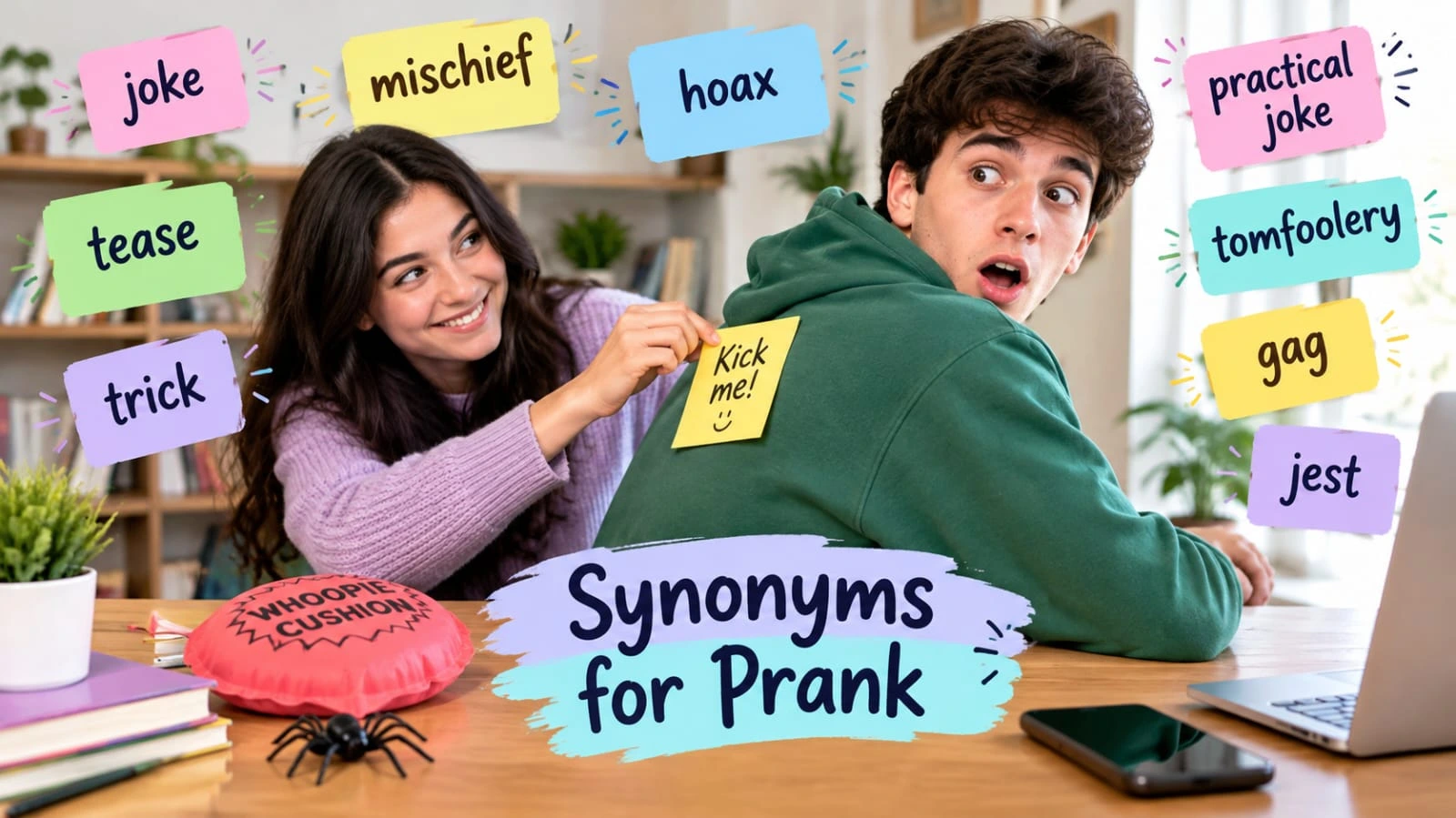
- Practical joke
- Gag
- Caper
- Antic
- Lark
- Escapade
- Shenanigan(s)
- Jape
- Stunt
- Monkeyshine(s)
- Tomfoolery
- High jinks
- Frolic
A prank is a trick that makes people laugh, feel surprised, or briefly believe something that is not true. For example, a student may put a funny note inside a friend’s notebook as a harmless prank. People use this word in daily talks, comedy, school stories, and online videos. But using the same word again and again can make writing dull. Learning synonyms for prank helps English learners and writers express ideas in fresh and clear ways. Some words describe a funny joke, while others suggest a clever trick or a false story. In this guide, you will learn the meaning of prank, its useful synonyms, their differences, and how to choose the right word for each situation.
Meaning of Prank
Definition
Prank (noun): A playful or mischievous trick done to surprise or amuse someone, usually without causing harm.
Prank (verb): To play a trick on someone for fun.
Examples
- The children played a harmless prank on their uncle.
- My friends planned a funny prank for my birthday.
- They pranked their teacher with a silly surprise.
Connotative Meaning
Connotation (the feelings or ideas a word brings to mind) depends on the type of prank.
- Positive tone: A harmless prank can create laughter and shared fun.
- Negative tone: A cruel prank can embarrass, frighten, or hurt someone.
- Neutral tone: A prank can simply describe a practical joke without judging it.
A prank is not always harmless just because the person who plans it thinks it is funny.
Pronunciation (IPA)
- IPA: /præŋk/
- Syllables: One syllable prank
- Part of speech: Noun and verb.
Etymology of Prank
The noun prank, meaning a mischievous trick, appeared in English around the 1520s. Its exact origin is uncertain. Historical sources also record an older verb prank meaning to show off or decorate in a showy way, possibly linked to Dutch pronken and related Germanic words. These histories are related in spelling but should not be treated as proof that the modern noun came directly from Dutch.
There is no need to assign a separate, definite origin to each English period when the word’s early history remains uncertain.
Word Forms and Related Expressions
Common word forms
- Prank (noun): A playful trick.
- Pranks (plural noun): More than one playful trick.
- Prank (verb): To play a trick on someone.
- Pranked (past tense/past participle): Played a trick on someone.
- Pranking (present participle/gerund): Playing a trick on someone.
- Prankster (noun): A person who often plays pranks.
- Prankish (adjective): Playful or mischievous.
The forms pranked and pranking are standard forms of the verb prank. Prankster is a common word for someone who enjoys playing tricks.
Related expressions
- Play a prank on someone: Play a trick on someone for fun.
- Pull a prank: Carry out a practical joke.
- Prank call: A phone call made to trick or amuse someone.
- Practical joke: An action designed to surprise or fool someone for amusement.
25 Synonyms for Prank With Meanings and Examples
Not all these words are exact substitutes for prank. Some are close synonyms, while others fit only certain kinds of tricks or playful acts. The notes below explain the difference.
1. Practical joke (noun)
Meaning: An action done to surprise or fool someone for fun.
Examples:
- The students played a practical joke on their friend.
- His practical joke made the whole class laugh.
2. Trick (noun)
Meaning: An action used to fool, surprise, or amuse someone.
Examples:
- She played a trick on her brother.
- The trick surprised everyone at the party.
3. Gag (noun)
Meaning: A joke or funny act designed to make people laugh.
Examples:
- The comedian used a silly gag in his show.
- The fake spider was a simple gag.
4. Caper (noun)
Meaning: A playful or silly act, often done for fun.
Examples:
- Their late-night caper became a funny story.
- The children enjoyed one last caper before bed.
5. Shenanigan (noun)
Meaning: A playful, mischievous, or sometimes dishonest act.
Examples:
- The boys were known for their silly shenanigans.
- The teacher stopped their classroom shenanigans.
6. Antic (noun)
Meaning: A silly or playful act meant to amuse others.
Examples:
- His funny antic made his friends laugh.
- The children performed playful antics in the garden.
7. Escapade (noun)
Meaning: An exciting or unusual act, often involving mischief.
Examples:
- Their weekend escapade became a family story.
- The young friends planned a harmless escapade.
8. Lark (noun)
Meaning: An activity done for fun or amusement.
Examples:
- They changed seats as a lark.
- The fake announcement was meant as a lark.
9. Frolic (noun)
Meaning: A playful activity full of fun and energy.
Examples:
- Their playful frolic ended in laughter.
- The children enjoyed a frolic in the park.
10. Jest (noun)
Meaning: Something said or done to cause laughter.
Examples:
- He made the remark in jest.
- The small trick was meant as a jest.
11. Joke (noun)
Meaning: Something said or done to make people laugh.
Examples:
- She played a joke on her cousin.
- The joke was harmless, and everyone laughed.
12. Hoax (noun)
Meaning: A false story or trick meant to make people believe something untrue.
Examples:
- The online story turned out to be a hoax.
- They spread a fake news report as a hoax.
Usage note: A hoax usually involves deception and may be more serious than a simple prank.
13. Ruse (noun)
Meaning: A clever plan used to trick or mislead someone.
Examples:
- He used a ruse to hide the birthday surprise.
- The false excuse was a ruse to avoid questions.
14. Deception (noun)
Meaning: The act of making someone believe something that is not true.
Examples:
- The deception lasted only a few minutes.
- The prank relied on deception to surprise the guests.
Usage note: Deception is broader and often more negative than prank.
15. Ploy (noun)
Meaning: An action or plan used to get an advantage or influence someone.
Examples:
- His claim was a ploy to gain attention.
- The surprise invitation was a ploy to bring everyone together.
16. Stunt (noun)
Meaning: An unusual or attention-grabbing act, sometimes done for entertainment.
Examples:
- The team planned a funny publicity stunt.
- His silly stunt became popular online.
17. Mischief (noun)
Meaning: Behavior that causes minor trouble or playful annoyance.
Examples:
- The children were always getting into mischief.
- Their harmless mischief made the party lively.
18. Shenanigans (plural noun)
Meaning: Playful, silly, or dishonest actions.
Examples:
- Their office shenanigans made everyone laugh.
- The coach put an end to the team’s shenanigans.
Usage note: Shenanigans is the common plural form used when talking about a series of silly or questionable acts.
19. Horseplay (noun)
Meaning: Rough or noisy play, often involving physical movement.
Examples:
- The teacher told the students to stop the horseplay.
- Their horseplay nearly knocked over a chair.
Usage note: Horseplay is not always a prank; it describes rough play more generally.
20. Frolicsome act (noun phrase)
Meaning: A playful action done in a cheerful, lively way.
Examples:
- Their frolicsome act brought smiles to the group.
- The silly dance was a frolicsome act at the party.
21. Caprice (noun)
Meaning: A sudden change of mind or an unpredictable choice.
Examples:
- On a caprice, he hid a funny note in her bag.
- The plan was a sudden caprice rather than a serious scheme.
Usage note: Caprice is not a direct synonym for prank. It describes the sudden or unpredictable nature of an action.
22. Jape (noun)
Meaning: A joke or trick, often playful or mischievous.
Examples:
- His jape made the group chuckle.
- The old story described a clever jape.
Usage note: Jape is uncommon in modern everyday English.
23. Lark (verb phrase: “have a lark”)
Meaning: To enjoy yourself by doing something silly or playful.
Examples:
- The friends had a lark after school.
- They dressed in funny hats for a lark.
Usage note: This is a related expression rather than a direct noun synonym.
24. Practical joke call (noun phrase)
Meaning: A phone call made to fool or amuse the person who answers.
Examples:
- The prank call confused the person who answered.
- They stopped making prank calls after someone complained.
Usage note: Prank call is the natural, standard expression; practical joke call is not the usual phrase.
25. Fooling (noun)
Meaning: Playful behavior that tricks or misleads someone.
Examples:
- The fooling stopped when everyone learned the truth.
- Their fooling was meant to be harmless.
Usage note: Fooling is a related term, not always a natural replacement for prank.
Synonyms for Prank Grouped by Context
Choosing a synonym becomes easier when you know what kind of prank you want to describe.
Harmless jokes and funny acts
- Practical joke: An action designed to surprise someone for fun.
- Gag: A funny act, often used in comedy.
- Joke: Something meant to amuse or make people laugh.
- Jest: A playful remark or action.
- Antic: A silly or amusing act.
Example: The comedian used a gag to make the audience laugh.
Playful mischief and silly behavior
- Caper: A playful or mischievous act.
- Shenanigan: A silly or mischievous action.
- Escapade: An unusual adventure or act.
- Lark: An activity done for fun.
- Mischief: Playful behavior that causes minor trouble.
Example: The children’s harmless mischief made everyone smile.
Tricks and deception
- Trick: An action that fools or surprises someone.
- Hoax: A false story or scheme that makes people believe something untrue.
- Ruse: A clever plan to mislead someone.
- Ploy: A plan used to gain an advantage.
- Deception: The act of misleading someone.
Example: The fake announcement was a hoax that confused many people.
Attention-grabbing acts
- Stunt: An unusual act designed to attract attention or entertain.
- Horseplay: Rough, noisy play.
- Frolic: Lively, playful activity.
- Jape: A joke or trick, often playful or mischievous.
Example: The group planned a funny stunt for the school event.
Writing tip: Use practical joke for a typical prank, gag for comedy, mischief for playful trouble, and hoax when false information is used to mislead people.
Prank vs. Joke vs. Hoax vs. Trick
These four words are related, but they do not mean exactly the same thing.
| Word | Main meaning | Example |
| Prank | A playful trick played on someone | He played a prank on his friend. |
| Joke | Something said or done to cause laughter | She told a funny joke. |
| Hoax | A false story or scheme meant to deceive | The warning was exposed as a hoax. |
| Trick | An action used to fool, surprise, or outsmart someone | He used a trick to surprise his sister. |
Which word should you choose?
- Use prank when someone plays a trick on another person for amusement.
- Use joke when the main purpose is laughter.
- Use hoax when a false claim or story is presented as true.
- Use trick when the focus is on the action used to fool someone.
A prank may involve a trick or joke, but a hoax often carries a stronger sense of deception.
Antonyms of Prank
There is no single exact antonym for prank. The best opposite depends on the contrast you want to express.
– Seriousness (noun): A state of being thoughtful or not playful. Example: The meeting required seriousness rather than silly pranks.
– Sincerity (noun): The quality of being honest and genuine. Example: She spoke with sincerity instead of trying to fool anyone.
– Honesty (noun): The quality of telling the truth. Example: Honesty replaced the deception behind the prank.
– Earnestness (noun): A serious and sincere attitude. Example: His earnestness showed that he was not joking.
– Straightforwardness (noun): The quality of being direct and clear rather than using tricks. Example: Her straightforwardness helped clear up the misunderstanding.
Remember: These are contextual opposites, not exact antonyms. Prank names an action, while these words describe attitudes or qualities that may contrast with it.
Common Usage Mistakes
1. Treating every prank as harmless
A prank may be intended as a joke, but it can still hurt or frighten someone.
- Less accurate: The prank was harmless because it made the others laugh.
- Better: The prank made the others laugh, but it embarrassed the person involved.
2. Using hoax for every joke
A hoax usually involves making people believe a false story or claim. A joke does not always involve deception.
- Incorrect in meaning: His funny comment was a hoax.
- Better: His funny comment was a joke.
3. Using scam as a synonym for prank
A scam usually involves dishonest activity intended to cheat someone, often for money or personal gain. It is not a suitable synonym for an ordinary playful prank.
4. Confusing a prank with horseplay
A prank involves a trick or practical joke. Horseplay means rough or noisy play and may not involve a trick at all.
Frequently Asked Questions
What does prank mean?
A prank is a playful or mischievous trick done to surprise or amuse someone. It is usually intended to be funny, but it can sometimes cause embarrassment or harm.
What are the most common synonyms for prank?
Common synonyms and close alternatives include practical joke, trick, gag, caper, antic, and shenanigan. Words such as hoax and ruse fit more deceptive situations.
Is prank a positive or negative word?
Prank is often playful or neutral. Its tone becomes negative when the act causes fear, humiliation, damage, or distress.
What is the difference between a prank and a practical joke?
A practical joke is a close synonym for prank. Both usually describe an action intended to fool or surprise someone for amusement. The phrases are often interchangeable.
What is a synonym for a playful prank?
A playful prank can also be called a practical joke, gag, caper, trick, or jape. These words describe amusing or mischievous acts intended to surprise or entertain someone.
What is another word for pranks in a crossword?
Possible crossword answers for pranks include gags, tricks, japes, capers, and antics. The correct answer depends on the number of letters and the puzzle’s clues.
What does prank mean? Can you use it in sentences?
A prank is a playful trick intended to surprise or amuse someone. For example:
- The students played a harmless prank on their teacher.
- His birthday prank made everyone laugh.
- They planned a funny prank for their friend.
What are the antonyms of prank?
There is no single exact antonym for prank, but contextual opposites include serious act, sincere action, honesty, and genuine behavior. The best choice depends on whether prank refers to a joke or a deceptive trick.
What is an old word for prank?
Jape is an old-fashioned word meaning a joke or trick. It can describe playful teasing or a mischievous act and may appear in historical or literary writing.
What is an old word for pranks in a crossword?
Japes is a possible crossword answer for pranks. Other options include antics, capers, and gags, depending on the required letter count.
What is a synonym for wobble uncertainly?
Words and phrases similar to wobble uncertainly include totter, teeter, stagger, sway, and stumble. Totter and teeter are especially suitable when someone moves unsteadily and seems close to falling.
Conclusion
Learning synonyms for prank helps you describe funny tricks, playful acts, and deceptive schemes with greater accuracy. Words such as practical joke, gag, and caper suit lighthearted situations, while hoax, ruse, and deception suggest misleading someone. Other terms, such as mischief and horseplay, describe related behavior but are not exact replacements. The key is to choose a word that matches the action and its purpose. Read examples, practise using new words in your own sentences, and notice how writers use them in context. With daily practice, you can build a stronger vocabulary, avoid repetition, and speak and write English with greater confidence.
Synonyms for Funny Person: 25 Words That Make You Stand Out

I’m a language enthusiast and content writer specializing in English vocabulary, synonyms, word meanings, and alternative word choices. My goal is to help readers expand their vocabulary and express themselves with greater clarity through simple, accurate, and easy-to-understand language guides.