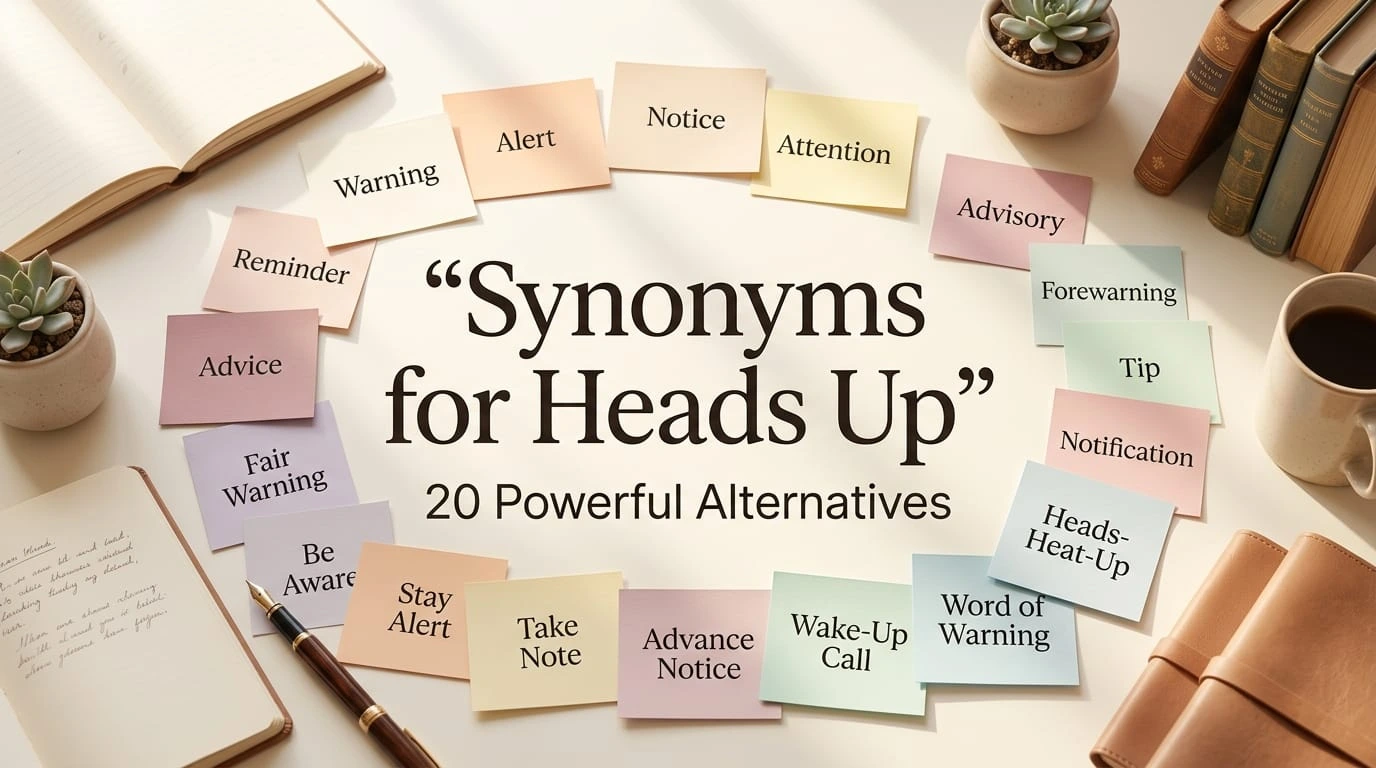
Synonyms for heads up include warning, alert, notice, reminder, caution, and FYI, with options for casual, professional, and formal situations.
Heads up is a casual English phrase used to give someone a quick warning, alert, or useful piece of information. Imagine a friend telling you, “Heads up! The floor is wet,” just before you walk into the room. The phrase helps people notice something important before it happens. It is common in everyday conversations, text messages, workplaces, and informal writing because it sounds friendly and direct. I have often used heads up when reminding someone about a deadline, a sudden change, or something they need to watch for. Learning synonyms for heads up helps English learners choose the right expression for different situations. Some alternatives sound casual, while others are better for professional or formal communication. This guide explores the meaning, pronunciation, origin, usage, synonyms, antonyms, and semantic categories of heads up.
Meaning of Heads Up
Definition
Heads up (Interjection/Noun):
A warning or notice that tells someone to pay attention to something important or unexpected.
Examples
- Heads up! The ball is coming your way.
- Just a heads-up that the meeting starts at 9 a.m.
Connotative Meaning
Connotation means the feeling or idea associated with a word beyond its basic meaning.
- Positive tone: Helpful, friendly, and considerate.
- Negative tone: May suggest danger or an unwanted event when used as a warning.
- Neutral tone: Simply gives someone information or advance notice.
Etymology
Heads up developed from the literal idea of keeping one’s head raised and paying attention. The phrase later became an informal warning meaning “pay attention” or “be alert.”
- Old English (450–1100): Head comes from Old English hēafod, meaning the upper part of the body.
- Middle English (1100–1500): Forms such as hed and heed developed, while expressions involving raising or keeping the head became more common.
- Modern English (1500–Present): Heads up became established as an informal expression for warning or advance notice.
Pronunciation (IPA)
- IPA: /hɛdz ʌp/
- Syllables: heads up
Affixation Pattern of Heads Up
- Root: head + up
- Prefix: None
- Suffix: None
- Word formations:
- head: noun/verb
- heads: noun/verb
- headed: verb/adjective
- heading: noun/verb
- head-up: adjective in some technical contexts
- heads-up: noun/adjective
30 Synonyms of Heads Up With Meaning & Examples
1. Warning (Noun)
Meaning: Information about possible danger or trouble.
Examples:
- She gave me a warning about the slippery road.
- The sign provides a warning to drivers.
2. Alert (Noun/Verb)
Meaning: A notice that tells someone about a possible problem or event.
Examples:
- The system sent an alert about the storm.
- Please alert me if anything changes.
3. Notice (Noun)
Meaning: Information given to make someone aware of something.
Examples:
- We received notice about the schedule change.
- Please give me notice before you leave.
4. Caution (Noun/Verb)
Meaning: A warning to act carefully.
Examples:
- The sign gives a caution about the wet floor.
- Doctors caution people against excessive sun exposure.
5. Forewarning (Noun)
Meaning: Information given before something happens.
Examples:
- We received a forewarning about the storm.
- The manager gave us forewarning of the changes.
6. Advisory (Noun)
Meaning: Official information or advice about a possible risk.
Examples:
- The weather service issued an advisory.
- Check the travel advisory before leaving.
7. Reminder (Noun)
Meaning: Information that helps someone remember something.
Examples:
- This email is a reminder about tomorrow’s meeting.
- Thanks for the reminder.
8. Alertness (Noun)
Meaning: The state of being watchful and ready to notice something.
Examples:
- Drivers need constant alertness.
- Her alertness helped prevent an accident.
9. Notification (Noun)
Meaning: A message that informs someone about something.
Examples:
- I received a notification about the appointment.
- The app sent a notification to users.
10. Announcement (Noun)
Meaning: Public or formal information about something.
Examples:
- The company made an announcement today.
- An important announcement was posted online.
11. Advance Notice (Noun Phrase)
Meaning: Information given before an event or change occurs.
Examples:
- We received advance notice of the closure.
- Please give customers advance notice.
12. Tip-Off (Noun)
Meaning: A piece of information that alerts someone to something.
Examples:
- She gave me a tip-off about the problem.
- The tip-off helped us prepare.
13. Alerting (Adjective)
Meaning: Giving information that makes someone aware of something.
Examples:
- The message was alerting users to a possible issue.
- We sent an alerting notice to staff.
14. Reminder Notice (Noun Phrase)
Meaning: A message that reminds someone about an upcoming event or requirement.
Examples:
- The school sent a reminder notice.
- I received a reminder notice yesterday.
15. FYI (Abbreviation)
Meaning: “For your information,” used to share useful information.
Examples:
- FYI, the meeting has moved to Friday.
- FYI, I already sent the report.
16. Be Careful (Phrase)
Meaning: A direct expression telling someone to avoid danger.
Examples:
- Be careful! The stairs are wet.
- Be careful when crossing the road.
17. Look Out (Phrasal Verb)
Meaning: A phrase used to warn someone about immediate danger.
Examples:
- Look out! The car is coming.
- Look out for falling branches.
18. Watch Out (Phrasal Verb)
Meaning: To warn someone to pay attention to danger.
Examples:
- Watch out! There’s a hole ahead.
- Watch out for the sharp edge.
19. Take Care (Phrase)
Meaning: A friendly warning to be careful.
Examples:
- Take care on the icy road.
- Take care when using the equipment.
20. Keep in Mind (Phrase)
Meaning: To remember or consider important information.
Examples:
- Keep in mind that prices may change.
- Keep in mind that the deadline is Friday.
21. Be Aware (Phrase)
Meaning: To know about or recognize something.
Examples:
- Be aware of the traffic around you.
- Be aware that the rules have changed.
22. Pay Attention (Verb Phrase)
Meaning: To focus on something carefully.
Examples:
- Pay attention to the warning signs.
- Pay attention when the instructor speaks.
23. Take Note (Verb Phrase)
Meaning: To pay attention to and remember something.
Examples:
- Take note of the new deadline.
- Please take note of these instructions.
24. Keep an Eye Out (Phrase)
Meaning: To watch carefully for someone or something.
Examples:
- Keep an eye out for the delivery.
- Keep an eye out for changes in the schedule.
25. Be on the Lookout (Phrase)
Meaning: To watch carefully for something expected.
Examples:
- Be on the lookout for suspicious activity.
- We are on the lookout for new opportunities.
26. Inform (Verb)
Meaning: To give someone information about something.
Examples:
- Please inform me of any changes.
- We will inform customers about the update.
27. Advise (Verb)
Meaning: To give someone information or guidance.
Examples:
- I advise you to arrive early.
- The doctor advised him to rest.
28. Notify (Verb)
Meaning: To officially tell someone about something.
Examples:
- Please notify us of any changes.
- The company notified employees about the new policy.
29. Signal (Noun/Verb)
Meaning: A sign or action that gives information about something.
Examples:
- The light signals that it is safe to proceed.
- The warning sign signaled danger ahead.
30. Alert Someone (Verb Phrase)
Meaning: To make someone aware of a possible problem or event.
Examples:
- Please alert the staff to the issue.
- The message alerted everyone to the change.
Heads-Up vs Warning vs Alert
| Word | Main Difference |
|---|---|
| Heads up | Casual advance warning |
| Warning | Alerts about danger or a problem |
| Alert | Makes someone aware of something important |
Prototype Meaning
The most typical meaning of heads up is a quick warning or advance notice. When someone says “Heads up!”, you usually understand that you should pay attention because something important is about to happen. It is especially common in casual speech and informal messages.
Prototype Categorization
| Semantic Category | Synonyms | Best Used For |
|---|---|---|
| Warnings & Danger | warning, caution, look out, watch out, be careful | Immediate risks and possible danger |
| Information & Notice | notice, alert, notification, announcement, FYI | Sharing useful information |
| Advance Information | forewarning, advance notice, reminder, advisory | Events or changes that happen later |
| Awareness & Attention | alertness, be aware, pay attention, take note | Encouraging careful attention |
| Monitoring | keep an eye out, be on the lookout, signal | Watching for something |
| Formal Communication | inform, advise, notify, advisory | Professional or official situations |
| Casual Expressions | tip-off, FYI, take care, heads up | Friendly everyday communication |
This categorization helps you choose a synonym based on tone and context. For example, watch out is best for immediate danger, while notify works better in formal communication.
Antonyms of Heads Up
1. Unawareness (Noun)
Meaning: A lack of knowledge about something.
2. Ignorance (Noun)
Meaning: A lack of information or awareness.
3. Surprise (Noun)
Meaning: Something unexpected that happens without advance notice.
4. Concealment (Noun)
Meaning: The act of keeping information hidden.
5. Silence (Noun)
Meaning: A lack of communication or information.
Short Questions and Answers
What does heads up mean?
Heads up means a warning or advance notice that tells someone to pay attention.
When should heads up be used?
Use heads up in casual conversations, messages, and informal situations when you want to quickly alert someone.
Is heads up positive or negative?
It is generally neutral. Its tone depends on the information being shared.
How is it different from similar words?
Heads up is casual and friendly. Warning can sound more serious, while notification and advisory are more formal.
Conclusion
Learning synonyms for heads up gives you more ways to warn, inform, and guide others. Words such as warning, alert, notice, caution, reminder, advisory, FYI, and notification can replace the phrase in different situations. Casual expressions such as look out, watch out, and be careful work well in everyday speech, while notify, inform, and advise are better suited to professional communication. Understanding these small differences helps English learners sound more natural and precise. It also gives writers more choices and helps them avoid repeating the same phrase. Practice these alternatives in real conversations and sentences to build stronger vocabulary and greater confidence in English.
Synonyms for Explode: 30 Powerful Alternatives

I am a language content specialist focused on English synonyms, vocabulary development, and word meanings. I create clear, practical guides that help readers choose the right words and communicate with confidence.