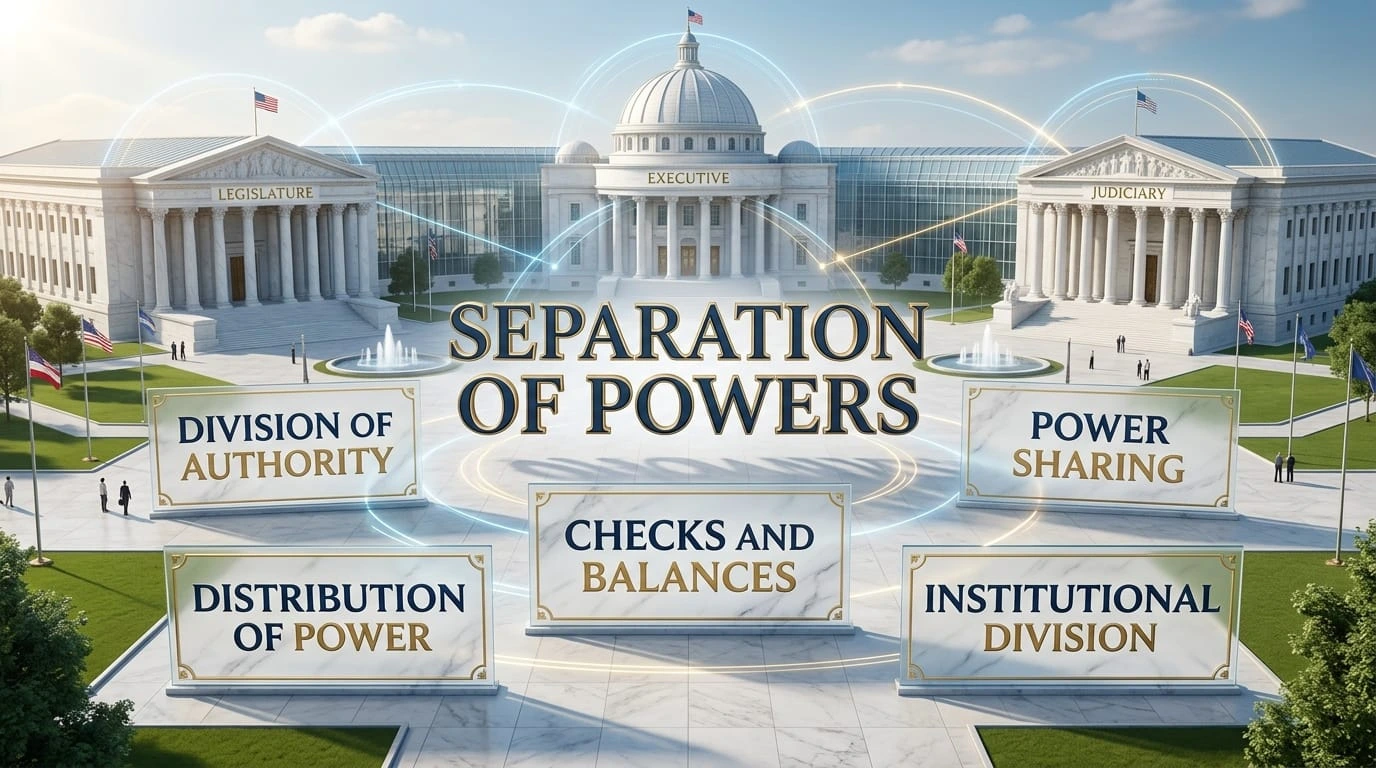
Separation of powers means dividing government authority among different branches so that no single branch has complete control.
Separation of powers is a system that divides government power among different branches. For example, one branch may make laws, another may carry them out, and another may interpret them. This system helps prevent too much power from being placed in one set of hands. The term is common in political science, law, civics, and government studies. English learners and students may search for synonyms because the phrase can sound formal or difficult to repeat in an essay. However, most alternatives are contextual equivalents, not perfect synonyms. In this guide, you will learn useful alternatives for separation of powers, their meanings, examples, history, pronunciation, word forms, and semantic categories. This will help you choose the clearest term for academic writing and discussions about government.
Meaning of Separation of Powers
Definition
Separation of powers (Noun Phrase):
A system in which government authority is divided among separate branches with different roles and powers.
Examples
- The constitution protects the separation of powers among the three branches of government.
- Separation of powers prevents one branch from controlling every part of government.
Connotative Meaning
Connotation means the feeling or idea associated with a word beyond its basic meaning.
- Positive tone: Suggests fairness, balance, accountability, and limited government power.
- Negative tone: May suggest conflict or delays between branches when they disagree.
- Neutral tone: Simply describes the division of government authority.
Etymology
The phrase separation of powers combines common English words with long Latin and French influences.
- Old English (450–1100): Separation ultimately comes from Latin separare, meaning “to set apart.” Power comes from Old French and ultimately Latin potere, meaning “to be able.”
- Middle English (1100–1500): Forms such as separacioun and power developed in English. Power referred to ability, authority, or control.
- Modern English (1500–Present): Separation of powers became a major political and constitutional term describing the division of government authority among branches.
The political idea is strongly linked with Montesquieu, whose 18th-century writings developed the modern theory of divided government powers.
Pronunciation (IPA)
- IPA: /ˌsepəˈreɪʃən əv ˈpaʊərz/
- Syllables: sep-a-ra-tion of pow-ers
Affixation Pattern of Separation of Powers
- Root: separate / power
- Prefix: None in separation; power has no productive prefix.
- Suffix: -ation in separation
- Word formations:
- separate verb/adjective
- separated verb/adjective
- separating verb
- separation noun
- separately adverb
- power noun/verb
- powerful adjective
- powerless adjective
- empower verb
- empowerment noun
25 Synonyms of Separation of Powers With Meaning & Examples
Note: Because separation of powers is a specialized constitutional concept, some alternatives below are close contextual equivalents rather than exact synonyms.
1. Division of Government Powers (Noun Phrase)
Meaning: The practice of dividing government authority among different branches.
Examples:
- The constitution supports the division of government powers.
- The division of government powers limits central control.
2. Division of Powers (Noun Phrase)
Meaning: The distribution of political authority among separate bodies.
Examples:
- The division of powers creates limits on government authority.
- Students studied the division of powers in civics class.
3. Distribution of Powers (Noun Phrase)
Meaning: The process of assigning government powers to different institutions.
Examples:
- The constitution defines the distribution of powers.
- A fair distribution of powers can reduce political concentration.
4. Division of Authority (Noun Phrase)
Meaning: The sharing of official control among different institutions.
Examples:
- The system depends on a division of authority.
- The division of authority prevents one office from controlling everything.
5. Distribution of Authority (Noun Phrase)
Meaning: The allocation of decision-making power among different bodies.
Examples:
- The constitution sets out the distribution of authority.
- The distribution of authority protects institutional independence.
6. Constitutional Division of Powers (Noun Phrase)
Meaning: The division of government powers established by a constitution.
Examples:
- The constitutional division of powers limits each branch.
- Courts often interpret the constitutional division of powers.
7. Branch-Based Government (Noun Phrase)
Meaning: A government organized into separate branches with different responsibilities.
Examples:
- Branch-based government can prevent excessive central control.
- The country uses a branch-based government structure.
8. Divided Government Authority (Noun Phrase)
Meaning: Government authority shared between separate institutions.
Examples:
- Divided government authority can create stronger checks.
- The constitution promotes divided government authority.
9. Institutional Separation (Noun Phrase)
Meaning: The separation of responsibilities among different government institutions.
Examples:
- Institutional separation protects the independence of each branch.
- Strong institutional separation can limit political interference.
10. Constitutional Separation (Noun Phrase)
Meaning: The formal division of government functions under constitutional rules.
Examples:
- Constitutional separation limits the reach of government branches.
- The court defended the principle of constitutional separation.
11. Functional Separation (Noun Phrase)
Meaning: Dividing government work according to different functions.
Examples:
- Functional separation gives each branch a distinct role.
- The system relies on functional separation.
12. Separation of Government Functions (Noun Phrase)
Meaning: Dividing lawmaking, administration, and judicial functions among institutions.
Examples:
- The separation of government functions supports accountability.
- Separation of government functions reduces overlapping authority.
13. Branch Separation (Noun Phrase)
Meaning: The division of responsibilities among government branches.
Examples:
- Branch separation is central to the constitutional system.
- Strong branch separation can limit executive power.
14. Independent Branches of Government (Noun Phrase)
Meaning: Separate government branches that have their own defined roles.
Examples:
- Independent branches of government can check one another.
- The constitution establishes independent branches of government.
15. Governmental Checks and Balances (Noun Phrase)
Meaning: A system in which government branches limit and monitor one another.
Examples:
- Governmental checks and balances help prevent abuse of power.
- The constitution uses checks and balances to limit each branch.
16. Constitutional Checks and Balances (Noun Phrase)
Meaning: Constitutional limits that allow government branches to check one another.
Examples:
- Constitutional checks and balances protect against excessive power.
- The system depends on constitutional checks and balances.
17. Institutional Checks (Noun Phrase)
Meaning: Limits placed on one institution by another institution.
Examples:
- Institutional checks can prevent government overreach.
- Strong institutional checks support accountability.
18. Mutual Checks (Noun Phrase)
Meaning: A system where institutions monitor and limit each other’s authority.
Examples:
- Mutual checks prevent one branch from becoming too powerful.
- The branches operate through mutual checks.
19. Dispersal of Political Power (Noun Phrase)
Meaning: The spreading of political power among different institutions.
Examples:
- The constitution encourages the dispersal of political power.
- Dispersal of political power can protect against authoritarian control.
20. Diffusion of Political Authority (Noun Phrase)
Meaning: The spread of political authority across several institutions.
Examples:
- Diffusion of political authority reduces concentration of power.
- The system encourages the diffusion of political authority.
21. Decentralization of Authority (Noun Phrase)
Meaning: Moving authority away from one central body and giving it to different bodies.
Examples:
- Decentralization of authority can reduce central control.
- The reform increased decentralization of authority.
22. Limited Government Structure (Noun Phrase)
Meaning: A government system in which official power is restricted by rules and institutions.
Examples:
- A limited government structure protects individual rights.
- The constitution creates a limited government structure.
23. Constitutional Power Sharing (Noun Phrase)
Meaning: The sharing of government authority under constitutional rules.
Examples:
- Constitutional power sharing limits the authority of each branch.
- The system is based on constitutional power sharing.
24. Balanced Government Power (Noun Phrase)
Meaning: A system where government power is spread so that no branch dominates.
Examples:
- Balanced government power can protect democratic institutions.
- The constitution aims for balanced government power.
25. Separation of State Authority (Noun Phrase)
Meaning: The division of state authority among different government institutions.
Examples:
- Separation of state authority limits political concentration.
- The constitution supports the separation of state authority.
Prototype Meaning
The most typical meaning of separation of powers is the division of government authority among separate branches. People usually imagine a system with three main functions: making laws, carrying out laws, and interpreting laws. The central idea is that no single branch should hold unlimited government power.
Prototype Categorization
| Semantic Category | Useful Alternatives | Main Idea |
| Division of Power | division of powers, distribution of powers, division of authority | Power is shared among institutions |
| Constitutional Structure | constitutional division of powers, constitutional separation, constitutional power sharing | Power is divided by constitutional rules |
| Government Branches | branch-based government, branch separation, independent branches of government | Different branches have different roles |
| Checks and Limits | checks and balances, institutional checks, mutual checks | Institutions limit one another |
| Political Power Distribution | dispersal of political power, diffusion of political authority | Power is spread across institutions |
| Decentralized Authority | decentralization of authority, distributed authority | Authority is moved away from one central body |
| Limited Government | limited government structure, balanced government power | Government power is restricted or balanced |
This categorization helps writers choose the right alternative. For a constitutional essay, use terms such as constitutional division of powers and for a discussion of branch relationships, checks and balances may be better. For a broader discussion of political authority, distribution of powers or dispersal of political power can work well.
Antonyms of Separation of Powers
There is no single perfect antonym, but these terms express the opposite idea:
- Concentration of power placing major authority in one institution or person.
- Centralization of power bringing government authority under central control.
- Concentration of authority allowing one body to hold most decision-making power.
- Unified government control control held by one central authority.
- Centralized government a government where major decisions are controlled centrally.
- One-party rule political control dominated by one political party.
- Absolute authority power without meaningful institutional limits.
- Autocratic rule government controlled by one leader with broad power.
- Consolidation of power bringing political authority together under one center.
Short Questions and Answers
What does separation of powers mean?
Separation of powers means dividing government authority among separate branches so that no single branch has complete control.
When should separation of powers be used?
Use the phrase when discussing constitutional systems, government branches, political authority, lawmaking, executive action, and judicial power.
Is separation of powers positive or negative?
It is generally viewed positively because it can prevent excessive power and support accountability, although divided branches can sometimes create delays or conflict.
How is it different from similar words?
Separation of powers focuses on dividing government functions among branches. Checks and balances focuses on how those branches limit and monitor one another. Decentralization is broader and can apply beyond the main branches of government.
Conclusion
Learning the meaning and contextual alternatives of separation of powers can improve your political, legal, and academic vocabulary. Terms such as division of powers, distribution of authority, and constitutional separation can help avoid repetition in formal writing. However, these expressions are not always exact synonyms. Words such as checks and balances describe a closely related idea but focus more on the way branches control one another. Understanding these small differences helps students, writers, and English learners choose accurate words. Regular practice with political vocabulary can make essays and discussions clearer and stronger. When writing about government, always consider the exact idea before replacing separation of powers with another expression.
Synonyms for Logos: 23 Words That Say It Better

I am a professional content writer with a passion for English vocabulary and word meanings. I create clear, informative guides on synonyms, alternative words, and word usage to help readers choose the right word and communicate with confidence.