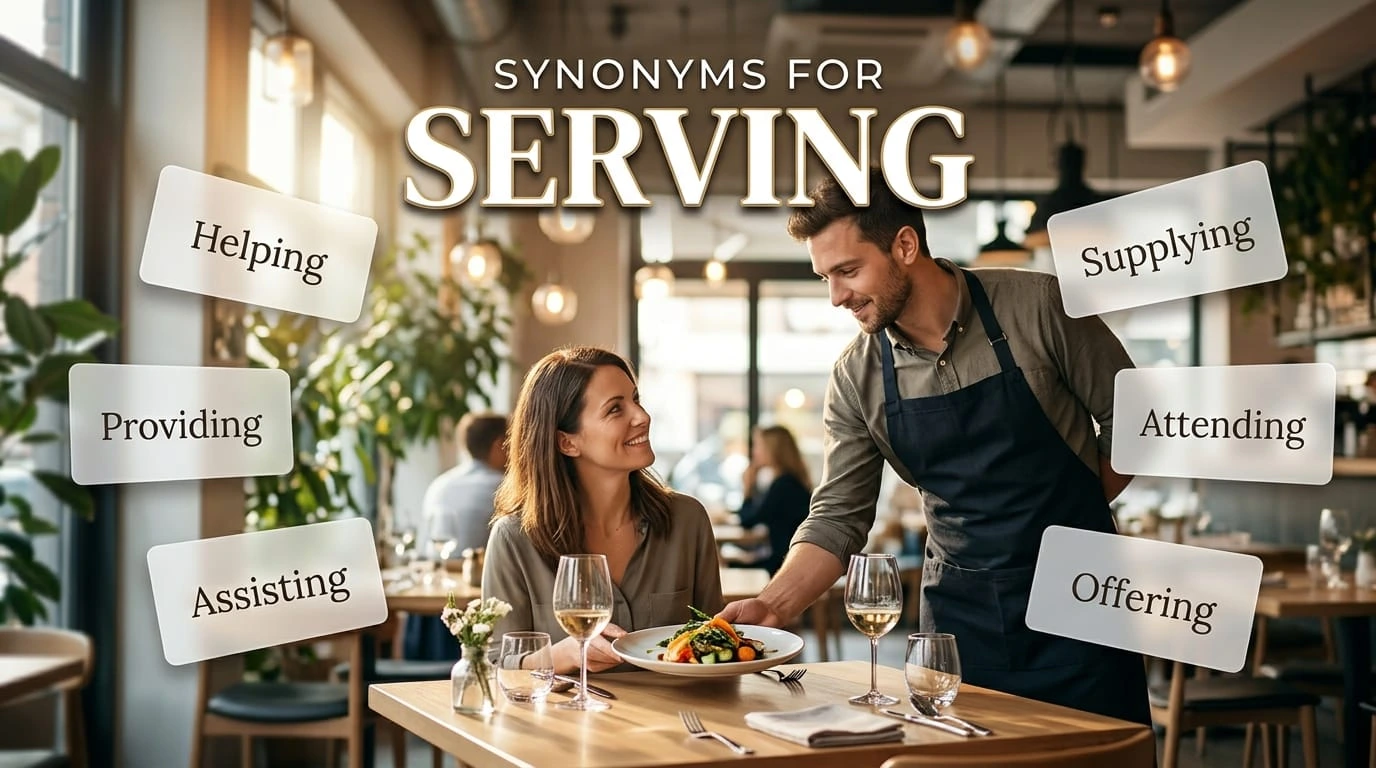
Serving means helping, providing, assisting, or fulfilling a need, duty, or purpose in different contexts.
Serving is a common English word with several meanings. It can describe giving food to someone, helping a person, working a customer, or performing a useful role. For example, a waiter may be serving dinner to guests, while a teacher is serving students by helping them learn. The word is common because it fits many everyday and professional situations. Learning synonyms for serving helps English learners avoid repeating the same word and choose language that fits the exact meaning. Writers can also use alternatives to make sentences clearer and more natural. In this guide, you will learn the meaning of serving, its useful synonyms, examples, grammar, history, pronunciation, word forms, and semantic categories. These alternatives will help you speak and write with greater confidence.
Meaning of Serving
Definition
Serving (Verb/Noun):
Serving means giving, providing, helping, working for, or performing a useful function for someone or something.
The exact meaning depends on the context.
Examples
- The waiter is serving dinner to the guests.
- She is serving her community through volunteer work.
Connotative Meaning
Connotation means the feeling or idea a word suggests beyond its basic meaning.
- Positive tone: Helpful, caring, useful, or devoted.
- Negative tone: Can suggest forced duty or unwanted work in some contexts.
- Neutral tone: Simply providing something or performing a function.
Etymology
The word serving comes from the verb serve, which has a long history in English.
- Old English (450–1100): Serve entered English through Old French and Latin influence. The Latin root servire meant “to serve” or “be a servant.”
- Middle English (1100–1500): Forms related to servan and servy were used for helping, working for someone, or performing duties.
- Modern English (1500–Present): Serve developed many meanings, including providing food, helping others, working in a role, and fulfilling a purpose. Serving is its present participle and gerund form.
Pronunciation (IPA)
- IPA: /ˈsɜː.vɪŋ/ (British English), /ˈsɝː.vɪŋ/ (American English)
- Syllables: serv-ing
Affixation Pattern of Serving
- Root: serv-
- Prefix: None
- Suffix: -ing
- Word formations:
- serve verb
- serves verb
- served verb/adjective
- serving verb/noun
- server noun
- service noun
- servant noun
- serviceman/servicewoman noun
- serviceable adjective
- servicing noun/verb
25 Synonyms of Serving With Meaning & Examples
1. Providing (Verb)
Meaning: Giving someone something they need or want.
Examples:
- The company is providing meals for workers.
- The charity is providing help to families.
2. Helping (Verb)
Meaning: Giving assistance to someone.
Examples:
- She is helping old people in her area.
- He spent the afternoon helping customers.
3. Assisting (Verb)
Meaning: Helping someone with a task or problem.
Examples:
- The nurse is assisting the doctor.
- Staff members are assisting visitors.
4. Supporting (Verb)
Meaning: Giving help, encouragement, or resources.
Examples:
- The organization is supporting local schools.
- Her family is supporting her during the project.
5. Supplying (Verb)
Meaning: Giving someone something that is needed.
Examples:
- The shop is supplying fresh food.
- The company is supplying equipment to schools.
6. Delivering (Verb)
Meaning: Taking or providing something to a person or place.
Examples:
- The restaurant is delivering meals.
- Workers are delivering supplies to the village.
7. Giving (Verb)
Meaning: Handing something to someone or making it available.
Examples:
- She is giving food to the children.
- He is giving useful advice.
8. Offering (Verb)
Meaning: Presenting something for someone to accept or use.
Examples:
- The hotel is offering free breakfast.
- She is offering help to new students.
9. Attending (Verb)
Meaning: Taking care of someone’s needs.
Examples:
- The nurse is attending to the patient.
- Staff are attending to the guests.
10. Caring for (Verb Phrase)
Meaning: Looking after someone or something.
Examples:
- She is caring for her pld mother.
- The worker is caring for the animals.
11. Waiting on (Verb Phrase)
Meaning: Serving customers, especially in a restaurant or shop.
Examples:
- The waiter was waiting on several guests.
- She spent the evening waiting on customers.
12. Catering (Verb)
Meaning: Providing food and drinks for an event or group.
Examples:
- The company is catering for a wedding.
- They are catering a large business event.
13. Administering (Verb)
Meaning: Giving or managing something officially, such as medicine or a service.
Examples:
- The nurse is administering the medicine.
- The agency is administering the program.
14. Functioning (Verb)
Meaning: Working or operating in a particular role.
Examples:
- The device is functioning as a backup system.
- The room is functioning as a temporary office.
15. Operating (Verb)
Meaning: Working or controlling a system, machine, or business.
Examples:
- The staff are operating the equipment.
- The company is operating several branches.
16. Performing (Verb)
Meaning: Carrying out a task, duty, or function.
Examples:
- The team is performing an important service.
- She is performing her duties well.
17. Working for (Verb Phrase)
Meaning: Doing a job for a person, company, or organization.
Examples:
- He is working for a local charity.
- She has been working for the company for five years.
18. Assuring (Verb)
Meaning: Giving confidence or certainty to someone.
Examples:
- The manager is assuring customers that the issue will be fixed.
- She is assuring the team of her support.
19. Satisfying (Verb)
Meaning: Meeting a need, desire, or requirement.
Examples:
- The new service is satisfying customer needs.
- The meal was satisfying the guests.
20. Meeting (Verb)
Meaning: Fulfilling a need, condition, or requirement.
Examples:
- The service is meeting customer expectations.
- The program is meeting an important community need.
21. Fulfilling (Verb)
Meaning: Successfully carrying out a duty, purpose, or requirement.
Examples:
- She is fulfilling her responsibilities.
- The program is fulfilling its main purpose.
22. Representing (Verb)
Meaning: Acting on behalf of a person, group, or organization.
Examples:
- He is representing his country at the event.
- She is representing the company professionally.
23. Devoting (Verb)
Meaning: Giving time, effort, or attention to a person or purpose.
Examples:
- She is devoting her time to community work.
- He is devoting himself to helping children.
24. Volunteering (Verb)
Meaning: Offering to help without being forced or paid.
Examples:
- Many students are volunteering at the shelter.
- She is volunteering to serve meals.
25. Assisting with (Verb Phrase)
Meaning: Helping with a particular activity or task.
Examples:
- He is assisting with the event.
- Staff are assisting with customer requests.
Prototype Meaning
The most typical meaning of serving is providing something or helping someone, especially by meeting a need. When people hear serving, they may imagine a waiter bringing food to a customer. However, the word also applies to wider situations, such as serving a community, serving a purpose, or serving in a professional role.
Prototype Categorization
| Semantic Category | Useful Synonyms | Best Used For |
| Providing something | providing, supplying, giving, offering | Food, goods, resources, information |
| Helping others | helping, assisting, supporting, assisting with | People, tasks, problems |
| Food and hospitality | catering, waiting on, attending | Restaurants, hotels, events |
| Care and duty | caring for, fulfilling, devoting | People, responsibilities, causes |
| Professional function | performing, operating, functioning, representing | Jobs, systems, roles |
| Meeting needs | satisfying, meeting, fulfilling | Needs, expectations, requirements |
| Community service | volunteering, working for, serving | Charities, communities, organizations |
This categorization helps writers choose a synonym based on the exact meaning they want instead of replacing serving with a word that only partly fits.
Antonyms of Serving
Because serving has several meanings, its antonyms also change with context.
- Neglecting (Verb): Failing to give proper care or attention.
- Withholding (Verb): Refusing to give something.
- Taking (Verb): Receiving or removing something rather than giving it.
- Ignoring (Verb): Choosing not to notice or respond to someone.
- Refusing (Verb): Choosing not to provide or accept something.
- Abandoning (Verb): Leaving someone or something without support.
- Receiving (Verb): Getting something rather than providing it.
- Hindering (Verb): Making an action or task harder.
Short Questions and Answers
What does serving mean?
Serving means providing something, helping someone, performing a role, or meeting a need. Its exact meaning depends on the sentence.
When should serving be used?
Use serving when talking about providing food, helping people, performing a duty, working for others, or fulfilling a purpose.
Is serving positive or negative?
Serving is usually neutral or positive. It often suggests help, care, duty, or useful action, but the tone depends on the context.
How is serving different from similar words?
Serving is broad. Providing focuses on giving something, helping focuses on assistance, catering focuses on food and events, and fulfilling focuses on completing a duty or purpose.
Conclusion
Learning serving and its synonyms gives you more ways to describe help, care, service, and providing something. Words such as providing, helping, assisting, and supporting are useful in everyday English. Other alternatives, such as catering, attending, and fulfilling, work better in specific situations. Knowing these differences helps you avoid repetition and choose the right word for your sentence. It also makes your writing clearer and more natural. English learners can improve by learning a few new synonyms each day and using them in short sentences. Writers can also study the context before replacing a common word. With regular practice, you can use serving and its alternatives with greater accuracy and confidence.
Synonyms for Good Enough : 30 Phrases to Know

I am a language content specialist focused on English synonyms, vocabulary development, and word meanings. I create clear, practical guides that help readers choose the right words and communicate with confidence.