Charisma is a natural personal quality that makes someone attractive, engaging, and influential.
Charisma is the special charm or personal appeal that makes people naturally interested in someone. Think about a person who walks into a room and quickly gets everyone’s attention without trying too hard. I once watched a speaker at an event who could make even a simple story feel exciting. People listened closely, smiled, and wanted to hear more. That natural ability is often called charisma. The word is common when we talk about leaders, actors, teachers, speakers, and other people who easily attract and influence others. Learning synonyms for charisma helps English learners describe personality and social appeal more precisely. It also helps writers avoid repetition and choose words that fit the exact context. In this guide, you will learn the meaning, pronunciation, origin, grammar, 20 synonyms, antonyms, and semantic categories of charisma.
Meaning of Charisma
Definition
Charisma (Noun):
A natural personal quality that makes someone attractive, engaging, and able to influence or inspire others.
Examples
- Her charisma made everyone feel comfortable around her.
- The speaker used his charisma to connect with the audience.
Connotative Meaning
Connotation means the feeling or idea associated with a word beyond its basic meaning.
- Positive tone: Charm, confidence, appeal, and inspiration.
- Negative tone: Can sometimes suggest manipulation or excessive influence.
- Neutral tone: Simply describes a person’s ability to attract or influence others.
Etymology
The word charisma comes from the Greek kharisma, meaning “favor,” “grace,” or “gift.” It originally referred to a special divine gift or grace.
- Old English (450–1100): Charisma was not part of Old English vocabulary.
- Middle English (1100–1500): The Greek-derived religious term was used mainly in theological contexts.
- Modern English (1500–Present): Charisma developed its broader modern meaning of exceptional personal appeal, charm, and influence.
Pronunciation (IPA)
- IPA: /kəˈrɪz.mə/
- Syllables: cha-ris-ma
Affixation Pattern of Charisma
- Root: Greek kharisma (“favor” or “gift”)
- Prefix: None
- Suffix: -ma
- Word formations:
- charisma: noun
- charismatic: adjective
- charismatically: adverb
- charismaticness: noun, uncommon
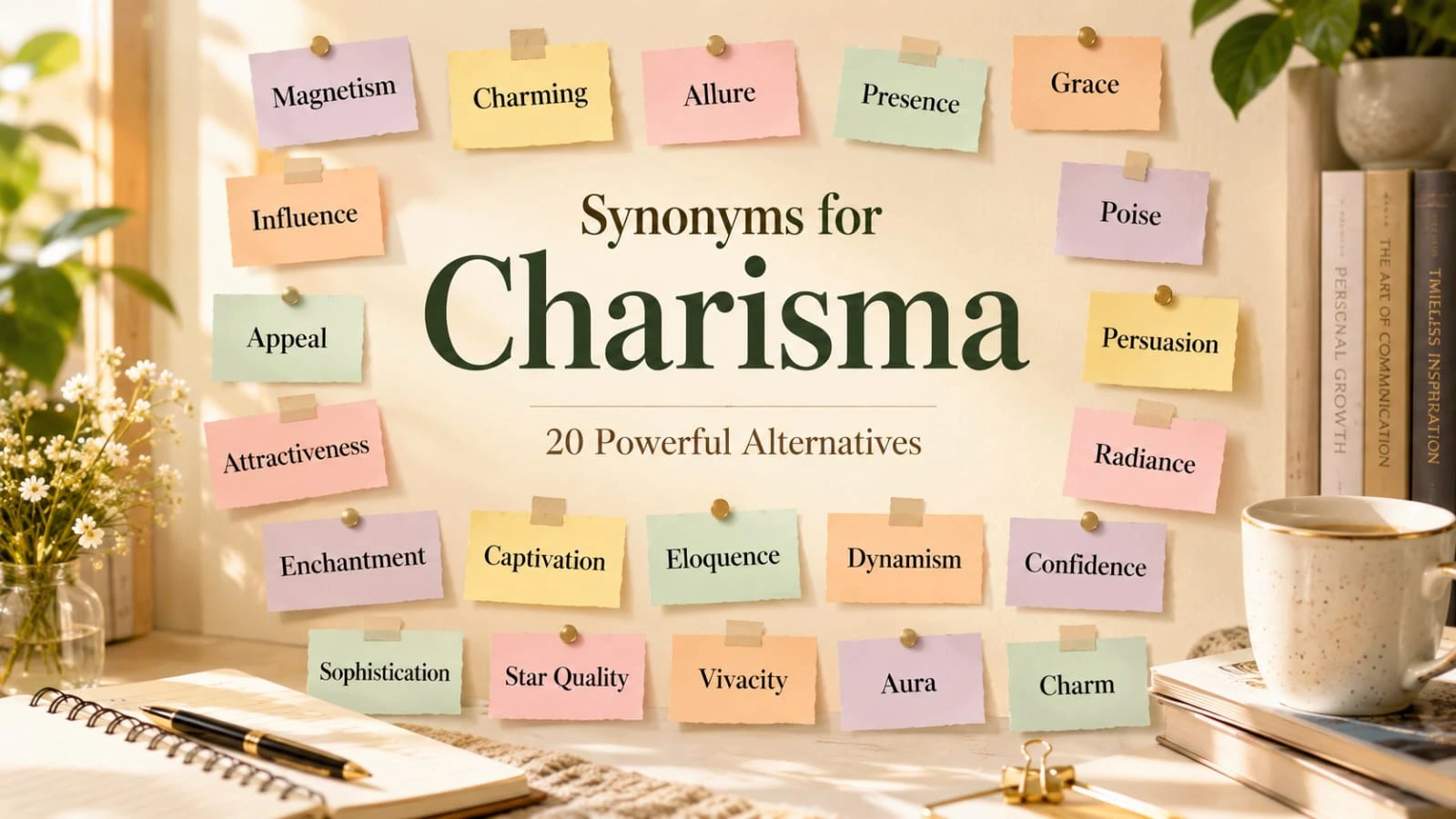
20 Synonyms of Charisma With Meaning & Examples
1. Charm (Noun)
Meaning: A pleasant quality that makes someone attractive or likable.
Examples:
- Her natural charm won over the audience.
- He has a quiet charm that people notice.
2. Appeal (Noun)
Meaning: The quality of being attractive or interesting to others.
Examples:
- The actor has strong appeal with younger audiences.
- Her friendly personality adds to her appeal.
3. Magnetism (Noun)
Meaning: A powerful personal attraction that draws people toward someone.
Examples:
- The leader had incredible magnetism.
- His magnetism attracted people wherever he went.
4. Allure (Noun)
Meaning: A strong quality of attraction or fascination.
Examples:
- Her allure was impossible to ignore.
- The performer had an unusual allure.
5. Attractiveness (Noun)
Meaning: The quality of being appealing or pleasing to others.
Examples:
- His confidence increased his attractiveness.
- Her warmth adds to her attractiveness.
6. Influence (Noun)
Meaning: The power to affect people’s thoughts, feelings, or actions.
Examples:
- Her influence extends far beyond her workplace.
- The leader used his influence to inspire change.
7. Presence (Noun)
Meaning: A noticeable and powerful quality that someone has when they are present.
Examples:
- The speaker had a strong presence on stage.
- Her calm presence made everyone feel relaxed.
8. Appealability (Noun)
Meaning: The quality of being attractive or appealing.
Examples:
- The candidate’s appealability helped attract younger voters.
- His public appealability grew over time.
9. Grace (Noun)
Meaning: A natural quality of elegance, kindness, or ease.
Examples:
- She handled the criticism with grace.
- His grace made him pleasant to work with.
10. Star Quality (Noun Phrase)
Meaning: A special quality that makes someone seem highly attractive or impressive.
Examples:
- The young actor has real star quality.
- Her star quality was clear from the first performance.
11. Glamour (Noun)
Meaning: An attractive or exciting quality that creates fascination.
Examples:
- The actress brought glamour to the event.
- The city’s nightlife has a certain glamour.
12. Fascination (Noun)
Meaning: A powerful feeling of interest or attraction.
Examples:
- His stories created fascination among listeners.
- Her personality held everyone’s fascination.
13. Enchantment (Noun)
Meaning: A feeling of delight or attraction that seems almost magical.
Examples:
- The performer cast an enchantment over the crowd.
- Her storytelling created a sense of enchantment.
14. Persuasiveness (Noun)
Meaning: The ability to convince people to accept an idea or take action.
Examples:
- His persuasiveness helped close the deal.
- Her persuasiveness made the argument convincing.
15. Eloquence (Noun)
Meaning: The ability to speak or write clearly and effectively.
Examples:
- His eloquence impressed the audience.
- She spoke with remarkable eloquence.
16. Popularity (Noun)
Meaning: The state of being liked or admired by many people.
Examples:
- His popularity grew after the interview.
- Her popularity helped promote the campaign.
17. Likability (Noun)
Meaning: The quality of being easy to like or enjoy being around.
Examples:
- His likability made him popular with coworkers.
- The actor’s likability helped build a strong fan base.
18. Warmth (Noun)
Meaning: A friendly and kind quality that makes others feel comfortable.
Examples:
- Her warmth made guests feel welcome.
- He greeted everyone with genuine warmth.
19. Vivacity (Noun)
Meaning: Lively energy and enthusiasm.
Examples:
- Her vivacity energized the entire room.
- His vivacity made his presentation memorable.
20. Dynamism (Noun)
Meaning: Energetic and active qualities that create movement or change.
Examples:
- Her dynamism made her an effective leader.
- The team’s dynamism attracted new members.
Note: Some words above, such as confidence, personality, leadership, and eloquence, overlap with charisma but are not exact synonyms in every context. They describe qualities that can contribute to or express charisma.
“Charisma vs Charm vs Magnetism”
| Word | Main Idea |
|---|---|
| Charisma | Attraction + influence |
| Charm | Pleasant attractiveness |
| Magnetism | Powerful ability to draw people |
| Allure | Fascinating attraction |
| Presence | Noticeable personal impact |
Prototype Meaning
The most typical meaning of charisma is a powerful personal charm that naturally attracts and influences people. When people hear this word, they often imagine a confident speaker, inspiring leader, performer, or public figure who easily captures attention and creates a strong connection with others.
Prototype Categorization
| Semantic Category | Synonyms | Best Used For |
|---|---|---|
| Charm & Attraction | charm, appeal, allure, attractiveness, glamour | Personal attractiveness and likability |
| Personal Magnetism | magnetism, presence, star quality, fascination | Someone who naturally draws attention |
| Communication & Influence | influence, persuasiveness, eloquence, leadership | Inspiring or convincing others |
| Confidence & Energy | confidence, vivacity, vigor, dynamism | Energetic and confident personalities |
| Warmth & Likability | warmth, likability, grace, personality | Friendly and pleasant people |
| Public Appeal | popularity, star quality, appeal | Public figures and performers |
This categorization helps writers choose a more precise alternative. For example, magnetism emphasizes attraction, eloquence focuses on communication, and dynamism highlights energy and action.
Antonyms of Charisma
1. Unattractiveness (Noun)
Meaning: A lack of qualities that make someone appealing.
2. Unlikability (Noun)
Meaning: The quality of being difficult to like.
3. Repulsiveness (Noun)
Meaning: A quality that causes strong dislike or rejection.
4. Blandness (Noun)
Meaning: A lack of excitement, personality, or distinctive qualities.
5. Dullness (Noun)
Meaning: A lack of energy, interest, or liveliness.
6. Awkwardness (Noun)
Meaning: A lack of ease or confidence in social situations.
Short Questions and Answers
What does charisma mean?
Charisma means a natural personal quality that makes someone attractive, engaging, and influential.
When should charisma be used?
Use charisma when describing someone’s ability to attract attention, connect with people, inspire others, or influence an audience.
Is charisma positive or negative?
Charisma is usually positive because it suggests charm, confidence, and influence. However, charismatic people can sometimes use their influence negatively.
How is it different from similar words?
Charisma is broader than charm. Charm mainly describes pleasant attractiveness, while charisma often includes charm, confidence, influence, and the ability to inspire others.
What is the best synonym for charisma?
The best synonym for charisma is “magnetism” because it describes a powerful personal quality that naturally attracts and influences people.
Is charisma a personality trait?
Yes. Charisma is generally considered a personality trait because it describes a person’s natural ability to attract, engage, and influence others through their personality and presence.
Conclusion
Learning synonyms for charisma gives you more precise ways to describe attractive and influential personalities. Words such as charm, magnetism, allure, presence, confidence, eloquence, warmth, dynamism, and likability each highlight a different part of personal appeal. Choosing the right word can make your writing more natural and specific. For example, magnetism emphasizes a powerful attraction, eloquence focuses on communication, and warmth highlights friendliness. These distinctions are useful for English learners, students, and content writers who want to expand their vocabulary without repeating the same word. Practice these synonyms in real sentences and notice how their meanings change with context. Regular vocabulary practice can help you communicate with greater clarity, variety, and confidence.
Synonyms for Indifference: 30 Powerful Alternatives

I’m Daniel Carter, specialize in helping readers discover synonyms, expand their vocabulary, and choose the perfect word with confidence. My content helps readers improve their English, avoid common mistakes, and write with confidence. My goal is to provide accurate, reliable, and easy-to-understand language resources