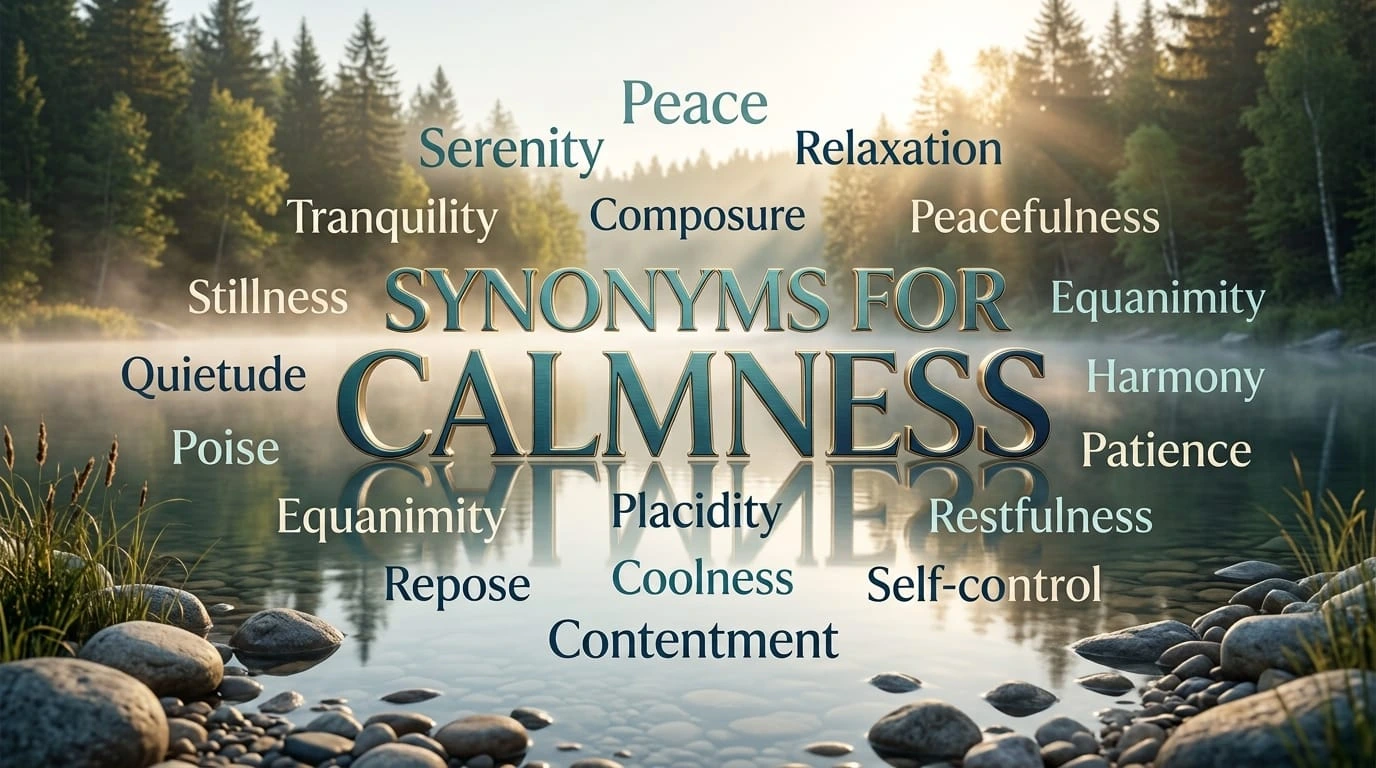
"Synonyms for calmness include serenity, tranquility, peace, composure, poise, stillness, quietness, equanimity, and peacefulness."
Calmness is a state of being peaceful, relaxed, and free from strong worry or excitement. Imagine sitting quietly after a busy day, taking a deep breath, and feeling your mind slow down. That peaceful feeling is calmness. The word is common in everyday English because people often use it to describe a relaxed mind, peaceful behavior, or a quiet situation. Learning synonyms for calmness can help English learners express emotions with greater accuracy and give writers more ways to describe peaceful states without repeating the same word. Some alternatives focus on inner peace, while others describe quiet behavior, emotional control, or freedom from worry. In this guide, we will explore the meaning of calmness, its examples, connotation, etymology, pronunciation, word formation, 22 useful synonyms, semantic categories, antonyms, and common questions.
Meaning of calmness
Definition
Calmness (Noun):
A peaceful and relaxed state without worry, anger, excitement, or stress.
Examples
- Her calmness helped everyone feel less nervous.
- He handled the difficult situation with remarkable calmness.
Connotative Meaning
Connotation means the feeling or idea that a word suggests beyond its basic meaning.
- Positive tone: Peace, self-control, confidence, patience, and emotional balance.
- Negative tone: In some situations, extreme calmness may seem like a lack of concern or emotion.
- Neutral tone: Simply describes a peaceful or steady state.
Etymology
The word calmness comes from calm, which entered English through French from Latin.
- Old English (450–1100): The modern word calmness did not exist in Old English. English used other words to express ideas such as quietness and peace.
- Middle English (1100–1500): Calm entered English through Old French calme, ultimately connected to Latin cauma, referring to the heat of the day or a period of stillness.
- Modern English (1500–Present): Calmness developed by adding the suffix -ness to calm, creating a noun meaning the state or quality of being calm.
Pronunciation (IPA)
- IPA: /ˈkɑːmnəs/
- Syllables: calm-ness
Affixation Pattern of calmness
- Root: calm
- Prefix: None
- Suffix: -ness
- Word formations:
- calm: adjective/verb/noun
- calmness: noun
- calmly: adverb
- calmer: adjective
- calmest: adjective
- calmed: verb
- calming: adjective/verb
- calmness: noun
The suffix -ness turns the adjective calm into the noun calmness, referring to the state or quality of being calm.
22 Synonyms of calmness With Meaning & Examples
1. Peace (Noun)
Meaning: A quiet and relaxed state without conflict, worry, or disturbance.
Examples:
- She found peace in the quiet garden.
- Meditation gives him a sense of peace.
2. Serenity (Noun)
Meaning: A deep feeling of peace and quiet.
Examples:
- The lake gave her a sense of serenity.
- He enjoyed the serenity of the countryside.
3. Tranquility (Noun)
Meaning: A state of complete peace and quiet.
Examples:
- The village is known for its tranquility.
- She searched for tranquility after a stressful week.
4. Composure (Noun)
Meaning: The ability to remain calm and controlled in a difficult situation.
Examples:
- She maintained her composure during the interview.
- His composure impressed everyone.
5. Equanimity (Noun)
Meaning: A calm and balanced state of mind, especially during trouble.
Examples:
- He faced the criticism with equanimity.
- Her equanimity helped the team stay focused.
6. Stillness (Noun)
Meaning: A state of being quiet, peaceful, and without movement.
Examples:
- She enjoyed the stillness of the early morning.
- The forest was filled with stillness.
7. Quietness (Noun)
Meaning: A state of being quiet and free from noise or disturbance.
Examples:
- I appreciate the quietness of the countryside.
- The quietness helped him concentrate.
8. Peacefulness (Noun)
Meaning: A gentle state of peace and freedom from disturbance.
Examples:
- The garden has a feeling of peacefulness.
- She admired the peacefulness of the small town.
9. Repose (Noun)
Meaning: A state of rest, relaxation, or peacefulness.
Examples:
- The quiet room offered a sense of repose.
- He spent the afternoon in peaceful repose.
10. Relaxation (Noun)
Meaning: A state of being free from physical or mental tension.
Examples:
- Reading provides much-needed relaxation.
- The vacation gave her time for relaxation.
11. Restfulness (Noun)
Meaning: A peaceful and relaxed condition.
Examples:
- The soft music created a feeling of restfulness.
- The room was designed for restfulness.
12. Quietude (Noun)
Meaning: A state of deep quiet and peacefulness.
Examples:
- He enjoyed the quietude of the mountain cabin.
- The library provided a sense of quietude.
13. Coolness (Noun)
Meaning: A calm and controlled attitude, especially during pressure.
Examples:
- Her coolness helped during the crisis.
- He responded with remarkable coolness.
14. Self-control (Noun)
Meaning: The ability to control your emotions and actions.
Examples:
- His self-control prevented an argument.
- She showed great self-control under pressure.
15. Self-possession (Noun)
Meaning: Confidence and control over your emotions and behavior.
Examples:
- She spoke with complete self-possession.
- His self-possession helped him answer difficult questions.
16. Poise (Noun)
Meaning: Calm confidence and graceful control.
Examples:
- She answered the questions with poise.
- His poise impressed the audience.
17. Collectedness (Noun)
Meaning: A calm and controlled mental state.
Examples:
- Her collectedness helped the group remain calm.
- He showed impressive collectedness during the emergency.
18. Unruffledness (Noun)
Meaning: A state of remaining calm and not becoming upset.
Examples:
- His unruffledness surprised his coworkers.
- She maintained her unruffledness despite the pressure.
19. Sangfroid (Noun)
Meaning: Calmness and self-control in a difficult or dangerous situation.
Examples:
- The pilot showed remarkable sangfroid.
- Her sangfroid impressed everyone during the crisis.
20. Steadiness (Noun)
Meaning: The quality of remaining calm, stable, and controlled.
Examples:
- His steadiness helped the team.
- She handled the situation with great steadiness.
21. Stability (Noun)
Meaning: A state of being steady and not easily disturbed.
Examples:
- The routine gave him emotional stability.
- The organization needs greater stability.
22. Patience (Noun)
Meaning: The ability to remain calm while waiting or dealing with difficulty.
Examples:
- Teaching young children requires patience.
- She handled the delay with patience.
Prototype Meaning
The prototype meaning of calmness is a peaceful and controlled state of mind or behavior. When people hear the word, they often imagine someone who remains relaxed, steady, and emotionally balanced even when facing stress. A calm person does not easily panic, become angry, or react impulsively. Calmness can describe both an inner emotional state and the peaceful way someone behaves.
Prototype Categorization
| Semantic Category | Synonyms | Typical Use |
| Inner Peace | Peace, serenity, tranquility, peacefulness, quietude | Describing a deep sense of peace |
| Emotional Control | Composure, equanimity, self-control, self-possession, collectedness | Describing control during stress or difficulty |
| Quiet & Stillness | Stillness, quietness, repose, restfulness | Describing peaceful surroundings or a relaxed state |
| Calm Confidence | Poise, coolness, sangfroid, steadiness, stability | Describing controlled and confident behavior |
| Relaxed State | Relaxation, patience | Describing freedom from tension or stress |
This categorization helps writers choose the most accurate synonym. Serenity works well for deep inner peace, composure for emotional control, tranquility for peaceful surroundings, and poise for calm confidence. Choosing the right word makes writing more precise and expressive.
Calmness vs. Serenity vs. Tranquility
Although calmness, serenity, and tranquility all describe peaceful states, they have slightly different meanings and uses.
| Word | Meaning | Best Use | Example |
| Calmness | A relaxed and controlled state | Emotions, behavior, or difficult situations | Her calmness helped everyone relax. |
| Serenity | A deep feeling of inner peace | Mind, emotions, or peaceful experiences | She enjoyed the serenity of the morning. |
| Tranquility | A state of peace and freedom from disturbance | Places, surroundings, or quiet situations | The garden was filled with tranquility. |
Easy way to remember:
- Calmness = staying calm
- Serenity = feeling deeply peaceful
- Tranquility = enjoying a peaceful, undisturbed setting
Which one should you use?
Choose calmness for emotional control, serenity for deep inner peace, and tranquility when emphasizing a quiet or peaceful environment.
Antonyms of calmness
1. Agitation (Noun)
Meaning: A state of worry, excitement, or emotional disturbance.
2. Anxiety (Noun)
Meaning: A feeling of worry, nervousness, or unease.
3. Stress (Noun)
Meaning: Mental or emotional pressure caused by difficult situations.
4. Panic (Noun)
Meaning: A sudden and intense feeling of fear or loss of control.
5. Restlessness (Noun)
Meaning: A state in which someone cannot relax or remain still.
6. Turbulence (Noun)
Meaning: A state of disorder, disturbance, or instability.
7. Excitement (Noun)
Meaning: A strong feeling of energy or enthusiasm that makes someone less calm.
Short Questions and Answers
What does calmness mean?
Calmness means a peaceful, relaxed, and controlled state without strong worry, anger, or excitement.
When should calmness be used?
Use calmness when describing a peaceful state of mind, relaxed behavior, emotional control, or a quiet atmosphere.
Is calmness positive or negative?
Calmness is generally positive because it suggests peace, patience, confidence, and emotional control. However, extreme calmness can sometimes seem like a lack of concern.
How is calmness different from similar words?
Calmness is a broad term for a peaceful and controlled state. Serenity suggests deep peace, composure focuses on emotional control, tranquility often describes peaceful surroundings, and poise suggests calm confidence.
Which Synonym Is Best for Calmness?
The best synonym depends on the context. Serenity is best for deep inner peace, tranquility for peaceful surroundings, composure for emotional control, and poise for calm confidence.
What Is the Opposite of Calmness?
Common opposites of calmness include agitation, anxiety, panic, restlessness, stress, and turmoil. The best choice depends on the type of disturbance or emotion being described.
Conclusion
Learning synonyms for calmness gives English learners more precise ways to describe peace, emotional control, relaxation, and quietness. Words such as serenity, tranquility, and peacefulness are useful when describing a peaceful state, while composure, equanimity, and self-control focus on staying calm during difficult situations. Poise and sangfroid can describe calm confidence under pressure. Understanding these differences helps writers avoid repetition and select words that fit each situation naturally. It also strengthens speaking and writing skills by making emotional descriptions more accurate. Try learning a few alternatives each day and use them in your own sentences. Regular practice will help you remember their meanings, recognize their different tones, and build greater confidence when expressing thoughts and feelings in English.
Synonyms for Charisma: 20 Powerful Alternatives

I’m a language enthusiast and content writer specializing in English vocabulary, synonyms, word meanings, and alternative word choices. My goal is to help readers expand their vocabulary and express themselves with greater clarity through simple, accurate, and easy-to-understand language guides.