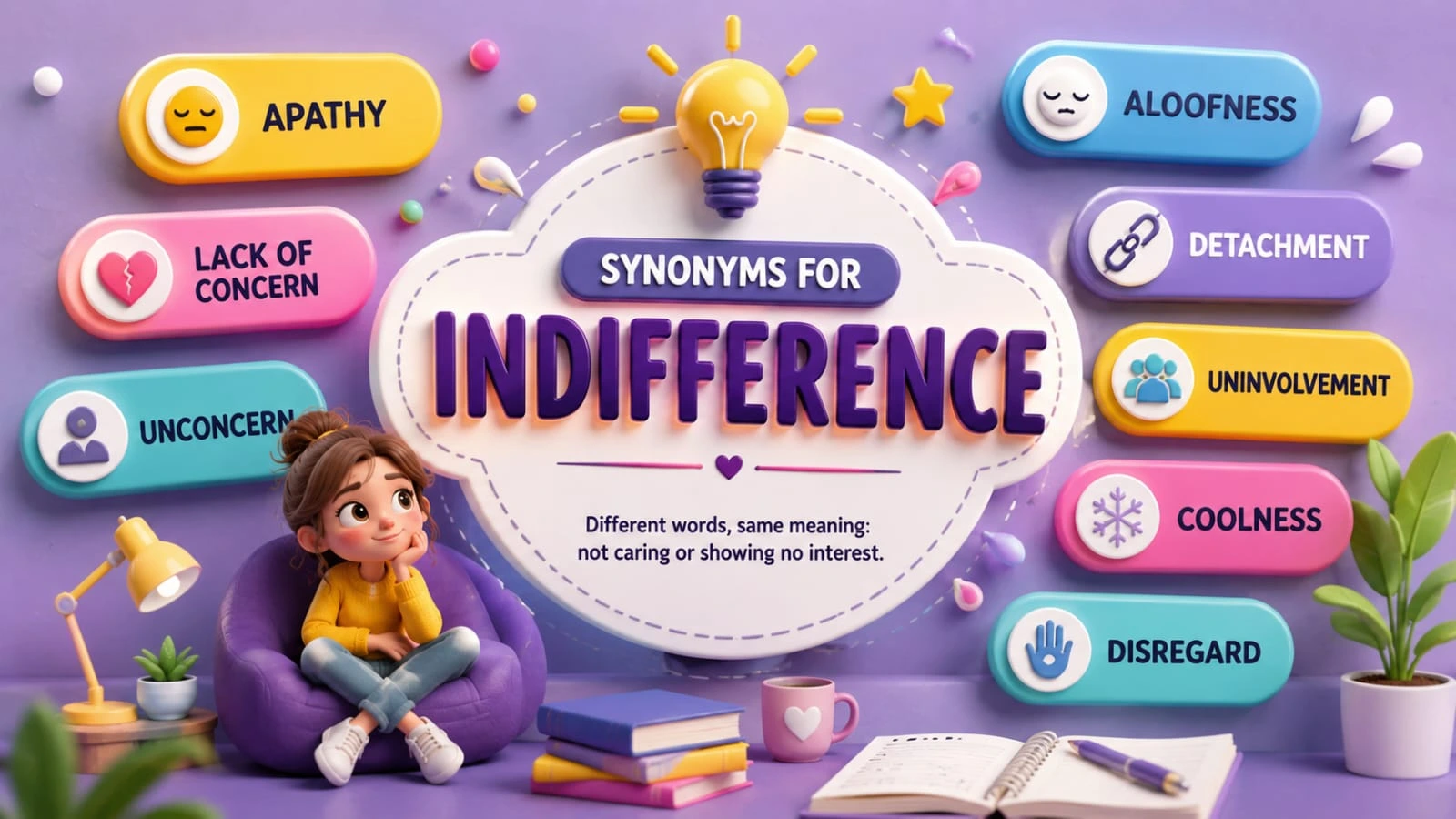
Indifference means a lack of interest, concern, or strong feeling, with synonyms such as apathy, detachment, unconcern, and nonchalance. ______________________________________________________________________________________________________
I first noticed how powerful indifference can be during a simple conversation with a friend. I was excitedly sharing some good news, but the response was only a quiet “Oh, okay.” There was no excitement, no surprise, and no real reaction. That moment made the meaning of indifference very clear: sometimes, not reacting says more than words do.
As an English writer, I often find that learners know a word but struggle to find the right alternative when they write. The same thing happens with indifference. Words such as apathy, detachment, unconcern, nonchalance, and callousness may look similar, but each carries a slightly different meaning and feeling.
Learning these synonyms for indifference can make your writing more natural and precise. In this guide, I’ll explain the meaning, pronunciation, history, grammar, and 30 useful alternatives, with simple examples to show exactly when to use each one.
Meaning of Indifference
Definition
Indifference (noun): a lack of interest, concern, care, or strong feeling toward someone or something.
In simple English, indifference means not caring very much.
Examples
- His indifference to the problem surprised everyone.
- She showed complete indifference to their criticism.
Connotative Meaning
Connotation means the feeling or idea a word suggests beyond its basic meaning.
- Positive tone: Indifference can sometimes suggest calmness or emotional control.
- Negative tone: It can suggest coldness, neglect, or a lack of care.
- Neutral tone: It may simply mean having no strong preference or interest.
The tone depends on the context.
Etymology of Indifference
The word indifference comes from Latin and entered English through French.
- Old English (450–1100): The modern word indifference was not used in Old English. Similar ideas were expressed through words and phrases related to lack of concern or preference.
- Middle English (1100–1500): French and Latin had a growing influence on English vocabulary. Related forms of indifferent entered the language.
- Modern English (1500–Present): Indifference developed its modern meaning of a lack of concern, interest, preference, or emotional response.
The word ultimately comes from Latin indifferentia, meaning lack of distinction or difference. It is related to Latin indifferens, meaning “not distinguishing.”
Pronunciation of Indifference
- IPA: /ɪnˈdɪf.ər.əns/
- Syllables: in-dif-fer-ence
The main stress falls on dif:
in-DIF-fer-ence
Affixation Pattern of Indifference
- Root: differ
- Prefix: in-, meaning “not” or “without”
- Suffix: -ence, used to form a noun describing a state or quality
Word Formations
- Differ: verb
- Different: adjective
- Differently: adverb
- Difference: noun
- Indifferent: adjective
- Indifference: noun
- Differential; adjective/noun
These words are connected through the idea of difference, distinction, or lack of distinction.
30 Synonyms for Indifference With Meaning & Examples
1. Apathy (Noun)
Meaning: A lack of interest, enthusiasm, or concern.
Examples:
- His apathy toward school worried his parents.
- Public apathy made the campaign difficult.
2. Unconcern (Noun)
Meaning: A lack of worry or concern about something.
Examples:
- Her unconcern about the delay was surprising.
- He showed complete unconcern about the criticism.
3. Detachment (Noun)
Meaning: A state of being emotionally separate from someone or something.
Examples:
- She discussed the issue with emotional detachment.
- His detachment helped him make a calm decision.
4. Disinterest (Noun)
Meaning: A lack of interest in something.
Examples:
- His disinterest in sports was obvious.
- She showed complete disinterest in the discussion.
5. Passivity (Noun)
Meaning: A tendency to accept things without taking action.
Examples:
- His passivity allowed the problem to grow.
- The team’s passivity cost them the game.
6. Neglect (Noun)
Meaning: A failure to give proper care or attention.
Examples:
- The garden suffered from neglect.
- The child’s needs were ignored through years of neglect.
7. Unresponsiveness (Noun)
Meaning: A lack of reaction or response.
Examples:
- His unresponsiveness worried the team.
- The manager’s unresponsiveness delayed the project.
8. Atony (Noun)
Meaning: A state of weakness or reduced energy or response.
Examples:
- The character’s emotional atony made the scene feel cold.
- His atony was clear during the tense discussion.
9. Insensitivity (Noun)
Meaning: A lack of awareness or concern for other people’s feelings.
Examples:
- Her insensitivity upset her colleague.
- His comment showed remarkable insensitivity.
10. Aloofness (Noun)
Meaning: A distant or unfriendly attitude.
Examples:
- His aloofness made him seem difficult to approach.
- Her aloofness kept others at a distance.
11. Coldness (Noun)
Meaning: A lack of warmth, kindness, or emotion.
Examples:
- I was surprised by his coldness.
- Her sudden coldness hurt her friend.
12. Unemotionality (Noun)
Meaning: A lack of visible emotional response.
Examples:
- His unemotionality made the difficult news hard to read.
- She answered with unusual unemotionality.
13. Indolence (Noun)
Meaning: A tendency to avoid effort or activity.
Examples:
- His indolence prevented him from finishing the task.
- The manager criticized the team’s indolence.
Note: Indolence is not a direct synonym in every context. It focuses more on laziness than lack of concern.
14. Lethargy (Noun)
Meaning: A state of low energy or lack of enthusiasm.
Examples:
- The team’s lethargy was obvious during the meeting.
- She struggled with lethargy after the long journey.
15. Complacency (Noun)
Meaning: A feeling of being too satisfied and not caring enough about possible problems.
Examples:
- Complacency can lead to serious mistakes.
- His complacency prevented him from preparing properly.
16. Nonchalance (Noun)
Meaning: A calm attitude that shows little worry or concern.
Examples:
- She accepted the criticism with nonchalance.
- His nonchalance surprised everyone.
17. Stoicism (Noun)
Meaning: The ability to remain calm and avoid showing strong emotion during difficulty.
Examples:
- He faced the setback with stoicism.
- Her stoicism impressed her friends.
Note: Stoicism does not always mean indifference. It can suggest emotional strength and self-control.
18. Disregard (Noun)
Meaning: A lack of attention or respect for something.
Examples:
- His disregard for the rules caused problems.
- The company showed disregard for customer complaints.
19. Inattention (Noun)
Meaning: A failure to pay attention.
Examples:
- The mistake resulted from simple inattention.
- His inattention during the lesson affected his grades.
20. Heedlessness (Noun)
Meaning: A failure to pay attention to something important.
Examples:
- His heedlessness put others at risk.
- The accident was caused by heedlessness.
21. Negativity (Noun)
Meaning: A tendency to focus on negative ideas or feelings.
Examples:
- Her negativity affected the team’s mood.
- Constant negativity can damage relationships.
Note: Negativity is related to a negative attitude, not simply a lack of concern.
22. Unfeelingness (Noun)
Meaning: A lack of sympathy, emotion, or compassion.
Examples:
- His unfeelingness shocked everyone.
- She criticized the decision for its unfeelingness.
23. Callousness (Noun)
Meaning: A lack of sympathy for other people’s suffering.
Examples:
- His callousness toward the victims was disturbing.
- The remark showed complete callousness.
24. Heartlessness (Noun)
Meaning: A lack of kindness, sympathy, or compassion.
Examples:
- Her heartlessness surprised her friends.
- The decision was criticized for its heartlessness.
25. Remoteness (Noun)
Meaning: Emotional or social distance from others.
Examples:
- His emotional remoteness made communication difficult.
- She sensed a growing remoteness between them.
26. Reserve (Noun)
Meaning: A tendency to avoid showing feelings or opinions openly.
Examples:
- His natural reserve made him seem distant.
- Her reserve was mistaken for indifference.
27. Impassivity (Noun)
Meaning: A state of showing little or no emotion.
Examples:
- He listened with complete impassivity.
- Her impassivity made it hard to know what she thought.
28. Uninterest (Noun)
Meaning: A lack of interest in something.
Examples:
- His uninterest in the topic was obvious.
- She expressed uninterest in the offer.
29. Unconcernedness (Noun)
Meaning: A state of not feeling worried or concerned.
Examples:
- His unconcernedness about the warning surprised us.
- Her unconcernedness made the situation seem less serious.
30. Lack of Concern (Noun Phrase)
Meaning: A state of not being worried or interested in something.
Examples:
- Her lack of concern surprised the entire team.
- His lack of concern about the deadline was frustrating.
Prototype Meaning of Indifference
The most typical meaning of indifference is a lack of care, interest, or emotional response.
When people hear this word, they often imagine someone who knows about a situation but does not react strongly. The person may not be angry, happy, or excited. They simply do not seem to care.
For example:
Her indifference to the criticism was obvious.
The word can describe a neutral lack of interest, but it often carries a negative tone when someone is expected to care.
Prototype Categorization: Synonyms for Indifference
The synonyms for indifference can be grouped by their closest meaning. This makes it easier to select the right word for a specific situation.
| Semantic Category | Synonyms | Main Idea | Best Used When |
| Lack of Interest | Apathy, Disinterest, Uninterest, Unconcern | Little or no interest | Someone does not care about a topic or situation |
| Emotional Distance | Detachment, Aloofness, Remoteness, Reserve | Being emotionally distant | Someone keeps feelings or connections at a distance |
| Lack of Emotion | Impassivity, Unemotionality, Stoicism | Showing little emotion | Someone remains calm or emotionally controlled |
| Lack of Sympathy | Callousness, Heartlessness, Insensitivity, Unfeelingness | Little concern for others’ feelings | Someone seems cold toward suffering or emotions |
| Lack of Attention | Inattention, Heedlessness, Disregard, Neglect | Failing to notice or care | Someone ignores a duty, rule, person, or problem |
| Low Motivation | Apathy, Passivity, Lethargy, Indolence | Little energy or action | Someone does not act or make an effort |
| Calm Lack of Concern | Nonchalance, Stoicism, Unconcern | Little visible worry | Someone stays calm in a situation |
| Lack of Care | Unconcern, Lack of Concern, Neglect | Not giving enough care | Someone fails to show proper concern |
This table shows why synonyms should not be treated as exact replacements. Callousness is much harsher than nonchalance, while detachment can sound neutral or even positive. Choosing the right category helps you express the exact feeling you want.
Antonyms of Indifference
1. Concern: Noun
A feeling of worry or care about something.
2. Interest: Noun
A feeling of wanting to know or learn more about something.
3. Enthusiasm: Noun
Strong excitement or interest.
4. Compassion: Noun
A desire to help someone who is suffering.
5. Care: Noun
Concern for someone or something.
6. Passion: Noun
A very strong feeling of interest or excitement.
7. Sympathy: Noun
Understanding and concern for another person’s feelings or problems.
8. Involvement: Noun
Active participation or emotional connection with something.
FAQs: Synonyms for Indifference
What does indifference mean?
Indifference means a lack of interest, concern, or strong feeling toward someone or something. It can describe an emotional, social, or general lack of concern.
When should indifference be used?
Use indifference when you want to describe someone who shows little care, interest, or emotional reaction. It works in both formal and everyday English.
Is indifference positive or negative?
It can be neutral or negative, depending on the context. Emotional distance may be neutral, but indifference toward someone’s suffering usually sounds negative.
How is indifference different from similar words?
Indifference is a broad term for a lack of concern or interest. Apathy often suggests a lack of motivation, detachment suggests emotional distance, and callousness suggests a lack of sympathy.
What is the strongest synonym for indifference?
There is no single strongest synonym for every situation. Words such as callousness, heartlessness, and unfeelingness can express a much stronger lack of care or sympathy.
Is apathy the same as indifference?
They are close, but not always identical. Indifference means a lack of concern or interest, while apathy often suggests a deeper lack of motivation, enthusiasm, or emotional response.
What is the best synonym for indifference in formal writing?
Unconcern, detachment, disinterest, and lack of concern can work well in formal writing. The best choice depends on the exact meaning of your sentence.
Conclusion
Learning synonyms for indifference gives you more ways to describe feelings, attitudes, and behavior. While indifference means a lack of concern or interest, nearby words can express much more specific ideas.
For example, apathy suggests a lack of motivation, detachment suggests emotional distance, and nonchalance suggests a calm lack of worry. Stronger words such as callousness and heartlessness suggest a lack of sympathy.
Knowing these differences can improve your writing and speaking. It also helps you avoid repeating the same word in every sentence. Instead, you can choose a word that matches the exact emotion or situation.
Make a habit of learning a few new words each day. Use them in your own sentences and notice how they are used in real English. With regular practice, your vocabulary will become richer, clearer, and more confident.
Synonyms for screamed: 30 Powerful Alternatives

I’m a language enthusiast and content writer specializing in English vocabulary, synonyms, word meanings, and alternative word choices. My goal is to help readers expand their vocabulary and express themselves with greater clarity through simple, accurate, and easy-to-understand language guides.