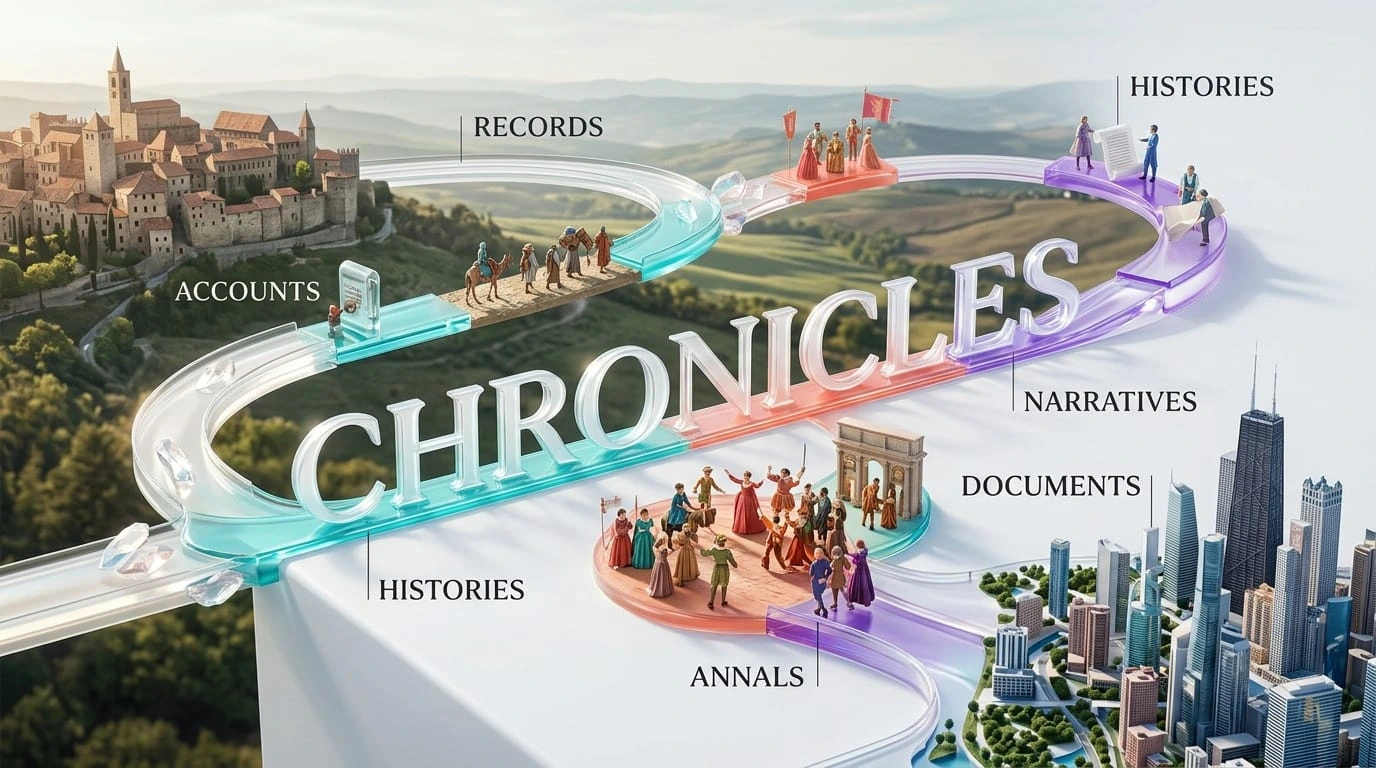
Synonyms for chronicles include records, histories, accounts, annals, journals, diaries, narratives, reports, logs, and stories.
Chronicles are written records of events, often told in the order they happened. Imagine reading about a town’s past, from its first school to its newest hospital. That account could be called a chronicle. The word can also describe the act of recording events, as in “The book chronicles the family’s journey.”
Learning synonyms for chronicles helps English learners and writers express ideas with greater clarity. A history book may need the word annals, while a personal record may be better called a journal or diary. This guide explains the meaning, pronunciation, word history, and useful alternatives to chronicles. You will also find examples and a categorization table to help you choose the right word for each situation.
Meaning of Chronicles
Definition
Chronicles (noun, plural): Written accounts of events, usually arranged in the order they happened.
Chronicles (verb): Records or describes events as they happen or over a period of time.
Examples
- The old chronicles describe the rise and fall of the kingdom.
- This book chronicles her journey from a small village to a large city.
Connotative Meaning
(Connotation: the feeling or idea a word suggests beyond its basic meaning.)
- Positive tone: Chronicles may suggest an important legacy or a valuable record of the past.
- Negative tone: Chronicles may suggest painful events, conflict, or a long series of problems.
- Neutral tone: Chronicles can simply refer to a factual record of events.
Etymology of Chronicles
The word chronicle comes through Anglo-French and Old French from Latin chronica, which traces back to Greek words relating to time. It entered English around 1300 and originally referred to an account of events arranged by time. The h in its spelling was restored during the 16th century.
Etymology, Origin & Meaning
- Old English (450–1100): An older related form, cranic, existed, but the modern word was not passed down unchanged from Old English.
- Middle English (1100–1500): Cronicle appeared around 1300; the verb to chronicle developed around 1400.
- Modern English (1500–present): The spelling gained its h, and the word came to be used for both historical records and the act of recording events.
Etymology, Origin & Meaning
Pronunciation (IPA)
- IPA: UK /ˈkrɒnɪkəlz/; US /ˈkrɑːnɪkəlz/
- Syllables: chron-i-cles (3 syllables)
Affixation Pattern of Chronicles
- Root word: Chronicle
- Prefix: None in the word chronicles
- Suffix: -s, used for a plural noun or the third-person singular verb form
Related word formations:
- Chronicle (noun/verb): A record of events; to record events.
- Chronicler (noun): A person who records historical events.
- Chronicled (verb): Recorded or described events.
- Chronicling (verb/noun): The act of recording events.
- Chronicles (plural noun/verb): Records of events, or records something.
25 Synonyms for Chronicles With Meanings and Examples
These words are useful alternatives, but they are not interchangeable in every sentence. Some describe written records, while others focus on telling or documenting events. Dictionary thesauruses list words such as record, history, account, journal, annals, and narrative among common alternatives for chronicle.
Cambridge English
+1
1. Record (Noun/Verb)
Meaning: Information written or saved as evidence of events; to preserve information about something.
Examples:
- The records reveal the town’s early history.
- The film records the changes in her life.
2. History (Noun)
Meaning: An account of past events, people, or places.
Examples:
- The book tells the history of the city.
- These chronicles cover the history of the royal family.
3. Account (Noun)
Meaning: A description or report of what happened.
Examples:
- She wrote an account of her travels.
- His account explains how the team won.
4. Annals (Noun, Plural)
Meaning: Historical records of events, often arranged by year.
Examples:
- The event entered the annals of local history.
- The annals describe many years of change.
5. Journal (Noun)
Meaning: A written record of events, thoughts, or experiences.
Examples:
- He kept a journal during the journey.
- Her journal chronicles life in the new country.
6. Diary (Noun)
Meaning: A personal record of daily events and feelings.
Examples:
- She found her grandmother’s old diary.
- The diary chronicles her school years.
7. Narrative (Noun)
Meaning: An account that tells a series of events.
Examples:
- The narrative follows the family through three generations.
- The author created a clear narrative of the war.
8. Story (Noun)
Meaning: An account of real or imagined events.
Examples:
- His story chronicles years of hard work.
- The story describes how the village changed.
9. Report (Noun/Verb)
Meaning: A formal or factual account; to give information about events.
Examples:
- The report covers the school’s progress.
- The journalist reports changes in the area.
10. Log (Noun/Verb)
Meaning: A record of activities or events; to record them.
Examples:
- The ship’s log chronicles each day at sea.
- The app logs every workout.
11. Register (Noun/Verb)
Meaning: An official list or record; to enter information into such a record.
Examples:
- The register lists births and deaths.
- The clerk registers each new event.
12. Archives (Noun, Plural)
Meaning: A collection of important records kept for future use.
Examples:
- The archives hold old letters and photographs.
- Researchers explored the town’s archives.
13. Saga (Noun)
Meaning: A long story about events, people, or family history.
Examples:
- The book tells a saga of family struggles.
- The saga chronicles the rise of a powerful dynasty.
14. Tale (Noun)
Meaning: A story about real or imagined events.
Examples:
- She told a tale of life in the mountains.
- The tale follows a family through many changes.
15. Memoir (Noun)
Meaning: A personal account of selected memories and experiences.
Examples:
- His memoir describes his years abroad.
- The memoir chronicles her life as a teacher.
16. Yearbook (Noun)
Meaning: A book recording the events or activities of a particular year.
Examples:
- The school yearbook captures the best moments.
- The yearbook chronicles the club’s achievements.
17. Logbook (Noun)
Meaning: A book used to keep a regular record of events or activities.
Examples:
- The captain updated the ship’s logbook.
- The logbook chronicles each stage of the voyage.
18. Documentation (Noun)
Meaning: Written or recorded information that explains or proves something.
Examples:
- The documentation records every major change.
- The team kept documentation of the project.
19. Chronology (Noun)
Meaning: A list or account of events in the order they happened.
Examples:
- The report provides a chronology of the case.
- The chronology shows how the conflict developed.
20. Narration (Noun)
Meaning: The act of telling or describing events.
Examples:
- The narration explains the events in the film.
- Her narration covers the journey from start to finish.
21. Recounts (Verb)
Meaning: Tells someone about events or experiences.
Examples:
- The novel recounts the fall of an empire.
- The witness recounts what happened that night.
22. Narrates (Verb)
Meaning: Tells a story or describes events in words.
Examples:
- The documentary narrates the town’s early years.
- The author narrates the journey through letters.
23. Documents (Verb)
Meaning: Records facts or events in writing, photographs, or another form.
Examples:
- The photographer documents life in the village.
- The report documents each step of the process.
24. Describes (Verb)
Meaning: Gives details about a person, place, event, or experience.
Examples:
- The book describes the city’s growth.
- The article describes events from that year.
25. Relates (Verb)
Meaning: Tells or gives an account of events.
Examples:
- The witness relates what she saw.
- The chapter relates the events that changed his life.
Prototype Meaning of Chronicles
The most typical meaning of chronicles is a written record of events over time. Readers often imagine history books, old manuscripts, diaries, or detailed accounts that show how events unfolded. When used as a verb, chronicles means that someone or something records or tells those events. For example, “The book chronicles the town’s growth” means the book records how the town changed over time.
Prototype Categorization of Synonyms for Chronicles
The table below groups the alternatives by their main use. This helps writers select a word that matches the kind of record or action they wish to describe.
| Semantic category | Synonyms or alternatives | Best used when |
| Historical records | History, annals, archives, chronology | Discussing past events or developments |
| Personal records | Journal, diary, memoir, logbook | Describing personal experiences or daily activities |
| Written accounts | Record, account, narrative, report, documentation | Presenting facts or explaining what happened |
| Stories and long accounts | Story, tale, saga, narration | Telling events in a flowing or engaging way |
| Official or organized records | Register, yearbook, log | Recording events, names, activities, or annual achievements |
| Actions of recording or telling | Recounts, narrates, documents, describes, relates | Explaining what a writer, witness, film, or book does |
Antonyms of Chronicles
There is no single exact antonym for chronicles. The opposite depends on whether the word refers to keeping a record or telling about events.
- Conceals (verb): Keeps information hidden. He conceals the truth about the past.
- Hides (verb): Prevents others from finding or knowing something. The report hides important details.
- Suppresses (verb): Prevents information from being shared or known. The group suppresses the findings.
- Omits (verb): Leaves out information. The account omits several key events.
- Erases (verb): Removes recorded information. The editor erases the original notes.
- Silence (noun/verb): The absence of speech or information; to stop someone from speaking. The silence leaves many questions unanswered.
- Cover-up (noun): An attempt to hide the truth about an event. The cover-up hides what really happened.
Short Questions and Answers
What does chronicles mean?
Chronicles means written accounts of events over time. As a verb, it means records or describes events.
When should chronicles be used?
Use chronicles when discussing historical records, personal accounts, or something that records events over a period. For example, “The book chronicles the rise of the city.”
Is chronicles positive or negative?
The word is usually neutral. Its tone depends on the events being recorded, which may be inspiring, painful, or ordinary.
How is chronicles different from similar words?
A chronicle often follows events over time. A diary records personal experiences, annals often cover historical events year by year, and a report presents information about a subject or event.
Conclusion
Learning synonyms for chronicles helps you describe events in a more accurate and interesting way. Words such as history, account, annals, and narrative can make your writing clearer, while journal, diary, and memoir work well for personal experiences. When describing the act of recording events, words such as documents, recounts, and narrates may fit better.
The key is to choose a word that matches your meaning instead of replacing chronicles with the first alternative you find. Read examples, notice how different words are used, and practise writing your own sentences each day. Over time, this habit can reduce repetition, improve your speaking and writing, and build your confidence in English.
Synonyms for underscore: 30 Powerful Alternatives

I’m Daniel Carter, specialize in helping readers discover synonyms, expand their vocabulary, and choose the perfect word with confidence. My content helps readers improve their English, avoid common mistakes, and write with confidence. My goal is to provide accurate, reliable, and easy-to-understand language resources