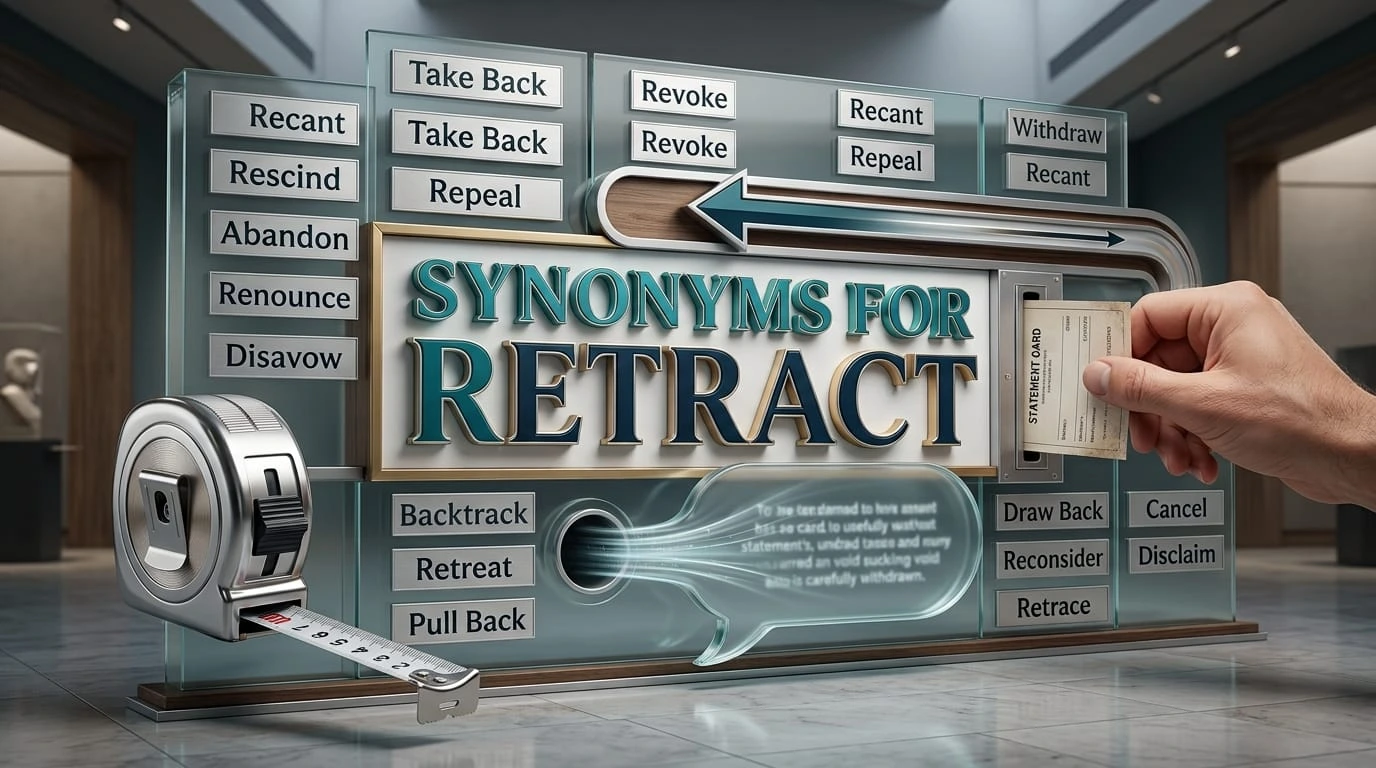
Synonyms for retract include withdraw, take back, revoke, rescind, reverse, disavow, recant, renounce, cancel, remove, pull back, and recall, depending on the context.
Retract means to take something back, withdraw it, or pull it back. Imagine someone posting a statement online and later realizing it was incorrect. They may retract the statement and admit that they no longer stand by it. The word is also used for physical movement, such as an animal pulling its claws back or a device folding inward. Because retract has several meanings, its best synonym depends on the situation. Learning these alternatives helps English learners choose more precise words and helps writers avoid repetition. In this guide, we will explore 20 useful synonyms for retract, with simple meanings, natural examples, pronunciation, word history, grammar, semantic categories, antonyms, and practical usage tips.
Meaning of Retract
Definition
Retract (Verb): To take back something previously said, written, offered, or stated, or to pull something back physically.
Examples
- The newspaper had to retract the inaccurate report.
- The cat retracted its claws when the danger disappeared.
Connotative Meaning
Connotation: The feeling or idea associated with a word beyond its basic meaning.
- Positive tone: Retracting an incorrect claim can suggest honesty and responsibility.
- Negative tone: Retracting a statement may suggest that someone made a mistake or gave false information.
- Neutral tone: Retract can simply describe pulling something back physically.
Etymology
Unlike many everyday English words, retract does not have a direct Old English → Middle English → Modern English development.
The word comes from Latin retrahere, meaning “to draw back,” from re- (“back”) and trahere (“to draw”).
- Old English (450–1100): There was no direct English form of retract.
- Middle English (1100–1500): The Latin-derived word was not yet part of ordinary English in its modern form.
- Modern English (1500–Present): Retract entered English as a learned Latin-derived verb meaning to draw back, withdraw, or take back.
Its physical and figurative meanings developed around the central idea of drawing something back.
Pronunciation (IPA)
- IPA: /rɪˈtrækt/
- Syllables: re-tract
Affixation Pattern of Retract
- Root: tract: related to Latin trahere, meaning “to draw”
- Prefix: re-: meaning “back” or “again”
- Suffix: None
- Word formations:
- Retract: verb
- Retracted: verb/adjective
- Retracting: verb/present participle
- Retraction: noun
- Retractable: adjective
- Retractor: noun
The prefix re- is meaningful here because retract carries the idea of drawing or taking back.
20 Synonyms of Retract With Meaning & Examples
1. Withdraw (Verb)
Meaning: To remove, take back, or stop supporting something previously offered or stated.
Examples:
- The company decided to withdraw its proposal.
- She withdrew her complaint after the issue was resolved.
Best for: Statements, offers, proposals, complaints, and support.
2. Take Back (Phrasal Verb)
Meaning: To say that you no longer mean or support something you previously said.
Examples:
- I take back what I said earlier.
- He apologized and took back his accusation.
Best for: Everyday, informal English.
3. Revoke (Verb)
Meaning: To officially cancel or withdraw something that was previously granted.
Examples:
- The agency revoked his license.
- The university revoked the offer after reviewing the documents.
Best for: Licenses, permissions, privileges, and official decisions.
4. Rescind (Verb)
Meaning: To officially cancel a decision, agreement, or offer.
Examples:
- The company rescinded the employment offer.
- They agreed to rescind the contract.
Best for: Legal, business, and formal contexts.
5. Revoke a Statement (Phrase)
Meaning: To officially withdraw something previously stated.
Examples:
- The witness revoked his statement during the investigation.
- She decided to revoke her earlier claim.
This is useful when the focus is specifically on withdrawing a previous claim or statement.
6. Recant (Verb)
Meaning: To publicly say that a previous belief, statement, or claim was wrong.
Examples:
- The witness later recanted his testimony.
- He refused to recant his accusation.
Best for: Beliefs, accusations, statements, testimony, and publicly expressed claims.
7. Disavow (Verb)
Meaning: To say that you do not accept, support, or have responsibility for something.
Examples:
- The organization disavowed the controversial statement.
- She disavowed any connection with the group.
Best for: Rejecting responsibility, support, or association.
8. Renounce (Verb)
Meaning: To formally give up, reject, or abandon something.
Examples:
- He renounced his previous position.
- She publicly renounced the claim.
Best for: Beliefs, principles, claims, rights, or positions.
9. Repudiate (Verb)
Meaning: To strongly reject or refuse to accept something.
Examples:
- The government repudiated the accusation.
- He repudiated his earlier remarks.
Best for: Strong or formal rejection.
10. Reverse (Verb)
Meaning: To change a previous decision, action, or position.
Examples:
- The court reversed the earlier decision.
- The company reversed its policy.
Best for: Decisions, policies, actions, and positions.
11. Cancel (Verb)
Meaning: To stop something that was planned or arranged.
Examples:
- The organizers canceled the event.
- The company canceled the order.
Cancel is sometimes related to retract, but it is not a universal substitute. It usually means stopping something rather than taking back a statement.
12. Recall (Verb)
Meaning: To officially ask for something to be returned or to withdraw something from circulation.
Examples:
- The manufacturer recalled the defective product.
- The publisher recalled the incorrect edition.
Best for: Products, publications, or items already distributed.
13. Remove (Verb)
Meaning: To take something away from a place, position, or situation.
Examples:
- The editor removed the inaccurate paragraph.
- The company removed the advertisement.
This can overlap with retract when something is physically or publicly taken away.
14. Pull Back (Phrasal Verb)
Meaning: To move or draw something backward.
Examples:
- The dog pulled back when it heard the noise.
- The soldier pulled back from the doorway.
Best for: Physical movement and informal descriptions.
15. Draw Back (Phrasal Verb)
Meaning: To move backward or away from something.
Examples:
- She drew back when the door suddenly opened.
- The animal drew back from the unfamiliar object.
This is especially useful for physical movement.
16. Recede (Verb)
Meaning: To move backward or farther away.
Examples:
- The floodwaters began to recede.
- The boat slowly receded into the distance.
Recede is a contextual alternative for physical movement, not for retracting a statement.
17. Fold Back (Phrasal Verb)
Meaning: To bend or move something backward onto itself.
Examples:
- Fold back the cover before opening the compartment.
- The device’s antenna folds back when not in use.
This works for physical objects that move inward or backward.
18. Contract (Verb)
Meaning: To become smaller or draw inward.
Examples:
- The muscles contract during movement.
- The material contracts as it cools.
This can overlap with retract when something physically draws inward.
19. Retrace (Verb)
Meaning: To go back over the same route or steps.
Examples:
- We had to retrace our steps.
- She retraced the path to find her lost phone.
Important: Retrace is not a direct synonym of retract. It is included because the shared re- and tract elements can cause confusion.
20. Reconsider (Verb)
Meaning: To think about a decision or opinion again.
Examples:
- The committee decided to reconsider its decision.
- He reconsidered his earlier position.
Reconsider may lead to retracting something, but it does not itself mean “take back.”
Prototype Meaning
The most typical meaning of retract is to take something back after it has already been stated, published, offered, or presented. In everyday writing, people often imagine a person withdrawing a claim or a newspaper correcting and taking back an inaccurate report. The physical sense—such as an animal retracting its claws comes from the same basic idea of pulling something back.
Prototype Categorization
The synonyms above fall into several useful groups:
🗣️ Withdrawing Statements or Claims
- Withdraw
- Take back
- Recant
- Disavow
- Renounce
- Repudiate
These are best when someone no longer supports something they previously said or claimed.
📑 Official or Formal Withdrawal
- Revoke
- Rescind
- Recall
- Reverse
These are common in legal, business, governmental, or institutional contexts.
↩️ Physical Movement Backward
- Pull back
- Draw back
- Recede
- Fold back
- Contract
These describe something physically moving, bending, or drawing inward.
🔄 Changing a Position or Decision
- Reverse
- Reconsider
- Withdraw
- Cancel
These work when someone changes a previous decision, offer, or position.
This categorization helps writers choose a word based on what is being taken back rather than treating every synonym as interchangeable.
Antonyms of Retract
Because retract has several meanings, its antonyms depend on context.
When retract means “take back a statement”
- Affirm (Verb): To state or confirm that something is true.
- Maintain (Verb): To continue to support or state an opinion.
- Assert (Verb): To state something confidently.
- Confirm (Verb): To establish that something is true or correct.
When retract means “pull back physically”
- Extend (Verb): To stretch, move, or make something longer or farther outward.
- Project (Verb): To extend outward from a surface.
- Advance (Verb): To move forward.
Short Questions and Answers
What does retract mean?
Retract means to take back something previously said or stated, or to pull something back physically.
When should retract be used?
Use retract when someone withdraws a previous statement, claim, offer, or publication, or when something physically pulls back or folds inward.
Is retract positive or negative?
Retract is neutral. Its effect depends on the situation. Retracting false information can be responsible, while retracting a claim may also highlight that an earlier statement was wrong.
How is retract different from recant?
Retract is broader and can refer to statements, publications, offers, or physical objects. Recant specifically focuses on publicly rejecting or withdrawing a previous belief, statement, or claim.
Is withdraw a synonym for retract?
Often, yes. Withdraw can replace retract when someone removes a statement, offer, proposal, or claim. However, withdraw has many additional meanings.
What is the difference between retract and revoke?
Retract commonly means taking back a statement or claim. Revoke usually means officially canceling something previously granted, such as a license, permission, or privilege.
Conclusion
Understanding retract and its synonyms gives you more control over your English. Words such as withdraw, take back, recant, revoke, rescind, reverse, and disavow can all express some form of withdrawal, but they do not work in exactly the same situations. For physical movement, expressions such as pull back, draw back, and fold back are more suitable. For formal writing, revoke, rescind, repudiate, and disavow can provide greater precision. The key is to identify what is being taken back: a statement, decision, permission, object, or physical movement. Choosing the right synonym makes your writing clearer, more natural, and more precise.
Synonyms for Motivational: 30 Powerful Words to Know

I am a professional content writer with a passion for English vocabulary and word meanings. I create clear, informative guides on synonyms, alternative words, and word usage to help readers choose the right word and communicate with confidence.