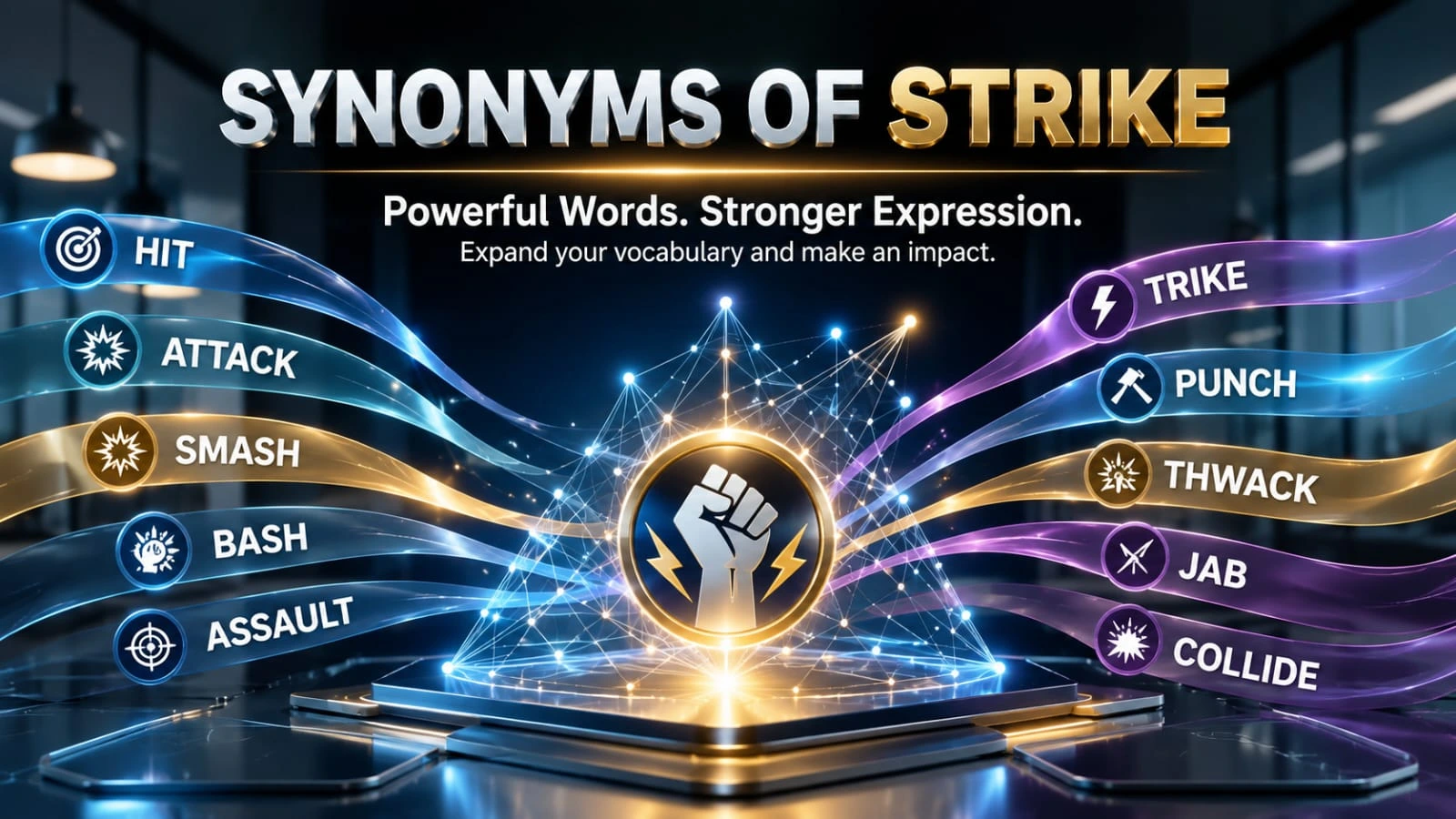
Strike can mean hit, attack, discover, remove, or protest, so its best synonym depends on the context.
Strike is one of those English words I often notice in very different situations. I first became more aware of its many meanings while reading and writing sentences where strike did not always mean “hit.” In one sentence, a player could strike a ball, while in another, workers could go on strike. I also came across phrases such as strike gold and strike a match, which made me realize how much meaning this small word can carry. That is why learning synonyms for strike is useful for English learners and writers. The right synonym can make a sentence more precise and natural instead of repeating the same word. In this guide, I will explain strike through its meaning, examples, pronunciation, history, word formation, synonyms, antonyms, and semantic categories, so you can choose the right word with confidence.
Meaning of Strike
Definition
Strike (verb/noun): To hit something or someone, or to take other actions such as stopping work, removing something, or suddenly noticing or finding something.
As a verb, strike has many meanings:
- to hit: He struck the ball hard.
- to attack: The army struck at dawn.
- to stop working as a protest: The workers decided to strike.
- to impress or affect: Her speech struck me as honest.
- to discover: They struck gold.
As a noun, strike can mean a hit or a period when workers stop working.
Examples
- The player struck the ball with great force.
- The workers went on strike for better wages.
Connotative Meaning
Connotation means the feeling or idea that a word suggests beyond its basic meaning.
- Positive tone: Strike can suggest success or discovery, as in strike gold.
- Negative tone: It can suggest violence or harm, as in strike an enemy.
- Neutral tone: It can describe an action without strong emotion, as in strike a match.
Etymology
The word strike has a long history in English.
- Old English (450–1100): Strike comes from Old English strīcan, meaning “to stroke, rub, go over, or move.”
- Middle English (1100–1500): The word developed into forms such as striken and gained the stronger sense of hitting or dealing a blow.
- Modern English (1500–Present): Strike developed many additional meanings, including attacking, removing, discovering, making an agreement, and stopping work as a protest.
Its wide range of meanings explains why strike is used in many different areas of modern English.
Pronunciation (IPA)
- IPA: /straɪk/
- Syllables: strike (1 syllable)
The vowel sound is the same as in like, bike, and Mike.
Affixation Pattern of Strike
- Root: strike
- Prefix: None
- Suffix: None in the basic word
Word Formations
- strike: verb/noun
- strikes: verb/noun
- struck: past tense/past participle
- stricken: past participle in some expressions
- striking: adjective/present participle
- striker: noun
- strikeout: noun
- strikebreaker: noun
- strikable/strikeable: adjective, meaning capable of being struck
30 Synonyms of Strike With Meaning & Examples
Because strike has many meanings, these are contextual synonyms rather than perfect replacements in every sentence.
1. Hit (Verb)
Meaning: To make forceful contact with something or someone.
Examples:
- The ball hit the wall.
- He hit the target accurately.
2. Smack (Verb)
Meaning: To hit something or someone with a sharp or loud blow.
Examples:
- The ball smacked the window.
- She smacked the table with her hand.
3. Punch (Verb)
Meaning: To hit someone with a closed hand.
Examples:
- He punched the bag.
- The boxer punched his opponent.
4. Slap (Verb)
Meaning: To hit with an open hand.
Examples:
- She slapped the table.
- He slapped the water with his hand.
5. Beat (Verb)
Meaning: To hit repeatedly.
Examples:
- The waves beat against the rocks.
- The rain beat against the roof.
6. Batter (Verb)
Meaning: To hit something repeatedly and heavily.
Examples:
- The storm battered the coast.
- The waves battered the boat.
7. Attack (Verb)
Meaning: To use force against a person, place, or group.
Examples:
- The soldiers attacked the fort.
- The animal attacked the fence.
8. Assault (Verb)
Meaning: To attack someone physically.
Examples:
- The man was charged with assaulting another person.
- The soldiers assaulted the enemy position.
9. Knock (Verb)
Meaning: To hit something, often causing movement or damage.
Examples:
- The ball knocked over the bottle.
- He knocked on the door.
10. Bash (Verb)
Meaning: To hit something with great force.
Examples:
- He bashed the door open.
- The stone bashed against the wall.
11. Collide (Verb)
Meaning: To hit another object while moving.
Examples:
- The two cars collided at the crossing.
- The bikes collided on the track.
12. Crash (Verb)
Meaning: To hit something suddenly and violently.
Examples:
- The car crashed into a wall.
- The plane crashed after losing power.
13. Affect (Verb)
Meaning: To have an emotional or mental effect on someone.
Examples:
- Her story affected me deeply.
- The news affected everyone in the room.
14. Impress (Verb)
Meaning: To make someone admire or respect something.
Examples:
- His confidence impressed the judges.
- Her performance impressed the audience.
15. Amaze (Verb)
Meaning: To surprise someone greatly.
Examples:
- The view amazed us.
- His skill amazed the crowd.
16. Surprise (Verb)
Meaning: To cause someone to feel unexpected wonder or shock.
Examples:
- The news surprised everyone.
- Her answer surprised the teacher.
17. Discover (Verb)
Meaning: To find something unexpectedly.
Examples:
- The miners discovered gold.
- They discovered a new source of water.
18. Find (Verb)
Meaning: To discover or come across something.
Examples:
- They found oil underground.
- She found an old letter in the drawer.
19. Remove (Verb)
Meaning: To take something away.
Examples:
- The editor removed the sentence.
- They removed the damaged part.
20. Delete (Verb)
Meaning: To remove something from a digital document or system.
Examples:
- Please delete the extra paragraph.
- He deleted the old file.
21. Cancel (Verb)
Meaning: To officially stop or end something.
Examples:
- The company canceled the meeting.
- They canceled the event because of rain.
22. Abolish (Verb)
Meaning: To officially end a law, system, or practice.
Examples:
- The government abolished the old law.
- The country abolished the unfair practice.
23. Eliminate (Verb)
Meaning: To remove or get rid of something.
Examples:
- We need to eliminate unnecessary costs.
- The team eliminated the final problem.
24. Protest (Verb)
Meaning: To publicly show disagreement with something.
Examples:
- Workers protested against the new policy.
- Students protested outside the building.
25. Walkout (Noun)
Meaning: An organized act of leaving work or another place as a protest.
Examples:
- The workers organized a walkout.
- The students joined a peaceful walkout.
26. Boycott (Verb)
Meaning: To refuse to buy, use, or support something as a form of protest.
Examples:
- Customers decided to boycott the product.
- The group boycotted the company.
27. Reject (Verb)
Meaning: To refuse to accept or approve something.
Examples:
- The committee rejected the proposal.
- She rejected the offer.
28. Light (Verb)
Meaning: To cause something such as a match or flame to burn.
Examples:
- He lit a match.
- She lit the candle carefully.
29. Ignite (Verb)
Meaning: To set something on fire or cause it to start burning.
Examples:
- A spark ignited the fuel.
- The dry grass ignited quickly.
30. Begin (Verb)
Meaning: To start something, especially in expressions where strike means to start or take action.
Examples:
- The workers began their protest at noon.
- The discussion began after lunch.
Prototype Meaning
The most typical meaning of strike is to hit something or someone with force. When people hear strike, they often imagine a hand, object, or weapon making sudden contact with another object. For example, The hammer struck the nail gives the clearest physical image of the word.
However, strike is much broader than physical hitting. It can describe a worker protest, a sudden discovery, an emotional effect, or the act of lighting a match. The surrounding words usually tell you which meaning is intended.
Prototype Categorization
| Semantic Category | Synonyms | When to Use |
|---|---|---|
| Physical Hitting | Hit, Smack, Punch, Slap, Beat, Knock, Bash | When someone or something makes physical contact |
| Heavy or Repeated Hitting | Batter, Beat, Bash | When the action involves strong or repeated blows |
| Attack | Attack, Assault | When someone uses force against another person or place |
| Accidental Contact | Collide, Crash | When two objects or vehicles hit each other |
| Emotional Effect | Affect, Impress, Amaze, Surprise | When something has a strong effect on someone’s feelings or thoughts |
| Discovery | Discover, Find | When something is found unexpectedly |
| Removal or Ending | Remove, Delete, Cancel, Abolish, Eliminate | When something is taken away or brought to an end |
| Protest | Protest, Walkout, Boycott, Reject | When people show disagreement or refuse to support something |
| Fire & Ignition | Light, Ignite | When strike means starting a flame or fire |
| Starting an Action | Begin | When strike is used in the sense of starting something |
Why this helps: This table makes it easier to choose the right synonym because strike has many meanings. Instead of using a synonym at random, writers can match the word to the exact situation.
Antonyms of Strike
- Avoid (Verb): To stay away from something or someone.
- Miss (Verb): To fail to hit a target.
- Protect (Verb): To keep someone or something safe from harm.
- Defend (Verb): To protect against an attack.
- Keep (Verb): To retain something instead of removing it.
- Continue (Verb): To keep something going instead of stopping it.
- Accept (Verb): To agree to receive or approve something.
- Support (Verb): To help or approve of something rather than protest against it.
FAQs
What does strike mean?
Strike can mean to hit, attack, affect, discover, remove, or stop working as a protest, depending on the context.
When should strike be used?
Use strike when its specific meaning is clear from the sentence. It is especially useful for describing hitting, work stoppages, sudden effects, and several fixed expressions.
Is strike positive or negative?
Strike is usually neutral, but its tone depends on context. A violent strike can sound negative, while strike gold can suggest success.
How is strike different from similar words?
Strike is broader than many of its synonyms. For example, punch specifically means hitting with a closed hand, while strike can describe many types of physical contact and several non-physical actions.
Conclusion
Learning strike and its synonyms gives English learners more control over their vocabulary. Instead of using the same word in every situation, you can choose a more exact alternative such as punch, attack, discover, remove, or protest. This makes writing clearer and more natural. It also helps speakers explain ideas without repeating the same words. The key is to remember that strike has many meanings, so its best synonym depends on context. Read each sentence carefully before choosing an alternative. Daily vocabulary practice can help you remember these words and use them with confidence. Try writing a few sentences with different synonyms each day to build stronger English skills.
Synonyms for screamed: 30 Powerful Alternatives

I am a language content specialist focused on English synonyms, vocabulary development, and word meanings. I create clear, practical guides that help readers choose the right words and communicate with confidence.