Quick Answer
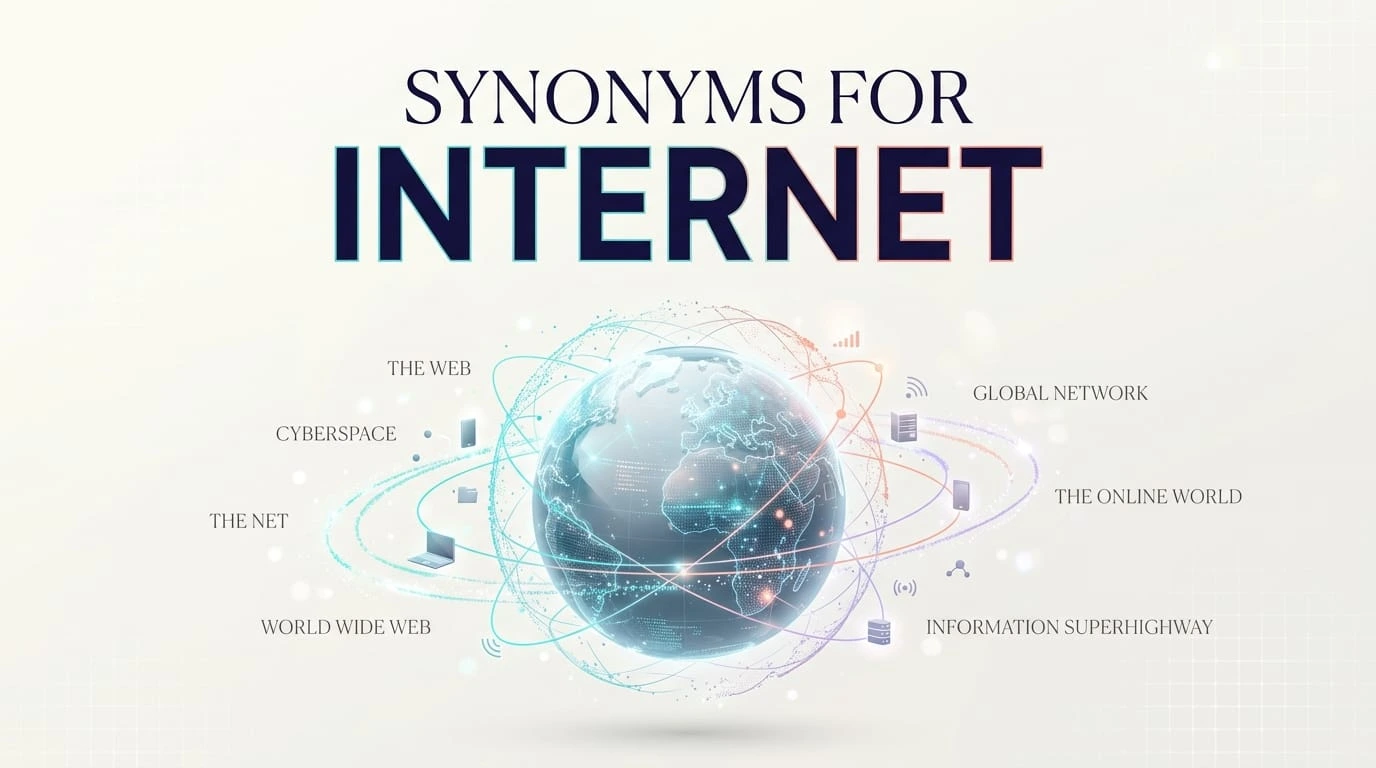
- Web
- World Wide Web (WWW)
- Cyberspace
- Net
- Online network
- Digital network
- Information superhighway
- Global network
The internet is a global network that connects computers, phones, and other devices. People use it every day to learn, work, shop, share ideas, and talk to others. For example, a student may use the internet to find facts for a school project, while a writer may use it to research a new topic. The word internet is common in daily speech, schoolwork, and online content. Yet using the same word again and again can make writing feel dull. Learning synonyms and related terms helps English learners build a stronger vocabulary and helps content writers create clear, varied text. In this guide, you will learn the meaning of internet, useful alternatives, examples, word origins, pronunciation, and semantic categories. You will also learn when each term fits best, so you can choose the right word for your sentence.
Meaning of Internet
Definition
Internet (Noun): A worldwide system of connected computer networks that lets people share information and communicate.
Examples
- I use the internet to study English.
- The internet helps people connect across the world.
Connotative Meaning
(Connotation: the feelings or ideas that a word brings to mind beyond its basic meaning.)
- Positive tone: Connection, learning, freedom, and access to information.
- Negative tone: Distraction, misinformation, privacy risks, and overuse.
- Neutral tone: A global network used to share information and communicate.
Etymology
The word internet comes from the idea of interconnected networks. It combines inter- (between or among) with network. The term became widely used as computer networks developed.
- Old English (450–1100): The modern word internet did not exist. English had words such as net, linked to the idea of a woven mesh.
- Middle English (1100–1500): Net continued to refer to a mesh used for catching or holding things. The modern digital meaning had not yet developed.
- Modern English (1500–Present): The term internet emerged in the twentieth century as computer networks became interconnected. It later became the common name for the global network.
Pronunciation (IPA)
- IPA: /ˈɪntərˌnɛt/
- Syllables: in-ter-net
Affixation Pattern of Internet
- Root: net — related to a network.
- Prefix: inter- — meaning between or among.
- Suffix: No standard derivational suffix in the word internet.
Word Formations
- Internet (noun): A global network of connected networks.
- Internet-based (adjective): Using or relying on the internet.
- Internet-connected (adjective): Linked to the internet.
- Internet-enabled (adjective): Designed to use internet access.
- Internetwork (noun/verb): A network of networks, or to connect networks.
- Internetworking (noun): The process of connecting computer networks.
30 Synonyms of Internet With Meaning & Examples
Note: The internet has no 30 exact synonyms. The following list includes close alternatives, technical terms, and related expressions. Their meanings can differ, so choose them according to context.
1. World Wide Web (Noun)
Meaning: A system of linked pages and online resources accessed through the internet.
Examples:
- I found the article on the World Wide Web.
- The World Wide Web makes many resources easy to access.
2. Web (Noun)
Meaning: A common short form for the World Wide Web.
Examples:
- She searched the web for recipes.
- The web offers many free learning tools.
3. Cyberspace (Noun)
Meaning: The digital world where people communicate and interact online.
Examples:
- The company has a strong presence in cyberspace.
- People share ideas in cyberspace every day.
4. Online World (Noun Phrase)
Meaning: The digital environment people use through internet-connected services.
Examples:
- Children need guidance in the online world.
- The online world offers many ways to learn.
5. Digital World (Noun Phrase)
Meaning: The wider world of digital tools, media, and services.
Examples:
- Students must learn to navigate the digital world.
- The digital world changes how people work.
6. Global Network (Noun Phrase)
Meaning: A network that connects systems and users around the world.
Examples:
- The internet is a global network.
- A global network helps people exchange information across borders.
7. Computer Network (Noun Phrase)
Meaning: A group of connected computers that share data and resources.
Examples:
- The school uses a computer network to share files.
- A computer network can connect devices in one office.
8. Information Superhighway (Noun Phrase)
Meaning: An informal term for a fast system that carries digital information.
Examples:
- Early writers called the internet the information superhighway.
- The information superhighway changed how people access news.
9. Network of Networks (Noun Phrase)
Meaning: A system made up of many connected networks.
Examples:
- The internet is often called a network of networks.
- A network of networks allows different systems to communicate.
10. Online Network (Noun Phrase)
Meaning: A network that connects users or systems through online services.
Examples:
- The online network supports remote teamwork.
- Members use the online network to exchange files.
11. Digital Network (Noun Phrase)
Meaning: A network that shares information in digital form.
Examples:
- The digital network links the company’s offices.
- A digital network can carry text, images, and video.
12. Communication Network (Noun Phrase)
Meaning: A system that allows people or devices to exchange information.
Examples:
- The internet serves as a global communication network.
- The communication network helps teams stay in touch.
13. Data Network (Noun Phrase)
Meaning: A system that transfers data between connected devices.
Examples:
- The data network supports online services.
- Engineers checked the data network for faults.
14. Digital Infrastructure (Noun Phrase)
Meaning: The digital systems and services that support online activity.
Examples:
- Reliable digital infrastructure helps businesses grow.
- The country is investing in digital infrastructure.
15. Online Platform (Noun Phrase)
Meaning: A website or service where people interact or complete tasks online.
Examples:
- The teacher shared lessons on an online platform.
- This online platform helps users exchange ideas.
16. Web Platform (Noun Phrase)
Meaning: A platform that runs through a web browser or web technologies.
Examples:
- The team built a web platform for its customers.
- Users can access the web platform from a browser.
17. Online Service (Noun Phrase)
Meaning: A service delivered through the internet.
Examples:
- The bank offers an online service for bill payments.
- I used an online service to book my ticket.
18. Digital Space (Noun Phrase)
Meaning: An environment where digital communication or activity takes place.
Examples:
- The group created a safe digital space for learners.
- Brands compete for attention in the digital space.
19. Virtual World (Noun Phrase)
Meaning: A computer-created environment where users can interact.
Examples:
- The game lets players explore a virtual world.
- Students visited a virtual world in their technology class.
20. Online Environment (Noun Phrase)
Meaning: The setting in which people use internet-based tools and services.
Examples:
- The school provides a safe online environment.
- Workers need clear rules in an online environment.
21. Electronic Network (Noun Phrase)
Meaning: A network that connects devices or systems electronically.
Examples:
- The electronic network supports information sharing.
- The office uses an electronic network to connect its computers.
22. Web Network (Noun Phrase)
Meaning: A network associated with web-based systems or resources.
Examples:
- The web network connects several online resources.
- Developers improved the web network’s performance.
23. Internet Ecosystem (Noun Phrase)
Meaning: The connected services, technologies, organizations, and users that make up internet activity.
Examples:
- Search engines are part of the internet ecosystem.
- The internet ecosystem includes websites, apps, and service providers.
24. Online Realm (Noun Phrase)
Meaning: The broad area of activity that takes place online.
Examples:
- The artist found new fans in the online realm.
- Safety matters in every online realm.
25. Digital Realm (Noun Phrase)
Meaning: The wider domain of digital technology and activity.
Examples:
- Many jobs now depend on the digital realm.
- Students explore the digital realm through learning tools.
26. Information Network (Noun Phrase)
Meaning: A network that helps people or systems share information.
Examples:
- The internet is a vast information network.
- An information network can support research and education.
27. Telecommunications Network (Noun Phrase)
Meaning: A system that carries information over communication links.
Examples:
- The telecommunications network supports voice and data services.
- Engineers expanded the telecommunications network in rural areas.
28. Broadband Network (Noun Phrase)
Meaning: A network that provides high-speed data transmission.
Examples:
- The town needs a faster broadband network.
- A broadband network supports video calls and large downloads.
29. Public Network (Noun Phrase)
Meaning: A network accessible to the public or a broad group of users.
Examples:
- Users should take care when connecting to a public network.
- The library provides access through a public network.
30. Connected Network (Noun Phrase)
Meaning: A network linked to other devices or networks.
Examples:
- A connected network can help teams share data.
- The connected network allows different systems to exchange information.
Prototype Meaning
The prototype meaning of internet is a worldwide system that connects computers and devices so people can access information and communicate. When most people hear the word, they think of websites, search engines, email, social media, video calls, and online learning. Although the World Wide Web is closely linked to the internet, the two are not identical: the web is one service that runs on the internet.
Prototype Categorization
The table below groups the 30 alternatives by their closest meaning and typical use. Some terms fit more than one category, and several are related expressions rather than exact synonyms.
| Semantic category | Words and expressions | Best use |
| Web and web pages | World Wide Web, Web, Web Platform, Web Network | Writing about websites, browsers, and linked pages |
| Global connectivity | Global Network, Network of Networks, Computer Network, Connected Network | Explaining how devices and networks connect |
| Data and communication | Communication Network, Data Network, Information Network, Electronic Network, Telecommunications Network | Technical writing about information transfer |
| Digital environment | Cyberspace, Online World, Digital World, Digital Space, Online Realm, Digital Realm, Virtual World, Online Environment | Describing online activity and digital experiences |
| Technology and infrastructure | Digital Infrastructure, Internet Ecosystem, Broadband Network, Information Superhighway | Discussing systems, access, and internet development |
| Services and access | Online Platform, Online Service, Public Network, Online Network, Digital Network | Explaining online tools, services, and connectivity |
How to Choose the Right Alternative
- Use web when you mean websites and linked pages.
- Use cyberspace or online world when describing online activity as a whole.
- Use global network or network of networks in technical explanations.
- Use online platform when referring to a particular service or application.
- Use digital infrastructure when discussing the systems that support digital services.
Antonyms of Internet
The word internet does not have a direct antonym because it names a technology. However, these terms can express contrasting ideas in specific contexts.
– Offline (adjective/adverb): Not connected to the internet. Example: I saved the file to read offline.
– Disconnected (adjective): Not linked to a network or another device. Example: The computer remained disconnected from the network.
– Unnetworked (adjective): Not connected to a network. Example: The unnetworked computer could not access shared files.
– Standalone (adjective): Operating independently rather than as part of a connected system. Example: The device works as a standalone unit.
– Isolated (adjective): Separated from other systems or users. Example: The isolated computer stored data locally.
– Air-gapped (adjective): Physically separated from networks to prevent electronic connections. Example: The sensitive system was kept air-gapped.
Short Questions and Answers
What does internet mean?
The internet is a global system of connected networks that lets people share information and communicate.
When should internet be used?
Use internet when referring to the worldwide network itself, including its role in communication, research, and online services.
Is internet positive or negative?
The word is neutral. Its tone depends on the context. It may suggest learning and connection or risks such as misinformation and privacy loss.
How is internet different from similar words?
The internet is the underlying global network. The World Wide Web is a collection of linked pages and resources accessed through it. An online platform is a specific service, while cyberspace describes the broader digital environment.
Conclusion
Learning the meaning of internet and its related terms helps you use English with greater care. Words such as web, cyberspace, global network, and online platform can add variety to your writing, but they do not all mean exactly the same thing. Choosing the right term makes your message clearer and helps readers understand what you mean. A stronger vocabulary also supports better speaking, reading, and content writing. To improve, practice using one new term each day. Write a sentence with it, check its meaning, and compare it with similar words. With regular practice, you can avoid repetition, express ideas more clearly, and build confidence in English.
Synonyms for Pay: 30 Useful Words to Know

I’m a language enthusiast and content writer specializing in English vocabulary, synonyms, word meanings, and alternative word choices. My goal is to help readers expand their vocabulary and express themselves with greater clarity through simple, accurate, and easy-to-understand language guides.