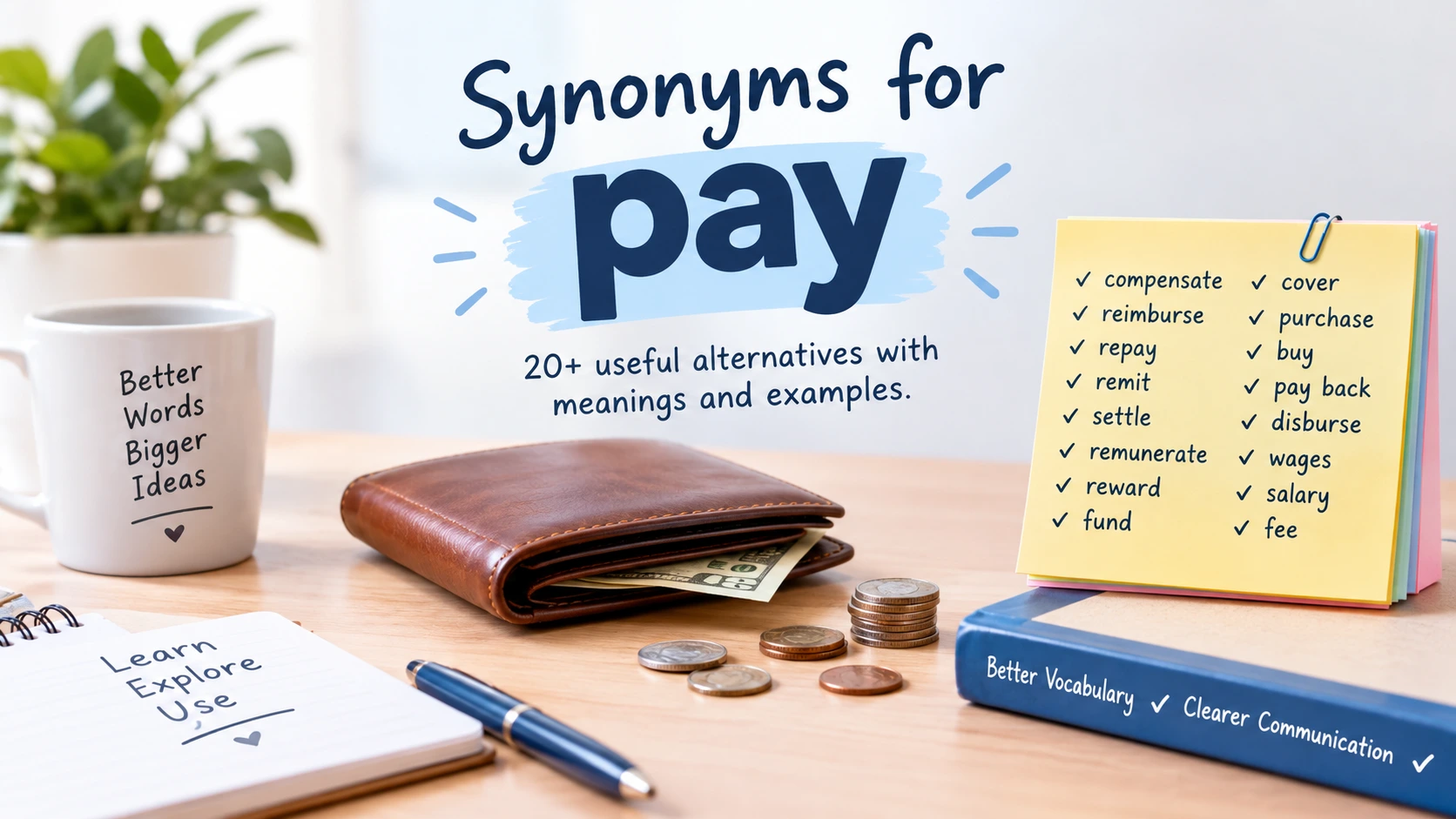
Synonyms for pay include compensate, reimburse, repay, remit, settle, reward, fund, cover, and purchase. Learn 20+ useful alternatives with meanings and examples.
The word pay is used in daily life. We pay for food, pay our bills, and pay workers for their time. For example, when you buy a book, you pay the seller in cash or by card. The word can also mean to give someone money for work or to face the result of an action.
Learning synonyms for pay helps you speak and write in a clear way. It also helps you avoid using the same word again and again. For English learners, students, and content writers, knowing similar words makes it easier to express ideas in the right context.
In this guide, you will learn the meaning of pay, 30 useful synonyms, and examples of how to use them. You will also explore its pronunciation, word forms, history, antonyms, and common questions. Each alternative has a slightly different meaning, so choosing the right word matters.
Meaning of Pay
Definition
Pay (verb and noun):
- As a verb: To give money for goods, services, work, or a debt.
- As a noun: Money given to someone for their work.
Examples
- I pay my bills at the end of each month.
- She earns good pay at her new job.
Connotative Meaning
(Connotation: the feeling or idea a word brings to mind beyond its basic meaning.)
- Positive tone: Pay can suggest fair rewards, respect for work, and financial success. Example: The company pays its workers well.
- Negative tone: It can suggest a burden or an unwanted cost. Example: I had to pay a large fine.
- Neutral tone: It can simply describe a money exchange. Example: We pay for groceries every week.
Synonyms for Pay: Etymology of Pay
The word pay comes from the Old French word paier, meaning to pay or settle a debt. It developed from the Latin pacare, meaning to pacify or make peace, which is linked to settling an obligation.
- Old English (450–1100): The modern word pay was not commonly used in its current form. Old English used other words to express payment and settling debts.
- Middle English (1100–1500): The word entered English through Anglo-French and Old French forms such as paien and paien related spellings.
- Modern English (1500–present): Pay became the standard form for giving money, settling debts, and rewarding work. It also developed other uses, such as pay attention and pay a price.
Pronunciation (IPA)
- IPA: /peɪ/
- Syllables: One syllable: pay
Synonyms for Pay: Affixation Pattern of Pay
- Root: pay
- Prefix: None in the basic word.
- Suffix: No suffix in the base form.
Word Formations
- Pay (verb/noun): To give money; money earned for work.
- Pays (verb): Third-person singular form. He pays the rent.
- Paid (verb/adjective): Past tense or past participle. She paid the bill.
- Paying (verb/adjective): Present participle. They are paying now.
- Payment (noun): Money given to settle a purchase or debt.
- Payer (noun): A person or organization that pays.
- Payee (noun): A person or organization that receives payment.
- Payable (adjective): Required to be paid. The amount is payable today.
- Payoff (noun): A final payment or a beneficial result.
- Paycheck (noun): Money paid to an employee, often through a regular payment.
- Payroll (noun): The list of employees and the wages or salaries paid to them.
- Overpay (verb): To pay more than the correct amount.
- Underpay (verb): To pay less than a fair or required amount.
- Repay (verb): To pay back money or return a favor.
- Prepay (verb): To pay before a service or product is received.
- Repayment (noun): The act or amount of paying something back.
30 Synonyms of Pay With Meaning and Examples
Not every synonym for pay works in every sentence. Some words describe giving money, while others refer to wages, debts, or the consequences of an action. Choose the word that matches your meaning.
1. Remit (Verb)
Meaning: To send money to a person or organization to settle a payment.
Examples:
- Please remit the fee before Friday.
- The company remitted the money to its supplier.
2. Compensate (Verb)
Meaning: To give someone money or another benefit in return for work, loss, or harm.
Examples:
- The firm compensated workers for overtime.
- The airline compensated passengers for the delay.
3. Reimburse (Verb)
Meaning: To repay someone for money they have already spent.
Examples:
- My employer will reimburse my travel costs.
- She reimbursed her friend for the tickets.
4. Repay (Verb)
Meaning: To return money that you borrowed or owe.
Examples:
- I will repay the loan next month.
- He repaid his friend in full.
5. Settle (Verb)
Meaning: To pay an amount that is owed or resolve a financial account.
Examples:
- We settled the bill after dinner.
- She settled her debt before moving abroad.
6. Remunerate (Verb)
Meaning: To pay someone for work or services.
Examples:
- The company remunerates its staff fairly.
- Experts were remunerated for their advice.
7. Reward (Verb)
Meaning: To give money or something valuable in recognition of effort or achievement.
Examples:
- The business rewarded her for excellent work.
- They rewarded the team with a cash prize.
8. Compensate for (Verb)
Meaning: To make up for a loss, disadvantage, or shortfall, sometimes by giving money.
Examples:
- The company compensated customers for the damage.
- Extra income helped compensate for the higher costs.
9. Disburse (Verb)
Meaning: To distribute or pay out money from a fund.
Examples:
- The office disbursed funds to local schools.
- The bank disbursed the approved loan.
10. Shell Out (Phrasal Verb)
Meaning: To pay money, often when the amount feels large or unwelcome.
Examples:
- I had to shell out $100 for repairs.
- They shelled out a lot for concert tickets.
11. Fork Out (Phrasal Verb)
Meaning: To pay money, often reluctantly.
Examples:
- He forked out for a new phone.
- We had to fork out extra for delivery.
12. Cough Up (Phrasal Verb)
Meaning: To pay money that someone is demanding, often unwillingly.
Examples:
- He finally coughed up the money he owed.
- The driver had to cough up a fine.
13. Pony Up (Phrasal Verb)
Meaning: To provide or pay the money that is needed or owed.
Examples:
- Everyone must pony up for the shared meal.
- The club asked its members to pony up the fee.
14. Foot (Verb)
Meaning: To pay a bill or cover a cost.
Examples:
- The company footed the hotel bill.
- Her parents footed the cost of her education.
15. Cover (Verb)
Meaning: To provide enough money to meet a cost.
Examples:
- My savings cover the rent.
- The grant covers the cost of books.
16. Finance (Verb)
Meaning: To provide money for a purchase, project, or activity.
Examples:
- The bank financed the new building.
- They financed their studies through savings.
17. Fund (Verb)
Meaning: To provide money for a person, plan, or project.
Examples:
- Donations funded the community center.
- The government funded the research.
18. Buy (Verb)
Meaning: To obtain something by giving money for it.
Examples:
- I bought a jacket at the store.
- She bought lunch for her team.
19. Purchase (Verb)
Meaning: To buy something by paying money.
Examples:
- He purchased a laptop online.
- The school purchased new equipment.
20. Procure (Verb)
Meaning: To obtain something, often through effort or formal arrangements; payment may be involved.
Examples:
- The firm procured supplies from a local seller.
- We procured the equipment through an approved supplier.
21. Wages (Noun)
Meaning: Money paid to a worker, often based on hours or days worked.
Examples:
- Her wages are paid every week.
- The workers asked for higher wages.
22. Salary (Noun)
Meaning: A fixed amount of money paid regularly for a job.
Examples:
- His salary arrives at the end of each month.
- She earns a good salary as a teacher.
23. Remuneration (Noun)
Meaning: Money or other payment given for work or services.
Examples:
- The role offers fair remuneration.
- The contract explains the worker’s remuneration.
24. Compensation (Noun)
Meaning: Money or another benefit given for work, loss, or harm.
Examples:
- The workers received compensation for the injury.
- Her compensation included a yearly bonus.
25. Fee (Noun)
Meaning: Money paid for a service or professional task.
Examples:
- The doctor charged a small fee.
- You must pay the entry fee online.
26. Honorarium (Noun)
Meaning: A payment given for a professional service that is often voluntary or not covered by a normal fee.
Examples:
- The guest speaker received an honorarium.
- The organization offered an honorarium to the lecturer.
27. Discharge (Verb)
Meaning: To fulfill or settle a duty, debt, or financial obligation.
Examples:
- He discharged his debt in full.
- The company discharged its payment obligations.
28. Liquidate (Verb)
Meaning: To settle a debt or financial obligation, or to convert assets into cash to meet payments.
Examples:
- The business liquidated some assets to pay its creditors.
- They liquidated the remaining debt during the sale.
29. Honor (Verb)
Meaning: To fulfill a financial promise, commitment, or obligation.
Examples:
- The company honored its payment agreement.
- He honored the check before the deadline.
30. Remit Payment (Verb Phrase)
Meaning: To send the money that is owed to the person or organization receiving it.
Examples:
- Please remit payment within 30 days.
- The customer remitted payment by bank transfer.
Synonyms for Pay: Prototype Meaning of Pay
The most typical meaning of pay is to give money in exchange for goods, services, or work, or to settle a debt. When people hear this word, they often think of paying at a shop, receiving wages, or clearing a bill. However, pay can also refer to facing the result of an action, as in “pay the price for a mistake.” Its meaning depends on the words around it and the situation in which it is used.
Prototype Categorization
The 30 synonyms and related alternatives can be grouped by meaning and use.
- Giving or sending money: Remit, settle, repay, remit payment, discharge. These are useful when discussing bills, debts, and financial duties.
- Paying for work or services: Compensate, remunerate, reward, remuneration, compensation, salary, wages. These fit employment, professional services, and rewards.
- Covering costs: Foot, cover, finance, fund, shell out, fork out, cough up, pony up. These describe paying expenses, sometimes reluctantly.
- Buying or obtaining goods: Buy, purchase, procure. Use these when someone obtains products or supplies.
- Paying back expenses or losses: Reimburse, compensate for, repay. These fit refunds, work expenses, and financial losses.
- Financial payments and charges: Fee, honorarium, disburse. These are useful in professional, formal, and organizational settings.
- Settling financial obligations: Liquidate, honor. These fit debts, agreements, checks, and other commitments.
This categorization helps writers select words that match the situation. For example, reimburse is suitable for repaying an employee’s expenses, while purchase is appropriate when someone buys a product. The words may be related to pay, but they are not interchangeable in every sentence.
Antonyms of Pay
There is no single opposite of pay that works in every context. These words express different kinds of contrast.
- Receive (verb): To get money or something from another person. She received payment yesterday.
- Collect (verb): To receive money that is owed. The company collected the fee.
- Withhold (verb): To hold back money instead of giving it. The employer withheld part of the payment.
- Default (verb): To fail to meet a financial obligation. He defaulted on his loan.
- Owe (verb): To have a duty to pay money. I still owe the bank money.
- Borrow (verb): To take money temporarily with the intention of returning it. She borrowed money from her sister.
- Earn (verb): To receive money in return for work. He earns money as a driver.
Note that receive and collect describe getting money, while withhold and default describe not making a payment. The best opposite depends on the intended meaning.
Synonyms for Pay: Short Questions and Answers
What does pay mean?
Pay means to give money for goods, services, or work, or to settle a debt. As a noun, it can mean the money someone earns from a job.
When should pay be used?
Use pay when discussing money given for a purchase, service, bill, debt, or job. For example, “I pay my rent every month.”
Is pay positive or negative?
Pay is usually neutral. It can have a positive or negative tone depending on the context. Fair pay sounds positive, while paying a heavy fine may sound negative.
How is pay different from similar words?
Pay is a general word for giving money. Reimburse means to repay expenses, compensate means to provide payment or make up for a loss, and remit often means to send money formally. Purchase means to buy something.
Synonyms for Pay: Conclusion
Learning pay and its synonyms helps you build a stronger English vocabulary. Words such as remit, reimburse, compensate, settle, and purchase let you explain financial actions with greater accuracy. They also make your writing more natural and reduce repetition.
However, remember that similar words can have different meanings. You would normally reimburse someone for an expense, remunerate a person for work, and settle a debt. Choosing the right word makes your message clear and easy to understand.
Try learning a few synonyms each day. Write your own sentences, read examples, and use new words in everyday conversations. With regular practice, you can improve your writing, speak with greater confidence, and express your ideas more effectively.
Synonyms for Ruse: 30 Clever Words and Alternatives

I am a language content specialist focused on English synonyms, vocabulary development, and word meanings. I create clear, practical guides that help readers choose the right words and communicate with confidence.