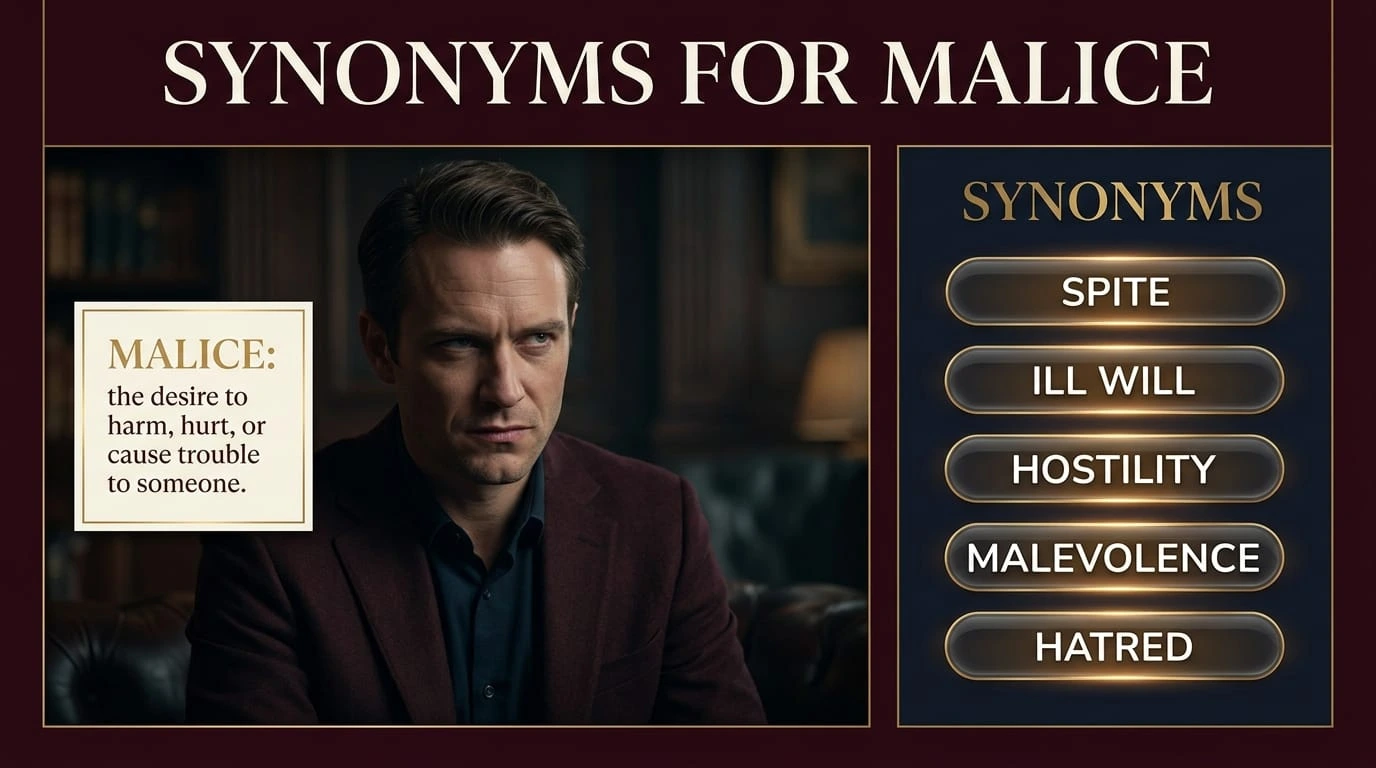
Synonyms for malice include spite, hatred, hostility, animosity, ill will, resentment, malevolence, cruelty, and vindictiveness.
Malice means a strong desire to hurt, harm, or upset another person. Imagine someone spreading a false rumor about a coworker simply because they want that person to lose respect at work. That harmful intention can be described as malice. The word is common in discussions about harmful behavior, conflict, law, and personal relationships. Learning synonyms for malice helps English learners understand the small differences between words such as hatred, spite, hostility, cruelty, and ill will. These words can describe similar feelings, but they do not always fit the same situation. For writers, knowing these differences makes sentences clearer and more precise. This guide explains the meaning, examples, connotation, etymology, pronunciation, word formation, synonyms, antonyms, and semantic categories of malice.
Meaning of Malice
Definition
Malice (Noun):
A strong intention or desire to hurt, harm, or cause trouble for another person.
Examples
- He spoke with malice after their argument.
- The damage was done out of pure malice.
Connotative Meaning
Connotation: The feeling or idea that a word suggests beyond its basic meaning.
- Positive tone: Malice itself has no positive meaning because it describes harmful intent.
- Negative tone: It strongly suggests hatred, cruelty, spite, or a desire to cause harm.
- Neutral tone: In formal or legal contexts, malice can describe harmful intent without directly expressing emotion.
Etymology
Old English (450–1100)
Malice was not an Old English word. Its history comes through French from Latin rather than from an Old English root.
Middle English (1100–1500)
The word entered Middle English as malice, influenced by Old French malice. The French word came from Latin malitia, meaning wickedness, badness, or ill will.
Modern English (1500–Present)
In Modern English, malice developed its current sense of a desire or intention to cause harm. It is now used in everyday, literary, and legal contexts. Related words include malicious, maliciously, and maliciousness.
Pronunciation (IPA)
- IPA: /ˈmælɪs/
- Syllables: mal-ice
Affixation Pattern of Malice
- Root: mal
- Prefix: None
- Suffix: -ice
Word formations
- malice: noun
- malicious: adjective
- maliciously: adverb
- maliciousness: noun
The root mal- is associated with badness or evil and appears in words such as malicious, malfunction, and malpractice.
30 Synonyms of Malice With Meaning & Examples
1. Spite (Noun)
Meaning: A desire to annoy, hurt, or upset someone because of anger or resentment.
Examples:
- He damaged her project out of spite.
- She refused to help him out of spite.
2. Hatred (Noun)
Meaning: A very strong feeling of dislike toward someone or something.
Examples:
- Years of conflict created deep hatred.
- His actions showed clear hatred toward his rival.
3. Hostility (Noun)
Meaning: Unfriendly or aggressive feelings toward someone.
Examples:
- There was obvious hostility between the two groups.
- She sensed hostility in his response.
4. Ill Will (Noun)
Meaning: An unfriendly or harmful feeling toward another person.
Examples:
- He bears no ill will toward his former colleague.
- Their disagreement created lasting ill will.
5. Animosity (Noun)
Meaning: Strong anger or dislike toward another person or group.
Examples:
- There was years of animosity between them.
- Personal animosity affected their working relationship.
6. Malevolence (Noun)
Meaning: A strong desire to do harm or evil.
Examples:
- His actions revealed deep malevolence.
- The character was driven by malevolence.
7. Malignity (Noun)
Meaning: A strong desire to cause harm or suffering.
Examples:
- The attack was carried out with malignity.
- His words showed unusual malignity.
8. Cruelty (Noun)
Meaning: Behavior that deliberately causes pain or suffering.
Examples:
- The victim suffered years of cruelty.
- There was no excuse for such cruelty.
9. Vindictiveness (Noun)
Meaning: A strong desire to hurt someone because of anger or revenge.
Examples:
- His vindictiveness made the dispute worse.
- She acted with unnecessary vindictiveness.
10. Viciousness (Noun)
Meaning: A quality of being cruel, violent, or deliberately harmful.
Examples:
- The viciousness of the attack shocked everyone.
- His comments showed surprising viciousness.
11. Bitterness (Noun)
Meaning: Strong anger or resentment that remains for a long time.
Examples:
- She spoke with bitterness about the breakup.
- Years of bitterness affected their friendship.
12. Resentment (Noun)
Meaning: A lasting feeling of anger about unfair treatment or past events.
Examples:
- He felt resentment toward his former employer.
- Her resentment grew over time.
13. Antagonism (Noun)
Meaning: Active opposition or strong dislike between people or groups.
Examples:
- Their political differences created antagonism.
- Personal antagonism made cooperation difficult.
14. Enmity (Noun)
Meaning: A strong and lasting feeling of hatred or hostility.
Examples:
- The two families had a long history of enmity.
- Their enmity continued for decades.
15. Hatred (Noun)
Meaning: An intense feeling of dislike or hostility.
Examples:
- Hatred can damage relationships.
- His speech was filled with hatred.
16. Aggression (Noun)
Meaning: Behavior or feelings that show a desire to attack or dominate.
Examples:
- His aggression made the situation worse.
- The argument quickly turned into aggression.
17. Hostile Intent (Noun Phrase)
Meaning: A purpose or plan to cause harm or opposition.
Examples:
- The message appeared to contain hostile intent.
- Investigators found evidence of hostile intent.
18. Harmfulness (Noun)
Meaning: The quality of being likely to cause harm.
Examples:
- The harmfulness of the behavior was clear.
- They discussed the harmfulness of the comments.
19. Evil Intent (Noun Phrase)
Meaning: A purpose or desire to do something morally wrong or harmful.
Examples:
- The act appeared to involve evil intent.
- There was no evidence of evil intent.
20. Bad Intentions (Noun Phrase)
Meaning: Plans or purposes that are meant to cause trouble or harm.
Examples:
- He questioned whether she had bad intentions.
- The warning was given because of his bad intentions.
21. Desire to Harm (Noun Phrase)
Meaning: A wish or intention to cause pain, damage, or trouble.
Examples:
- The act showed a clear desire to harm.
- There was little evidence of a desire to harm others.
22. Desire for Revenge (Noun Phrase)
Meaning: A strong wish to hurt someone in response to a perceived wrong.
Examples:
- His actions were motivated by a desire for revenge.
- A desire for revenge can lead to poor decisions.
23. Retaliation (Noun)
Meaning: An action taken to hurt someone in response to something they did.
Examples:
- The attack was seen as retaliation.
- He threatened retaliation after the dispute.
24. Revenge (Noun)
Meaning: The act of hurting someone because they have caused harm or trouble.
Examples:
- He wanted revenge for the insult.
- She chose forgiveness instead of revenge.
25. Malevolence (Noun)
Meaning: A deliberate wish to cause harm or suffering.
Examples:
- The villain acted with malevolence.
- His malevolence was obvious to everyone.
26. Spitefulness (Noun)
Meaning: The quality of wanting to hurt or upset someone because of anger or resentment.
Examples:
- Her spitefulness surprised her friends.
- He acted with unnecessary spitefulness.
27. Maliciousness (Noun)
Meaning: The quality of intentionally wanting to cause harm or trouble.
Examples:
- The maliciousness of the rumor was obvious.
- His maliciousness damaged their relationship.
28. Ill Feeling (Noun)
Meaning: A feeling of anger, dislike, or resentment toward someone.
Examples:
- There was still some ill feeling between them.
- The discussion ended without creating ill feeling.
29. Hostile Feeling (Noun Phrase)
Meaning: A strong unfriendly or aggressive feeling toward someone.
Examples:
- He expressed hostile feelings toward the group.
- Hostile feelings can make peaceful discussion difficult.
30. Contempt (Noun)
Meaning: A strong feeling that someone or something is unworthy of respect.
Examples:
- He spoke about his opponent with contempt.
- Her expression showed clear contempt.
Prototype Meaning
The most typical meaning of malice is a deliberate desire to hurt or harm another person. When people hear malice, they usually imagine harmful behavior that comes from spite, hatred, or bad intentions. The word focuses especially on the intention behind an action, rather than simply the harmful result. Someone can cause harm by accident, but an action done with malice involves a purposeful wish to cause trouble, pain, or damage.
Prototype Categorization
The 30 synonyms can be grouped into several semantic categories:
- Spite and resentment: spite, spitefulness, bitterness, resentment, ill will, and ill feeling describe personal anger or lasting negative feelings.
- Hatred and hostility: hatred, hostility, animosity, enmity, antagonism, and hostile feeling describe strong dislike or opposition.
- Harmful intent: malevolence, malignity, maliciousness, evil intent, bad intentions, and desire to harm focus on the intention to cause damage.
- Cruel behavior: cruelty, viciousness, aggression, and harmfulness focus more on harmful actions or behavior.
- Revenge and retaliation: revenge, retaliation, and desire for revenge describe attempts to hurt someone in response to a perceived wrong.
- Disrespect and rejection: contempt describes a strong lack of respect and can overlap with hostile attitudes.
This categorization helps writers select a more precise synonym. For example, spite works well for a personal act meant to upset someone, while malevolence suggests a deeper and more deliberate desire to cause harm. Resentment focuses on lingering anger, while revenge focuses on an action taken in response to a wrong.
Antonyms of Malice
Kindness (Noun)
A friendly and caring attitude toward others.
Goodwill (Noun)
A friendly or helpful feeling toward another person or group.
Benevolence (Noun)
A desire to help others and promote their well-being.
Compassion (Noun)
A caring feeling toward someone who is suffering.
Friendliness (Noun)
A warm and pleasant attitude toward others.
Good Intention (Noun Phrase)
A sincere purpose to do something helpful or positive.
Forgiveness (Noun)
The decision to stop feeling anger toward someone who caused harm.
Short Questions and Answers
What does malice mean?
Malice means a strong desire or intention to hurt, harm, or cause trouble for another person.
When should malice be used?
Use malice when you want to describe harmful intent, especially when someone deliberately wants to cause pain, trouble, or damage.
Is malice positive or negative?
Malice is negative. It describes harmful intent, ill will, or a desire to cause suffering.
How is malice different from similar words?
Malice focuses on the intention to cause harm. Spite often describes a smaller personal act meant to upset someone, while hatred describes an intense feeling of dislike. Resentment focuses on lasting anger, and revenge describes an action taken because of a perceived wrong.
Conclusion
Learning synonyms for malice can make your English more precise and expressive. Words such as spite, hatred, hostility, animosity, malevolence, cruelty, resentment, and vindictiveness all relate to negative feelings or harmful behavior, but each has a slightly different focus. Understanding these differences helps English learners choose the right word for each situation. It also helps writers avoid repeating the same word and create clearer sentences. Malice is especially useful when you want to emphasize the harmful intention behind an action. Practice using new synonyms in short sentences, conversations, and everyday writing. Over time, this simple habit can strengthen your vocabulary, improve your communication, and give you greater confidence when expressing complex feelings and ideas.
Synonyms for Tentatively: 30 Words to Know

I am a professional content writer with a passion for English vocabulary and word meanings. I create clear, informative guides on synonyms, alternative words, and word usage to help readers choose the right word and communicate with confidence.